2. a) Use one example to describe Born-Haber cycle (Not the example on your slides). b)...
Homework Answers
2. a) Born Haber Cycle Examples
The heat of formation of sodium chloride (ΔHf0) from the sodium metal and chlorine gas can be experimentally measured.
Na (s) + 12 Cl2 (g) → NaCl(s) ΔHf0 = -411kJ/mol
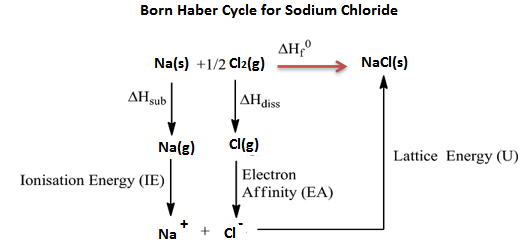
The formation of ionic solid sodium chloride form solid sodium metal and gaseous chlorine is not a single step process but goes through several processes. Heat changes of all the processes except the lattice energy can be experimentally measured.
The processes or steps in the formation of sodium chloride are-
1. Solid sodium atom sublimes to gaseous atom by absorbing heat energy (∆Hsub).
Na (s) → Na (g),
Sublimation energy ΔHsub = + 107kJ/mol
2. Gaseous sodium atom absorbs the ionization energy to release one electron and forms gaseous sodium ion.
Na(g) → Na+(g) + 1e– ,
Ionization energy ∆HIE = +502kJ/mol
3. Diatomic gaseous chlorine breaks into two individual atoms by absorbing bond energy, such that each chlorine atom absorbs half of the bond energy of chlorine molecule.
Cl2(g) → 2Cl(g) 1/2
Bond dissociation energy of chlorine = 1/2* ∆Hdiss= 1/2* 242 = +121kJ/mol
4. Chlorine atom accepts an electron to form chloride ion and releases energy equivalent to electron affinity.
Cl(g) + 1e– → Cl– (g)
Electron affinity = ∆HEA = -355kJ/mol
5. Gaseous sodium ion and gaseous chloride ion combine to form solid sodium chloride molecule and releases energy equivalent to lattice energy.
Na+(g) + Cl–(g) → Na+ Cl– (s)
Lattice energy = ∆HLE = U = ?
Summation of enthalpy of all the processes from step 1 to step 5) give the net enthalpy of formation of solid crystalline sodium chloride from sodium and chlorine in their standard conditions of solid and gas respectively. This should be equal to the experimentally measured enthalpy of formation of solid sodium chloride.
The enthalpies are represented as a cycle in the figure.
b. I)
b. i) Relationship between dipole moment & bond angle is :-
μ2=m12+m22+2m1m2Cos
θ 
µ = resultant dipole moment
m1 & m2 are dipole moments
µ2 = (1.2)2 + (1.8)2 + 2 x 1.2 x 1.8 x Cos 1300
µ2 = 1.44 + 3.24 + 4.32 x – 0.6427
µ2 = 4.68 – 2.7764
µ2 = 1.9035
µ = 1.3796 Ans.
ii)
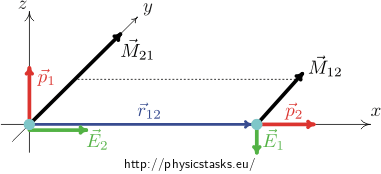
Interaction energy between two rotating dipole is :-
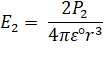
E2=
2P2/4πε°r3
E2 = 9 x 109x 2x 1.5/(10-10 )3
E2 = 27 x 109/10-30
E2 = 27 x 1039
E2 = 2.7 x 1037 KJ/mol
Add Answer to:
2. a) Use one example to describe Born-Haber cycle (Not the
example on your slides).
b)...
Most questions answered within 3 hours.
-
Where is the error in this code sequence?
String s1 = "Hello";
String s2 = "ello";...
asked 10 months ago -
Financial data for Joel de Paris, Inc., for last year
follow:
Joel de Paris, Inc.
Balance...
asked 10 months ago -
Consider this reaction:
Al2(SO4)3 (aq)+ BaCl3
(aq) Al2Cl6 (aq)- +
3BaSO4(s) . What is the...
asked 10 months ago -
Suppose that Savneet is considering increasing her
recent random sample from 20 car rentals to 40...
asked 10 months ago -
Trucks arrive at an unloading terminal at an average rate of 120
per hour.
Trucks arrive...
asked 10 months ago -
Why are methanol and ethanol completely soluble in water while
octanol is not very little soluble....
asked 10 months ago -
A facilities manager at a university reads in a research report
that the mean amount of...
asked 10 months ago -
When the CuSO4 is rehydrated by adding water to the anhydrous
compound, is this an endothermic...
asked 10 months ago -
A ray of sunlight is passing from diamond into crown glass; the
angle of incidence is...
asked 10 months ago -
A block of mass 0.249 kg is placed on top of a light, vertical
spring of...
asked 10 months ago -
how do the kidneys compensate in the presences of acidosis
a) trigger hyperventilate
b) reserve acid...
asked 10 months ago -
Question 501 pts
The rental rate of capital to the firm increases. Which of the
following...
asked 10 months ago