12.0 mL of a 437.1 mM AgNO3 solution is added to a 20.0 mL sample containing...
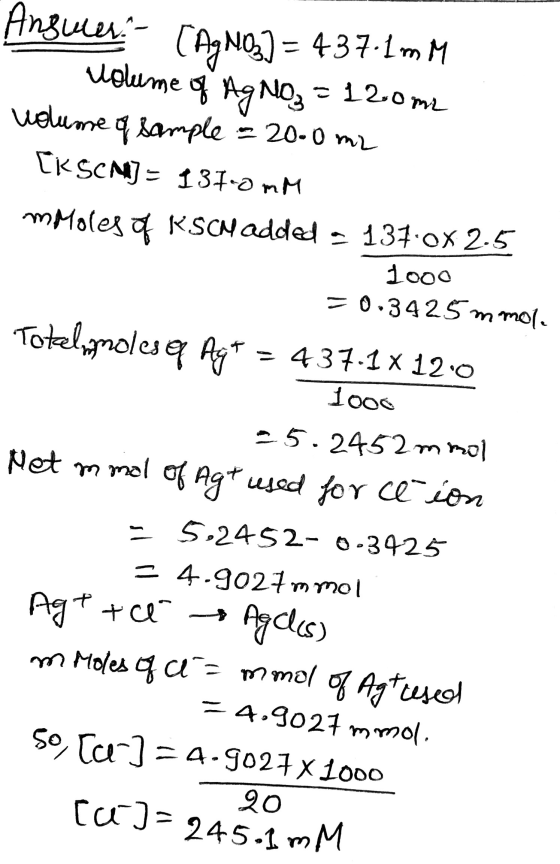
12.0 mL of a 437.1 mM AgNO3 solution is added to a 20.0 mL sample containing an unknown chloride ion concentration to precipitate Cl- as AgCl. The AgCl solid is removed and excess Ag+ is titrated with a standard 137.0 mM KSCN solution in the presence of Fe3+. After 2.5 mL of the standard solution have been added, all Ag+ has precipitated as AgSCN and the red complex FeSCN2+ forms. What is the chloride ion concentration in the sample to the nearest 0.1 mM?
Homework Answers
Answer:-
This question is solved by using simple concept of stoichiometry and calculation of molarity.
The answer is given in the image ,
Add Answer to:
12.0 mL of a 437.1 mM AgNO3 solution is added to a
20.0 mL sample containing...
(5 marks) A solution containing chloride ion was analyzed by the mL sample containing chloride ion...
 (5 marks) A solution containing chloride ion was analyzed by the mL sample containing chloride ion was treated with 25.00 mL of 0.2500 M silver nitrate. The precipitated AgCl was removed from the solution by filtration, and 1.00 mL of 0.1000 M Fe3 was added to the filtrate in order to titrate excess Ag with SCN. A volume of 10.67 mL of 0.2380 M KSCN was required for solution to turn red colour. What is the concentration of chloride ion...
A 0.7498-g sample of a chlorocarbon compound was analyzed by burning it in oxygen and collecting...
A 0.7498-g sample of a chlorocarbon compound was analyzed by burning it in oxygen and collecting the evolved gases in a solution of NaOH. After neutralizing, the sample was treated with 48.85 mL of a 0.2298 M AgNO3 solution. This precipitated the chloride (Cl-) out as AgCl and left an excess of AgNO3. The excess AgNO3 was titrated with 0.1165 M KSCN and required 20.82 mL to reach the endpoint in a Volhard titration. Calculate the % w/w Cl– (35.45...
Question A 20.0 mL sample solution contains unknown amount of bromide ion (Br). To this solution...
 Question
A 20.0 mL sample solution contains unknown amount of bromide ion (Br). To this solution was added the solution that contains plenty of AgNO3. AgBr precipitates were formed. The precipitate were filtered and measured to be is 0.6964 g. What is the molarity of bromide ion in the original sample solution? The molar mass of Br = 80.0 g; the molar mass of AgBr = 188 g. (Solution) AgNO, is soluble and thus exists Ag+ ion and NO3-ion. Ag+...
Question
A 20.0 mL sample solution contains unknown amount of bromide ion (Br). To this solution was added the solution that contains plenty of AgNO3. AgBr precipitates were formed. The precipitate were filtered and measured to be is 0.6964 g. What is the molarity of bromide ion in the original sample solution? The molar mass of Br = 80.0 g; the molar mass of AgBr = 188 g. (Solution) AgNO, is soluble and thus exists Ag+ ion and NO3-ion. Ag+...
QUESTION 1 A 20.0 mL sample solution contains unknown amount of bromide ion (Br). To this...
 QUESTION 1 A 20.0 mL sample solution contains unknown amount of bromide ion (Br). To this solution was added the solution that contains plenty of AgNO3. AgBr precipitates were formed. The precipitate were filtered and measured to be is 0.6964 g. What is the molarity of bromide ion in the original sample solution? The molar mass of Br = 80.0 g; the molar mass of AgBr = 188 g. (Solution) AgNO, is soluble and thus exists Ag+ ion and NO3-ion....
Suppose that 51.0 mL of 0.11 M AgNO3 is added to 50.0 mL of 0.048 M...
Suppose that 51.0 mL of 0.11 M AgNO3 is added to 50.0 mL of 0.048 M NaCl solution. (a) What mass of AgCl will form? g AgCl the tolerance is +/-2% (b) Calculate the final concentrations of all of the ions in the solution that is in contact with the precipitate. [Ag+] = × 10 M [NO3−] = × 10 M [Na+] = × 10 M [Cl−] = × 10 M (c) What percentage of the Ag+ ions have precipitated?...
Chloride in a water sample can be determined indirectly by atomic absorption spectrometry by precipitating chloride...
 Chloride in a water sample can be determined indirectly by
atomic absorption spectrometry by precipitating chloride as AgCl(s)
with a measured amount of AgNO3 that is excess of the chloride
content of the sample. The AgNO3 is added and the sample is
centrifuged. The remaining Ag+ in the solution (supernatant) is
quantified and the chloride is measured by assuming that chloride
was quantitatively precipitated.
Chloride in a water sample can be determined indirectly by atomic absorption spectrometry by precipitating chloride...
Chloride in a water sample can be determined indirectly by
atomic absorption spectrometry by precipitating chloride as AgCl(s)
with a measured amount of AgNO3 that is excess of the chloride
content of the sample. The AgNO3 is added and the sample is
centrifuged. The remaining Ag+ in the solution (supernatant) is
quantified and the chloride is measured by assuming that chloride
was quantitatively precipitated.
Chloride in a water sample can be determined indirectly by atomic absorption spectrometry by precipitating chloride...
In the United States, table salt is “iodized” and contains NaCl and a small amount of KI. The iodide was added to help p...
In the United States, table salt is “iodized” and contains NaCl and a small amount of KI. The iodide was added to help prevent thyroid disorders in the population. The iodide concentration in table salt was measured using the following steps: 1.000 g of table salt was dissolved in 100.0 mL of water. The salt solution was titrated using 4.00 × 10⁻⁵ M Ag+ and a Volhard titration (back titration). 15.00 mL of 4.00 × 10⁻⁵ M Ag+ solution was...
solid silver nitrate, AgNO3 is slowly added to a solution containing 0.2M chloride ion and 0.3M...
solid silver nitrate, AgNO3 is slowly added to a solution containing 0.2M chloride ion and 0.3M chromate ion. Assume that the addition of the solid causes no volume change. Which will precipitate first, the silver chloride or the silver chromate? For AgCl, Ksp = 1.81x10⁻¹⁰, for Ag2CrO4 Ksp = 1.12x10⁻¹²
l A 40.00 mL solution of 0.3450 M AGNO, was added to a solution of AsO...
 l
A 40.00 mL solution of 0.3450 M AGNO, was added to a solution of AsO Ag, AsO, precipitated and was filtered off. Fe was added and the solution was titrated with 0.2100 M KSCN. After 36.10 mL of KSCN solution was added, the solution turned red. What mass of AsO was in the original solution? mass: 836.1 mg AsO
l
A 40.00 mL solution of 0.3450 M AGNO, was added to a solution of AsO Ag, AsO, precipitated and was filtered off. Fe was added and the solution was titrated with 0.2100 M KSCN. After 36.10 mL of KSCN solution was added, the solution turned red. What mass of AsO was in the original solution? mass: 836.1 mg AsO
If a dilute AgNO3 solution is slowly added to the solution, what is the first compound to precipitate: Ag2CrO4 ( Ksp =...
 If a dilute AgNO3 solution is slowly added
to the solution, what is the first compound to precipitate: Ag2CrO4
( Ksp = 1.2×10?12), Ag2CO3 (
Ksp = 8.1×10?12), or AgCl ( Ksp
= 1.8×10?10)?
Problem 17.75 A solution contains three anions with the following concentrations: 0.20 M Cro 0.10 M CO and 0.010 M Cl Part A If a dilute AgNO3 solution is slowly added to the solution, what is the first compound to precipitate: Aga Cro4 Ksp 1.2 x...
If a dilute AgNO3 solution is slowly added
to the solution, what is the first compound to precipitate: Ag2CrO4
( Ksp = 1.2×10?12), Ag2CO3 (
Ksp = 8.1×10?12), or AgCl ( Ksp
= 1.8×10?10)?
Problem 17.75 A solution contains three anions with the following concentrations: 0.20 M Cro 0.10 M CO and 0.010 M Cl Part A If a dilute AgNO3 solution is slowly added to the solution, what is the first compound to precipitate: Aga Cro4 Ksp 1.2 x...
 (5 marks) A solution containing chloride ion was analyzed by the mL sample containing chloride ion was treated with 25.00 mL of 0.2500 M silver nitrate. The precipitated AgCl was removed from the solution by filtration, and 1.00 mL of 0.1000 M Fe3 was added to the filtrate in order to titrate excess Ag with SCN. A volume of 10.67 mL of 0.2380 M KSCN was required for solution to turn red colour. What is the concentration of chloride ion...
 Question
A 20.0 mL sample solution contains unknown amount of bromide ion (Br). To this solution was added the solution that contains plenty of AgNO3. AgBr precipitates were formed. The precipitate were filtered and measured to be is 0.6964 g. What is the molarity of bromide ion in the original sample solution? The molar mass of Br = 80.0 g; the molar mass of AgBr = 188 g. (Solution) AgNO, is soluble and thus exists Ag+ ion and NO3-ion. Ag+...
Question
A 20.0 mL sample solution contains unknown amount of bromide ion (Br). To this solution was added the solution that contains plenty of AgNO3. AgBr precipitates were formed. The precipitate were filtered and measured to be is 0.6964 g. What is the molarity of bromide ion in the original sample solution? The molar mass of Br = 80.0 g; the molar mass of AgBr = 188 g. (Solution) AgNO, is soluble and thus exists Ag+ ion and NO3-ion. Ag+...
 QUESTION 1 A 20.0 mL sample solution contains unknown amount of bromide ion (Br). To this solution was added the solution that contains plenty of AgNO3. AgBr precipitates were formed. The precipitate were filtered and measured to be is 0.6964 g. What is the molarity of bromide ion in the original sample solution? The molar mass of Br = 80.0 g; the molar mass of AgBr = 188 g. (Solution) AgNO, is soluble and thus exists Ag+ ion and NO3-ion....
 Chloride in a water sample can be determined indirectly by
atomic absorption spectrometry by precipitating chloride as AgCl(s)
with a measured amount of AgNO3 that is excess of the chloride
content of the sample. The AgNO3 is added and the sample is
centrifuged. The remaining Ag+ in the solution (supernatant) is
quantified and the chloride is measured by assuming that chloride
was quantitatively precipitated.
Chloride in a water sample can be determined indirectly by atomic absorption spectrometry by precipitating chloride...
Chloride in a water sample can be determined indirectly by
atomic absorption spectrometry by precipitating chloride as AgCl(s)
with a measured amount of AgNO3 that is excess of the chloride
content of the sample. The AgNO3 is added and the sample is
centrifuged. The remaining Ag+ in the solution (supernatant) is
quantified and the chloride is measured by assuming that chloride
was quantitatively precipitated.
Chloride in a water sample can be determined indirectly by atomic absorption spectrometry by precipitating chloride...
 l
A 40.00 mL solution of 0.3450 M AGNO, was added to a solution of AsO Ag, AsO, precipitated and was filtered off. Fe was added and the solution was titrated with 0.2100 M KSCN. After 36.10 mL of KSCN solution was added, the solution turned red. What mass of AsO was in the original solution? mass: 836.1 mg AsO
l
A 40.00 mL solution of 0.3450 M AGNO, was added to a solution of AsO Ag, AsO, precipitated and was filtered off. Fe was added and the solution was titrated with 0.2100 M KSCN. After 36.10 mL of KSCN solution was added, the solution turned red. What mass of AsO was in the original solution? mass: 836.1 mg AsO
 If a dilute AgNO3 solution is slowly added
to the solution, what is the first compound to precipitate: Ag2CrO4
( Ksp = 1.2×10?12), Ag2CO3 (
Ksp = 8.1×10?12), or AgCl ( Ksp
= 1.8×10?10)?
Problem 17.75 A solution contains three anions with the following concentrations: 0.20 M Cro 0.10 M CO and 0.010 M Cl Part A If a dilute AgNO3 solution is slowly added to the solution, what is the first compound to precipitate: Aga Cro4 Ksp 1.2 x...
If a dilute AgNO3 solution is slowly added
to the solution, what is the first compound to precipitate: Ag2CrO4
( Ksp = 1.2×10?12), Ag2CO3 (
Ksp = 8.1×10?12), or AgCl ( Ksp
= 1.8×10?10)?
Problem 17.75 A solution contains three anions with the following concentrations: 0.20 M Cro 0.10 M CO and 0.010 M Cl Part A If a dilute AgNO3 solution is slowly added to the solution, what is the first compound to precipitate: Aga Cro4 Ksp 1.2 x...
Most questions answered within 3 hours.
-
Where is the error in this code sequence?
String s1 = "Hello";
String s2 = "ello";...
asked 11 months ago -
Financial data for Joel de Paris, Inc., for last year
follow:
Joel de Paris, Inc.
Balance...
asked 11 months ago -
Consider this reaction:
Al2(SO4)3 (aq)+ BaCl3
(aq) Al2Cl6 (aq)- +
3BaSO4(s) . What is the...
asked 11 months ago -
Suppose that Savneet is considering increasing her
recent random sample from 20 car rentals to 40...
asked 11 months ago -
Trucks arrive at an unloading terminal at an average rate of 120
per hour.
Trucks arrive...
asked 11 months ago -
Why are methanol and ethanol completely soluble in water while
octanol is not very little soluble....
asked 11 months ago -
A facilities manager at a university reads in a research report
that the mean amount of...
asked 11 months ago -
When the CuSO4 is rehydrated by adding water to the anhydrous
compound, is this an endothermic...
asked 11 months ago -
A ray of sunlight is passing from diamond into crown glass; the
angle of incidence is...
asked 11 months ago -
A block of mass 0.249 kg is placed on top of a light, vertical
spring of...
asked 11 months ago -
how do the kidneys compensate in the presences of acidosis
a) trigger hyperventilate
b) reserve acid...
asked 11 months ago -
Question 501 pts
The rental rate of capital to the firm increases. Which of the
following...
asked 11 months ago