In a cylinder with a cross-sectional area A = 100 cm2 the air is at a...
In a cylinder with a cross-sectional area A = 100 cm2 the air is at a Temperature t1 = 12C. The atmospheric pressure is equal to p1 = 101 kPa. At altitude h1 = 60 cm from the bottom of the cylinder there is an airtight, movable piston. By which distance will the piston sinks, when a weight of m = 100 kg falls on the piston and heats the air in the cylinder up to a temperature t2 = 27C? Neglect the frictional force between the piston and cylinder walls and the mass of the piston.
Thank you so much. A clear explanation is highly appreciated!
Homework Answers
The piston sinks by a distance of 28.263 cm .
do comment , if you have any doubts..!!

Add Answer to:
In a cylinder with a cross-sectional area A = 100 cm2 the air is
at a...
A piston/cylinder with a cross- sectional area of .01 m^2 has a piston mass of 100...
A piston/cylinder with a cross- sectional area of .01 m^2 has a piston mass of 100 kg resting on stops. With an outside atmospheric pressure of 120 kPa , what should the water pressure be to lift the piston?
A piston/cylinder arrangement with an cross sectional area of 1 mạ contains carbon dioxide at 200...
 A piston/cylinder arrangement with an cross sectional area of 1 mạ contains carbon dioxide at 200 kPa and 290 K. The cylinder has a thick piston that initially held by a pin as shown in Figure 1. The metal piston has a density of 8000 kg/mº, standard acceleration of gravity, &c is 9.81 m/s and the atmospheric pressure is 101 kPa. The pin is now removed, allowing the piston to move and after a while the gas returns to 290...
A spring loaded piston-cylinder device with a cross sectional area of 0.2 m2 contains 0.6 kg...
 A spring loaded piston-cylinder device with a cross sectional area of 0.2 m2 contains 0.6 kg of air, as shown in the figure. The air initially at 100 kPa and 20°C, is heated to 450 kPa at which the piston begins to move. The process continues until the final volume is 12 times the initial volume. Calculate (a) the final temperature in kb) the work done in kJ. (the total heat transfer in this process Use the following properties for...
roblem 4. A vertical cylinder of cross-sectional area A is fitted with a tight-fitting, fric- tionless...
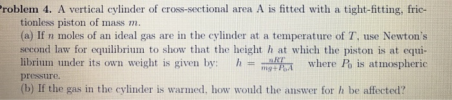 roblem 4. A vertical cylinder of cross-sectional area A is fitted with a tight-fitting, fric- tionless piston of mass m. (a) If n moles of an ideal gas are in the cylinder at a temperature of T, use Newton's second law for equilibrium to show that the height h at which the piston is at equi- librium under its own weight is given by: where Po is atmospheric pressure. (b) If the gas in the cylinder is warmed, how would...
A cylinder fitted with a frictionless piston contains stops arranged as shown in the following figure....
 A cylinder fitted with a frictionless piston contains stops
arranged as shown in the following figure. When the piston rests on
the lower stops the volume is 0.4m3 ; when it is in contact with
the upper stops the volume is 0.6m3 . If the piston is not in
contact with the stops, it maintains a constant pressure of 200kPa
in the cylinder. Initially, the cylinder contains air at P1=150kPa
with a temperature of T1=300K. The air is then heated...
A cylinder fitted with a frictionless piston contains stops
arranged as shown in the following figure. When the piston rests on
the lower stops the volume is 0.4m3 ; when it is in contact with
the upper stops the volume is 0.6m3 . If the piston is not in
contact with the stops, it maintains a constant pressure of 200kPa
in the cylinder. Initially, the cylinder contains air at P1=150kPa
with a temperature of T1=300K. The air is then heated...
Question 1 Air is contained in a vertical piston-cylinder assembly fitted with an electrical heater. The...
 Question 1 Air is contained in a vertical piston-cylinder assembly fitted with an electrical heater. The atmospheric pressure is 100 kPa and piston has a mass of 50 kg and a face area of 0.1 m . Electric current passes through the heater, and the volume of air slowly increases by 0.045 m. The mass of the air is 0.3 kg and its specific internal energy increases by 42.2 kJ/kg. Assume the assembly (including the piston) is insulated and neglect...
A stoichiometric mixture of ethanol (C2H6O), octane (C8H18), and air initially at T1 = 300 K,...
A stoichiometric mixture of ethanol (C2H6O), octane (C8H18), and air initially at T1 = 300 K, P1 = 100 kPa, P2 =4500 kPa, and V1 = 5 liters (0.005 m3) is compressed in a piston-cylinder assembly in a polytropic process where n = 1.2 What is the final volume V2 (m3 ), the initial total volume of moles (kmol), and the final Temperature T2? NOTE: Universal gas constant: Ru = 8.314 k]/ kmolK Please show ALL steps and units with...
Answers are next to the problems. 2. A small, un-insulated closed cylinder with a freely moving...
 Answers are next to the problems.
2. A small, un-insulated closed cylinder with a freely moving piston contains air and is accidentally dropped into a lake and falls slowly to the bottom at 100 m below the surface Initially, the air in the cylinder is at atmospheric pressure of 100 kPa with a volume of 0.1 m3 and a temperature of 20°C. The lake is also at a uniform and constant temperature of 20°C. As the cylinder falls, the air...
Answers are next to the problems.
2. A small, un-insulated closed cylinder with a freely moving piston contains air and is accidentally dropped into a lake and falls slowly to the bottom at 100 m below the surface Initially, the air in the cylinder is at atmospheric pressure of 100 kPa with a volume of 0.1 m3 and a temperature of 20°C. The lake is also at a uniform and constant temperature of 20°C. As the cylinder falls, the air...
The construction of a water pistol is shown in the figure below. The cylinder with cross-sectional...
 The construction of a water pistol is shown in the figure below. The cylinder with cross-sectional area A1 is filled with water and when the piston is pushed (by pulling the trigger), water is forced out the tube with cross- sectional area A2. The radius of the cylinder and tube are, respectively, 1.50 cm and 1.30 mm, and the center of the tube is a height - 3,00 en above the center of the cylinder. (Assume atmospheric pressure is 1.013...
The construction of a water pistol is shown in the figure below. The cylinder with cross-sectional...
 The construction of a water pistol is shown in the figure below. The cylinder with cross-sectional area A, is filled with water and when the piston is pushed (by pulling the trigger), water is forced out the tube with cross-sectional area A. The radius of the cylinder and tube are, respectively, 1.50 cm and 1.40 mm, and the center of the tube is a height h = 3.00 cm above the center of the cylinder. (Assume atmospheric pressure is 1.013...
 A piston/cylinder arrangement with an cross sectional area of 1 mạ contains carbon dioxide at 200 kPa and 290 K. The cylinder has a thick piston that initially held by a pin as shown in Figure 1. The metal piston has a density of 8000 kg/mº, standard acceleration of gravity, &c is 9.81 m/s and the atmospheric pressure is 101 kPa. The pin is now removed, allowing the piston to move and after a while the gas returns to 290...
 A spring loaded piston-cylinder device with a cross sectional area of 0.2 m2 contains 0.6 kg of air, as shown in the figure. The air initially at 100 kPa and 20°C, is heated to 450 kPa at which the piston begins to move. The process continues until the final volume is 12 times the initial volume. Calculate (a) the final temperature in kb) the work done in kJ. (the total heat transfer in this process Use the following properties for...
 roblem 4. A vertical cylinder of cross-sectional area A is fitted with a tight-fitting, fric- tionless piston of mass m. (a) If n moles of an ideal gas are in the cylinder at a temperature of T, use Newton's second law for equilibrium to show that the height h at which the piston is at equi- librium under its own weight is given by: where Po is atmospheric pressure. (b) If the gas in the cylinder is warmed, how would...
 A cylinder fitted with a frictionless piston contains stops
arranged as shown in the following figure. When the piston rests on
the lower stops the volume is 0.4m3 ; when it is in contact with
the upper stops the volume is 0.6m3 . If the piston is not in
contact with the stops, it maintains a constant pressure of 200kPa
in the cylinder. Initially, the cylinder contains air at P1=150kPa
with a temperature of T1=300K. The air is then heated...
A cylinder fitted with a frictionless piston contains stops
arranged as shown in the following figure. When the piston rests on
the lower stops the volume is 0.4m3 ; when it is in contact with
the upper stops the volume is 0.6m3 . If the piston is not in
contact with the stops, it maintains a constant pressure of 200kPa
in the cylinder. Initially, the cylinder contains air at P1=150kPa
with a temperature of T1=300K. The air is then heated...
 Question 1 Air is contained in a vertical piston-cylinder assembly fitted with an electrical heater. The atmospheric pressure is 100 kPa and piston has a mass of 50 kg and a face area of 0.1 m . Electric current passes through the heater, and the volume of air slowly increases by 0.045 m. The mass of the air is 0.3 kg and its specific internal energy increases by 42.2 kJ/kg. Assume the assembly (including the piston) is insulated and neglect...
 Answers are next to the problems.
2. A small, un-insulated closed cylinder with a freely moving piston contains air and is accidentally dropped into a lake and falls slowly to the bottom at 100 m below the surface Initially, the air in the cylinder is at atmospheric pressure of 100 kPa with a volume of 0.1 m3 and a temperature of 20°C. The lake is also at a uniform and constant temperature of 20°C. As the cylinder falls, the air...
Answers are next to the problems.
2. A small, un-insulated closed cylinder with a freely moving piston contains air and is accidentally dropped into a lake and falls slowly to the bottom at 100 m below the surface Initially, the air in the cylinder is at atmospheric pressure of 100 kPa with a volume of 0.1 m3 and a temperature of 20°C. The lake is also at a uniform and constant temperature of 20°C. As the cylinder falls, the air...
 The construction of a water pistol is shown in the figure below. The cylinder with cross-sectional area A1 is filled with water and when the piston is pushed (by pulling the trigger), water is forced out the tube with cross- sectional area A2. The radius of the cylinder and tube are, respectively, 1.50 cm and 1.30 mm, and the center of the tube is a height - 3,00 en above the center of the cylinder. (Assume atmospheric pressure is 1.013...
 The construction of a water pistol is shown in the figure below. The cylinder with cross-sectional area A, is filled with water and when the piston is pushed (by pulling the trigger), water is forced out the tube with cross-sectional area A. The radius of the cylinder and tube are, respectively, 1.50 cm and 1.40 mm, and the center of the tube is a height h = 3.00 cm above the center of the cylinder. (Assume atmospheric pressure is 1.013...
Most questions answered within 3 hours.
-
Where is the error in this code sequence?
String s1 = "Hello";
String s2 = "ello";...
asked 11 months ago -
Financial data for Joel de Paris, Inc., for last year
follow:
Joel de Paris, Inc.
Balance...
asked 11 months ago -
Consider this reaction:
Al2(SO4)3 (aq)+ BaCl3
(aq) Al2Cl6 (aq)- +
3BaSO4(s) . What is the...
asked 11 months ago -
Suppose that Savneet is considering increasing her
recent random sample from 20 car rentals to 40...
asked 11 months ago -
Trucks arrive at an unloading terminal at an average rate of 120
per hour.
Trucks arrive...
asked 11 months ago -
Why are methanol and ethanol completely soluble in water while
octanol is not very little soluble....
asked 11 months ago -
A facilities manager at a university reads in a research report
that the mean amount of...
asked 11 months ago -
When the CuSO4 is rehydrated by adding water to the anhydrous
compound, is this an endothermic...
asked 11 months ago -
A ray of sunlight is passing from diamond into crown glass; the
angle of incidence is...
asked 11 months ago -
A block of mass 0.249 kg is placed on top of a light, vertical
spring of...
asked 11 months ago -
how do the kidneys compensate in the presences of acidosis
a) trigger hyperventilate
b) reserve acid...
asked 11 months ago -
Question 501 pts
The rental rate of capital to the firm increases. Which of the
following...
asked 11 months ago