Explain the reaction between iodine solution and polysaccharides by giving the structures of related compounds.
Explain the reaction between iodine solution and polysaccharides by giving the structures of related compounds.
Homework Answers
It is a charge-transfer complex reaction.
Here there is no chemical reaction between these two reactants.
Prepared by mixing I2 with KI solution.
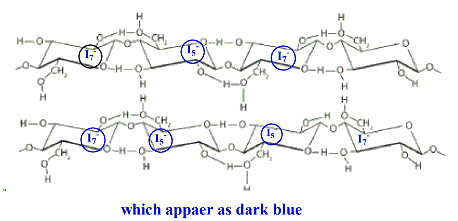
And I2 could not react directly as such but form poly-iodate ions viz. I5-or I7-.
The negatively charged iodide in these compounds acts as charge donor, the neutral iodine as a charge acceptor.
A solution of iodine (I2) and potassium iodide (KI) in water has a light orange-brown color.
Once amylose is added, it forms another CT complex.
The polysaccharide acts as a charge donor and the polyiodide as an acceptor.
This new complex absorbs light of a different wavelength than polyiodide, and the color turns dark blue.
The exact structure of the polyiodides inside the amyloid helix is not clear.
These ions are bulky and sit inside the polysaccharide of glucose units and could not get out of these coiled spring of polysaccharide especially amyloses.
Add Answer to:
Explain the reaction between iodine solution and
polysaccharides by giving the structures of related compounds.
9. Chlorine, bromine and iodine all react with alkenes such as ethene in an addition reaction....
 9. Chlorine, bromine and iodine all react with alkenes such as ethene in an addition reaction. (a) Write the equation for the bromination of ethene, and name the product. (b) Explain why this is called an addition reaction. (c) Describe what you would see if you bubbled ethene through a solution of bromine in an organic solvent such as hexane. 10. If you use a permanganate test to distinguish between cyclohexane and cyclohexene, in which would the purple color of...
Can the iodine test distinguish between amylose and amylopectin? What Would you look for? Can sucrose...
 Can the iodine test distinguish between amylose and amylopectin? What Would you look for? Can sucrose act as a reducing sugar? Explain your answer. In the acid-catalyzed hydrolysis of starch, how can you tell when the hydrolysis of starch is complete? Why does the test work this way? What is the monosaccharide that results at the end? Polysaccharides generally do not give a positive test with Fehling's solution. Why?
1. a) Write a balanced equation for the reaction between iodine and ascorbic acid, C6H8O6. Identify...
1. a) Write a balanced equation for the reaction between iodine and ascorbic acid, C6H8O6. Identify the oxidizing agent, and the reducing agent. b) A solution of iodine was standardized with ascorbic acid. A 0.1150 g sample of ascorbic acid required 28.37 mL of I2 to reach a starch end point. Calculate the molarity of the iodine solution.
Briefly explain the FOUR project management organization structures, giving advantages and disadvantages.
Briefly explain the FOUR project management organization structures, giving advantages and disadvantages.
The reaction between the iodine(I) cation and the pyridine is best understood as the Lewis acid/Lewis...
 The reaction between the iodine(I) cation and the pyridine is best understood as the Lewis acid/Lewis base formation of an addict. Use a 2D VSEPR representation of the "best Lew is diagrams for these species to explain this observation.
Draw the structures of the organic compounds formed in the following reaction. (in the beginning it...
 Draw the structures of the organic compounds formed in the
following reaction.
(in the beginning it should be CH3 but it got cut off )
Mp Range of Recrystallized Benzoin:-13 Mp Range of Recrystallized Benzoin:12 aw the structures of the organic compounds fo Thiamine HCI 3M aq. NaOH EtOH-H20
Draw the structures of the organic compounds formed in the
following reaction.
(in the beginning it should be CH3 but it got cut off )
Mp Range of Recrystallized Benzoin:-13 Mp Range of Recrystallized Benzoin:12 aw the structures of the organic compounds fo Thiamine HCI 3M aq. NaOH EtOH-H20
1) Based on the explanation on the interaction between starch, salivary amylase and iodine solution at...
1) Based on the explanation on the interaction between starch, salivary amylase and iodine solution at the beginning of the presentation, please give a brief explanation on the differences in colour over time for each concentration. 2) Why do you think the rate of reaction increases as the concentration of the enzyme is increased? Is the rate of reaction increasing indefinitely as the concentration increases? 3) Why do you think the reaction rate is different as the pH of the...
please answer i,ii,iii,iv,v Predict the major product(s) of the following reaction, giving regiochemical and/or stereochemical details...
 please
answer i,ii,iii,iv,v
Predict the major product(s) of the following reaction, giving regiochemical and/or stereochemical details as relevant. (6 MARKS) q Bry, H0 ? ANSWER: (ii) Predict the product(s) of the oxidation of 2,3,4-trimethyl-1,5-heptadiene with hot, alkaline KMnO4 followed by acidic work up. (6 MARKS) (iii) Complete the following reaction sequence, giving structures for compounds C and D (Na2CO3 just acts as a base!): CH,SOCI CH,OH Na2CO3 D DMF (6 MARKS) D (iv) Supply the missing structures A and B....
please
answer i,ii,iii,iv,v
Predict the major product(s) of the following reaction, giving regiochemical and/or stereochemical details as relevant. (6 MARKS) q Bry, H0 ? ANSWER: (ii) Predict the product(s) of the oxidation of 2,3,4-trimethyl-1,5-heptadiene with hot, alkaline KMnO4 followed by acidic work up. (6 MARKS) (iii) Complete the following reaction sequence, giving structures for compounds C and D (Na2CO3 just acts as a base!): CH,SOCI CH,OH Na2CO3 D DMF (6 MARKS) D (iv) Supply the missing structures A and B....
a) Identify the two compounds: give their names and structures. b) Explain in detail (step by...
 a) Identify the two compounds: give their names and
structures.
b) Explain in detail (step by step) how you interpreted each
spectra and how you identified
your unknowns.
a) b) Identify the two compounds: give their names and structures Explain in detail (step by step) how you interpreted each spectra and how you identified your unknowns
a) Identify the two compounds: give their names and
structures.
b) Explain in detail (step by step) how you interpreted each
spectra and how you identified
your unknowns.
a) b) Identify the two compounds: give their names and structures Explain in detail (step by step) how you interpreted each spectra and how you identified your unknowns
Provide the structures of compounds and intermediates I-12 in the chemical reaction provided below.
 Provide the structures of compounds and intermediates I-12 in the chemical reaction provided below.
 9. Chlorine, bromine and iodine all react with alkenes such as ethene in an addition reaction. (a) Write the equation for the bromination of ethene, and name the product. (b) Explain why this is called an addition reaction. (c) Describe what you would see if you bubbled ethene through a solution of bromine in an organic solvent such as hexane. 10. If you use a permanganate test to distinguish between cyclohexane and cyclohexene, in which would the purple color of...
 Can the iodine test distinguish between amylose and amylopectin? What Would you look for? Can sucrose act as a reducing sugar? Explain your answer. In the acid-catalyzed hydrolysis of starch, how can you tell when the hydrolysis of starch is complete? Why does the test work this way? What is the monosaccharide that results at the end? Polysaccharides generally do not give a positive test with Fehling's solution. Why?
 The reaction between the iodine(I) cation and the pyridine is best understood as the Lewis acid/Lewis base formation of an addict. Use a 2D VSEPR representation of the "best Lew is diagrams for these species to explain this observation.
 Draw the structures of the organic compounds formed in the
following reaction.
(in the beginning it should be CH3 but it got cut off )
Mp Range of Recrystallized Benzoin:-13 Mp Range of Recrystallized Benzoin:12 aw the structures of the organic compounds fo Thiamine HCI 3M aq. NaOH EtOH-H20
Draw the structures of the organic compounds formed in the
following reaction.
(in the beginning it should be CH3 but it got cut off )
Mp Range of Recrystallized Benzoin:-13 Mp Range of Recrystallized Benzoin:12 aw the structures of the organic compounds fo Thiamine HCI 3M aq. NaOH EtOH-H20
 please
answer i,ii,iii,iv,v
Predict the major product(s) of the following reaction, giving regiochemical and/or stereochemical details as relevant. (6 MARKS) q Bry, H0 ? ANSWER: (ii) Predict the product(s) of the oxidation of 2,3,4-trimethyl-1,5-heptadiene with hot, alkaline KMnO4 followed by acidic work up. (6 MARKS) (iii) Complete the following reaction sequence, giving structures for compounds C and D (Na2CO3 just acts as a base!): CH,SOCI CH,OH Na2CO3 D DMF (6 MARKS) D (iv) Supply the missing structures A and B....
please
answer i,ii,iii,iv,v
Predict the major product(s) of the following reaction, giving regiochemical and/or stereochemical details as relevant. (6 MARKS) q Bry, H0 ? ANSWER: (ii) Predict the product(s) of the oxidation of 2,3,4-trimethyl-1,5-heptadiene with hot, alkaline KMnO4 followed by acidic work up. (6 MARKS) (iii) Complete the following reaction sequence, giving structures for compounds C and D (Na2CO3 just acts as a base!): CH,SOCI CH,OH Na2CO3 D DMF (6 MARKS) D (iv) Supply the missing structures A and B....
 a) Identify the two compounds: give their names and
structures.
b) Explain in detail (step by step) how you interpreted each
spectra and how you identified
your unknowns.
a) b) Identify the two compounds: give their names and structures Explain in detail (step by step) how you interpreted each spectra and how you identified your unknowns
a) Identify the two compounds: give their names and
structures.
b) Explain in detail (step by step) how you interpreted each
spectra and how you identified
your unknowns.
a) b) Identify the two compounds: give their names and structures Explain in detail (step by step) how you interpreted each spectra and how you identified your unknowns
 Provide the structures of compounds and intermediates I-12 in the chemical reaction provided below.
Most questions answered within 3 hours.
-
Where is the error in this code sequence?
String s1 = "Hello";
String s2 = "ello";...
asked 10 months ago -
Financial data for Joel de Paris, Inc., for last year
follow:
Joel de Paris, Inc.
Balance...
asked 10 months ago -
Consider this reaction:
Al2(SO4)3 (aq)+ BaCl3
(aq) Al2Cl6 (aq)- +
3BaSO4(s) . What is the...
asked 10 months ago -
Suppose that Savneet is considering increasing her
recent random sample from 20 car rentals to 40...
asked 10 months ago -
Trucks arrive at an unloading terminal at an average rate of 120
per hour.
Trucks arrive...
asked 10 months ago -
Why are methanol and ethanol completely soluble in water while
octanol is not very little soluble....
asked 10 months ago -
A facilities manager at a university reads in a research report
that the mean amount of...
asked 10 months ago -
When the CuSO4 is rehydrated by adding water to the anhydrous
compound, is this an endothermic...
asked 10 months ago -
A ray of sunlight is passing from diamond into crown glass; the
angle of incidence is...
asked 10 months ago -
A block of mass 0.249 kg is placed on top of a light, vertical
spring of...
asked 10 months ago -
how do the kidneys compensate in the presences of acidosis
a) trigger hyperventilate
b) reserve acid...
asked 10 months ago -
Question 501 pts
The rental rate of capital to the firm increases. Which of the
following...
asked 10 months ago