A student is given a sample of unknown liquid and she collects the following information at...
Homework Answers


Add Answer to:
A
student is given a sample of unknown liquid and she collects the
following information at...
An empty graduated cylinder weighs 56.90 g. A student puts 24.6 mL of an unknown liquid...
An empty graduated cylinder weighs 56.90 g. A student puts 24.6 mL of an unknown liquid into the cylinder and the mass of the cylinder plus the liquid equals 98.47 g. What is the density of the unknown liquid (in g/mL)?
A sample of unknown liquid is weighed in a graduated cylinder and the mass is 130.6g....
 A sample of unknown liquid is weighed in a graduated cylinder and the mass is 130.6g. The empty graduated cylinder weighs 100.3 g. The volume of the liquid is 28.15 mL. What is the density of the liquid?
An empty graduated cylinder has a mass of 31.760 g. 50.0 mL of an unknown liquid...
An empty graduated cylinder has a mass of 31.760 g. 50.0 mL of an unknown liquid are added and the mass increases to 71.810 g. What is the density of the unknown liquid?
An empty graduated cylinder has a mass of 31.760 g. 50.0 mL of an unknown liquid...
 An empty graduated cylinder has a mass of 31.760 g. 50.0 mL of an unknown liquid are added and the mass increases to 71.810 g. What is the density of the unknown liquid? -_-lo... Le This is the Mcns for
A student was given a 10 mL sample of a clear, colorless liquid. She was assigned...
 A student was given a 10 mL sample of a clear, colorless liquid. She was assigned the task of identifying the unknown liquid and was told that the sample could be methanol (CH_3OH), acetone (C_3H_6O), or ethanol (C_2H_5OH). She decided to attempt to determine the molar mass of the liquid by the vapor density method, which involves completely vaporizing a small sample of the liquid, cooling it and determining the mass of the condensed vapor. She also collects the volume...
A student performed a series of measurements (volume/mass) of an unknown liquid in order to determine...
 A student performed a series of measurements (volume/mass) of an unknown liquid in order to determine its density. Using a graduated cylinder, the student added an amount of unknown liquid to the graduated cylinder, then recorded the mass and volume of the liquid. The student repeated the process several times, adding more liquid each time and recording the mass and volume. The student plotted the data (mass on y-axis, volume on x-axis). The resulting data table and graph looked like...
4. Suppose that a student performed the experiment and calculations perfectly as directed except that, unknown...
 4. Suppose that a student performed the experiment and calculations perfectly as directed except that, unknown to the student, the balance was not zeroed but weighed 0.100 g too high throughout the experiment. Would the calculated val- ue for the density of the unknown liquid be correct? That is, would it be equal to, higher than, or lower than the true value. Explain your answer in clear and correct English. 16 LABORATORY EXPERIMENTS IN GENERAL CHEMISTRY ed in question 4...
3. A student was given an unknown metal. The student determined that the mass of the...
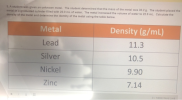 3. A student was given an unknown metal. The student determined that the mass of the metal was 30.2 g. The student placed the metal in a graduated cylinder filled with 20.0 mL of water. The metal increased the volume of water to 22.9 mL. Calculate the density of the metal and determine the identity of the metal using the table below. Metal Density (g/mL) 11.3 Lead Silver 10.5 Nickel 9.90 Zinc 7.14 010000 Word
2. In attempting to calculate the density of chloroform, CHCl3, Riley determines the following densities: 1.30...
 2. In attempting to calculate the density of chloroform, CHCl3, Riley determines the following densities: 1.30 g/mL, 1.35 g/mL, 1.32 g/mL, 1.23 g/mL, 1.13 g/mL, and 1.39 g/mL. a. Calculate the average density of chloroform from his data. b. If the accepted density of chloroform is 1.48 g/mL, calculate the percent error. C. Was Riley's data accurate? Was the data precise? Explain your reasoning. Experiment 1: Determination of the Density of Water and nft page 14 3. For each of...
1)The density of the unknown liquid with the volume of 13.3 mL and a mass of...
1)The density of the unknown liquid with the volume of 13.3 mL and a mass of 8.86 g is _______________ g/mL . 2) Describe how you can use the graduated cylinder to determine the volume of a small, irregularly-shaped metal. 3) What safety precaution should you take when adding the irregularly-shaped metal into the glass graduated cylinder?
 A sample of unknown liquid is weighed in a graduated cylinder and the mass is 130.6g. The empty graduated cylinder weighs 100.3 g. The volume of the liquid is 28.15 mL. What is the density of the liquid?
 An empty graduated cylinder has a mass of 31.760 g. 50.0 mL of an unknown liquid are added and the mass increases to 71.810 g. What is the density of the unknown liquid? -_-lo... Le This is the Mcns for
 A student was given a 10 mL sample of a clear, colorless liquid. She was assigned the task of identifying the unknown liquid and was told that the sample could be methanol (CH_3OH), acetone (C_3H_6O), or ethanol (C_2H_5OH). She decided to attempt to determine the molar mass of the liquid by the vapor density method, which involves completely vaporizing a small sample of the liquid, cooling it and determining the mass of the condensed vapor. She also collects the volume...
 A student performed a series of measurements (volume/mass) of an unknown liquid in order to determine its density. Using a graduated cylinder, the student added an amount of unknown liquid to the graduated cylinder, then recorded the mass and volume of the liquid. The student repeated the process several times, adding more liquid each time and recording the mass and volume. The student plotted the data (mass on y-axis, volume on x-axis). The resulting data table and graph looked like...
 4. Suppose that a student performed the experiment and calculations perfectly as directed except that, unknown to the student, the balance was not zeroed but weighed 0.100 g too high throughout the experiment. Would the calculated val- ue for the density of the unknown liquid be correct? That is, would it be equal to, higher than, or lower than the true value. Explain your answer in clear and correct English. 16 LABORATORY EXPERIMENTS IN GENERAL CHEMISTRY ed in question 4...
 3. A student was given an unknown metal. The student determined that the mass of the metal was 30.2 g. The student placed the metal in a graduated cylinder filled with 20.0 mL of water. The metal increased the volume of water to 22.9 mL. Calculate the density of the metal and determine the identity of the metal using the table below. Metal Density (g/mL) 11.3 Lead Silver 10.5 Nickel 9.90 Zinc 7.14 010000 Word
 2. In attempting to calculate the density of chloroform, CHCl3, Riley determines the following densities: 1.30 g/mL, 1.35 g/mL, 1.32 g/mL, 1.23 g/mL, 1.13 g/mL, and 1.39 g/mL. a. Calculate the average density of chloroform from his data. b. If the accepted density of chloroform is 1.48 g/mL, calculate the percent error. C. Was Riley's data accurate? Was the data precise? Explain your reasoning. Experiment 1: Determination of the Density of Water and nft page 14 3. For each of...
Most questions answered within 3 hours.
-
Where is the error in this code sequence?
String s1 = "Hello";
String s2 = "ello";...
asked 10 months ago -
Financial data for Joel de Paris, Inc., for last year
follow:
Joel de Paris, Inc.
Balance...
asked 10 months ago -
Consider this reaction:
Al2(SO4)3 (aq)+ BaCl3
(aq) Al2Cl6 (aq)- +
3BaSO4(s) . What is the...
asked 10 months ago -
Suppose that Savneet is considering increasing her
recent random sample from 20 car rentals to 40...
asked 10 months ago -
Trucks arrive at an unloading terminal at an average rate of 120
per hour.
Trucks arrive...
asked 10 months ago -
Why are methanol and ethanol completely soluble in water while
octanol is not very little soluble....
asked 10 months ago -
A facilities manager at a university reads in a research report
that the mean amount of...
asked 10 months ago -
When the CuSO4 is rehydrated by adding water to the anhydrous
compound, is this an endothermic...
asked 10 months ago -
A ray of sunlight is passing from diamond into crown glass; the
angle of incidence is...
asked 10 months ago -
A block of mass 0.249 kg is placed on top of a light, vertical
spring of...
asked 10 months ago -
how do the kidneys compensate in the presences of acidosis
a) trigger hyperventilate
b) reserve acid...
asked 10 months ago -
Question 501 pts
The rental rate of capital to the firm increases. Which of the
following...
asked 10 months ago