A 3.93 gsample of a compound consisting of carbon, hydrogen, oxygen, nitrogen, and sulfur was combusted...
A 3.93 gsample of a compound consisting of carbon, hydrogen, oxygen, nitrogen, and sulfur was combusted in excess oxygen. This produced 2.21 g CO2and 1.36 g H2O. A second sample of this compound with a mass of 4.72 g produced 4.84 g SO3. A third sample of this compound with a mass of 8.39 g produced 3.39 g HNO3. What is the empirical formula of the compound?
Homework Answers
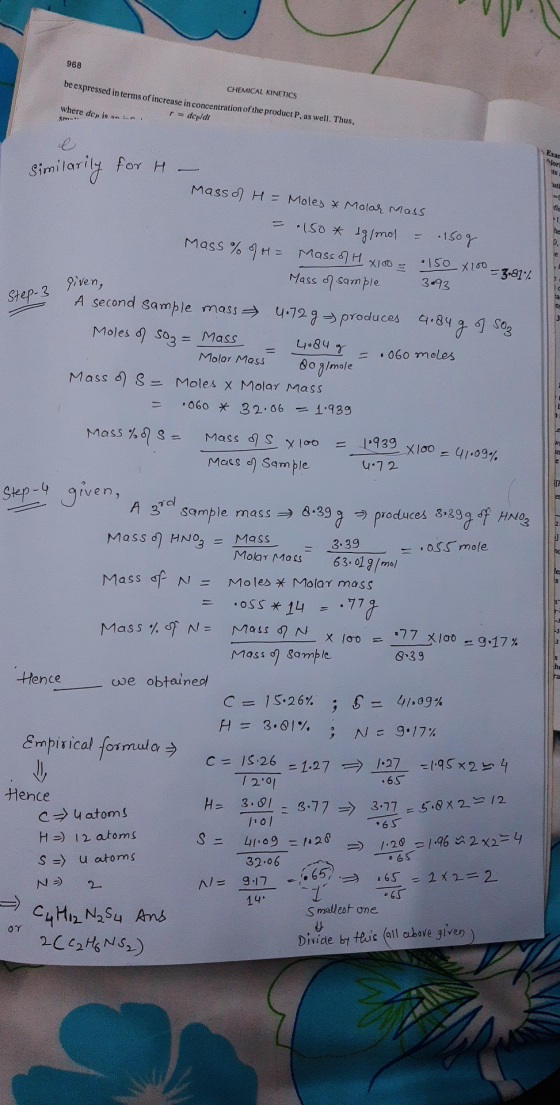
 please avoid errors.
To make a whole digit , I have multiplied in each calculAted values with 2 and took approximate values for empirical formula.
Thank you
Add Answer to:
A 3.93 gsample of a compound consisting of carbon, hydrogen,
oxygen, nitrogen, and sulfur was combusted...
A 2.75 g sample of a compound consisting of carbon, hydrogen, oxygen, nitrogen, and sulfur was combusted in excess oxyg...
 A 2.75 g sample of a compound consisting of carbon, hydrogen, oxygen, nitrogen, and sulfur was combusted in excess oxygen. This produced 1.55 g CO, and 0.951 g H,O. A second sample of this compound with a mass of 6.21 g produced 6.37 g SOZ. A third sample of this compound with a mass of 8.41 g produced 3.39 g HNO3. Determine the empirical formula of the compound. Enter the correct subscripts on the given chemical formula. empirical formula: CHNSO
f a compound consisting of carbon, hydrogen, oxygen, nitrogen, and sulfur was combusted in excess oxygen. This produced 2.20 g Co2 and 1.20 g H,O. A second sample of this compound with a mass of...
 f a compound consisting of carbon, hydrogen, oxygen, nitrogen, and sulfur was combusted in excess oxygen. This produced 2.20 g Co2 and 1.20 g H,O. A second sample of this compound with a mass of 4.86 g produced 3.19 g SO,. A third sample of this compound with a mass of 8.86 g produced 4.57 g HNO,. Determine the empirical formula of the compound. Enter the correct subscripts on the given chemical formula. empirical formula: CHNSO
f a compound consisting...
f a compound consisting of carbon, hydrogen, oxygen, nitrogen, and sulfur was combusted in excess oxygen. This produced 2.20 g Co2 and 1.20 g H,O. A second sample of this compound with a mass of 4.86 g produced 3.19 g SO,. A third sample of this compound with a mass of 8.86 g produced 4.57 g HNO,. Determine the empirical formula of the compound. Enter the correct subscripts on the given chemical formula. empirical formula: CHNSO
f a compound consisting...
estion 38 of 38 > A 3.56 g sample of a compound consisting of carbon, hydrogen,...
 estion 38 of 38 > A 3.56 g sample of a compound consisting of carbon, hydrogen, oxygen, nitrogen, and sulfur was combusted in excess oxygen. This produced 3.85 g Co, and 2.10 g H,0. A second sample of this compound with a mass of 4.85 g produced 3.18 so,. A third sample of this compound with a mass of 8.78 g produced 4.53 g HNO, Determine the empirical formula of the compound. Enter the correct subscripts on the given chemical...
1.)) An unknown compound containing carbon, hydrogen and oxygen is combusted. If 25.000 g of the...
1.)) An unknown compound containing carbon, hydrogen and oxygen is combusted. If 25.000 g of the compound produced 61.024 g of CO2 and 24.981 g of H2O, what is the empirical formula of the compound? 2.)) If the molar mass of this compound is 72.1 g/mol, what is the molecular formula?
5. Compound X contains only carbon, nitrogen, hydrogen, oxygen and sulfur. Analysis experiments produced the following...
 5. Compound X contains only carbon, nitrogen, hydrogen, oxygen and sulfur. Analysis experiments produced the following results: 1. 2.52 g of X burned in excess O2 produces 4.25 g of carbon dioxide and 1.02 g of water at 100% yield. 2. 4.14 g orx reacts to produce 1.785 g of sulfur trioxide at 85% yield. 3. 5.66 g orx reacts to produce 1.68 g of nitric acid at 75% yield. What is the empirical formula of compound X?
The compound known as diethyl ether, commonly referred to as ether, contains carbon, hydrogen, and oxygen....
 The compound known as diethyl ether, commonly referred to as ether, contains carbon, hydrogen, and oxygen. A 3.501 g sample of ether was combusted in an oxygen rich environment to produce 8.315 g of CO2(g) and 4.254 g of H2O(g). Insert subscripts to complete the empirical formula of ether. empirical formula: CHO
A 25.121 mg sample of a chemical known to contain only carbon, hydrogen, sulfur, and oxygen...
 A 25.121 mg sample of a chemical known to
contain only carbon, hydrogen, sulfur, and oxygen is put into a
combustion analysis apparatus, yielding 44.751 mg of carbon dioxide
and 18.319 mg of water. In another experiment, 30.199 mg of the
compound is reacted with excess oxygen to produce 13.05 mg of
sulfur dioxide. Add subscripts to the formula provided to correctly
identify the empirical formula of this compound. Do not change the
order of the elements.
A 25.121 mg...
A 25.121 mg sample of a chemical known to
contain only carbon, hydrogen, sulfur, and oxygen is put into a
combustion analysis apparatus, yielding 44.751 mg of carbon dioxide
and 18.319 mg of water. In another experiment, 30.199 mg of the
compound is reacted with excess oxygen to produce 13.05 mg of
sulfur dioxide. Add subscripts to the formula provided to correctly
identify the empirical formula of this compound. Do not change the
order of the elements.
A 25.121 mg...
A sample of a hydrocarbon, containing just carbon and hydrogen, is combusted in air to produce
A sample of a hydrocarbon, containing just carbon and hydrogen, is combusted in air to produce 15.00 g CO2 and 9.20 g H2O.What mass of hydrocarbon was combusted? What is its empirical formula? Mass spectrometry indicated that the molecular mass of the compound is 75.1 g/mol. What is themolecular formulae?
Combustion of a 1.025 g sample of a compound containing only carbon, hydrogen and oxygen produced...
Combustion of a 1.025 g sample of a compound containing only carbon, hydrogen and oxygen produced 2.265 g of CO2 and 1.236 g of H2O. What is the empirical and molecular formulas of the sample compound, if its molecular weight has been roughly determined to be 363 g/mol by mass spectrometer?
1.025 g of a compound containing hydrogen, oxygen, and carbon is subjected to combustion analysis in...
1.025 g of a compound containing hydrogen, oxygen, and carbon is subjected to combustion analysis in excess oxygen. A total of 1.5022 g CO2 and 0.6149 g H2O are produced by the complete combustion of the sample. A mass spectrometry experiment finds that the molecular ion has a mass of 360 amu. What is the molecular formula of the sample?
 A 2.75 g sample of a compound consisting of carbon, hydrogen, oxygen, nitrogen, and sulfur was combusted in excess oxygen. This produced 1.55 g CO, and 0.951 g H,O. A second sample of this compound with a mass of 6.21 g produced 6.37 g SOZ. A third sample of this compound with a mass of 8.41 g produced 3.39 g HNO3. Determine the empirical formula of the compound. Enter the correct subscripts on the given chemical formula. empirical formula: CHNSO
 f a compound consisting of carbon, hydrogen, oxygen, nitrogen, and sulfur was combusted in excess oxygen. This produced 2.20 g Co2 and 1.20 g H,O. A second sample of this compound with a mass of 4.86 g produced 3.19 g SO,. A third sample of this compound with a mass of 8.86 g produced 4.57 g HNO,. Determine the empirical formula of the compound. Enter the correct subscripts on the given chemical formula. empirical formula: CHNSO
f a compound consisting...
f a compound consisting of carbon, hydrogen, oxygen, nitrogen, and sulfur was combusted in excess oxygen. This produced 2.20 g Co2 and 1.20 g H,O. A second sample of this compound with a mass of 4.86 g produced 3.19 g SO,. A third sample of this compound with a mass of 8.86 g produced 4.57 g HNO,. Determine the empirical formula of the compound. Enter the correct subscripts on the given chemical formula. empirical formula: CHNSO
f a compound consisting...
 estion 38 of 38 > A 3.56 g sample of a compound consisting of carbon, hydrogen, oxygen, nitrogen, and sulfur was combusted in excess oxygen. This produced 3.85 g Co, and 2.10 g H,0. A second sample of this compound with a mass of 4.85 g produced 3.18 so,. A third sample of this compound with a mass of 8.78 g produced 4.53 g HNO, Determine the empirical formula of the compound. Enter the correct subscripts on the given chemical...
 5. Compound X contains only carbon, nitrogen, hydrogen, oxygen and sulfur. Analysis experiments produced the following results: 1. 2.52 g of X burned in excess O2 produces 4.25 g of carbon dioxide and 1.02 g of water at 100% yield. 2. 4.14 g orx reacts to produce 1.785 g of sulfur trioxide at 85% yield. 3. 5.66 g orx reacts to produce 1.68 g of nitric acid at 75% yield. What is the empirical formula of compound X?
 The compound known as diethyl ether, commonly referred to as ether, contains carbon, hydrogen, and oxygen. A 3.501 g sample of ether was combusted in an oxygen rich environment to produce 8.315 g of CO2(g) and 4.254 g of H2O(g). Insert subscripts to complete the empirical formula of ether. empirical formula: CHO
 A 25.121 mg sample of a chemical known to
contain only carbon, hydrogen, sulfur, and oxygen is put into a
combustion analysis apparatus, yielding 44.751 mg of carbon dioxide
and 18.319 mg of water. In another experiment, 30.199 mg of the
compound is reacted with excess oxygen to produce 13.05 mg of
sulfur dioxide. Add subscripts to the formula provided to correctly
identify the empirical formula of this compound. Do not change the
order of the elements.
A 25.121 mg...
A 25.121 mg sample of a chemical known to
contain only carbon, hydrogen, sulfur, and oxygen is put into a
combustion analysis apparatus, yielding 44.751 mg of carbon dioxide
and 18.319 mg of water. In another experiment, 30.199 mg of the
compound is reacted with excess oxygen to produce 13.05 mg of
sulfur dioxide. Add subscripts to the formula provided to correctly
identify the empirical formula of this compound. Do not change the
order of the elements.
A 25.121 mg...
Most questions answered within 3 hours.
-
Where is the error in this code sequence?
String s1 = "Hello";
String s2 = "ello";...
asked 11 months ago -
Financial data for Joel de Paris, Inc., for last year
follow:
Joel de Paris, Inc.
Balance...
asked 11 months ago -
Consider this reaction:
Al2(SO4)3 (aq)+ BaCl3
(aq) Al2Cl6 (aq)- +
3BaSO4(s) . What is the...
asked 11 months ago -
Suppose that Savneet is considering increasing her
recent random sample from 20 car rentals to 40...
asked 11 months ago -
Trucks arrive at an unloading terminal at an average rate of 120
per hour.
Trucks arrive...
asked 11 months ago -
Why are methanol and ethanol completely soluble in water while
octanol is not very little soluble....
asked 11 months ago -
A facilities manager at a university reads in a research report
that the mean amount of...
asked 11 months ago -
When the CuSO4 is rehydrated by adding water to the anhydrous
compound, is this an endothermic...
asked 11 months ago -
A ray of sunlight is passing from diamond into crown glass; the
angle of incidence is...
asked 11 months ago -
A block of mass 0.249 kg is placed on top of a light, vertical
spring of...
asked 11 months ago -
how do the kidneys compensate in the presences of acidosis
a) trigger hyperventilate
b) reserve acid...
asked 11 months ago -
Question 501 pts
The rental rate of capital to the firm increases. Which of the
following...
asked 11 months ago