Draw your very own Galvanic cell. The process you will be using is that solid chromium...
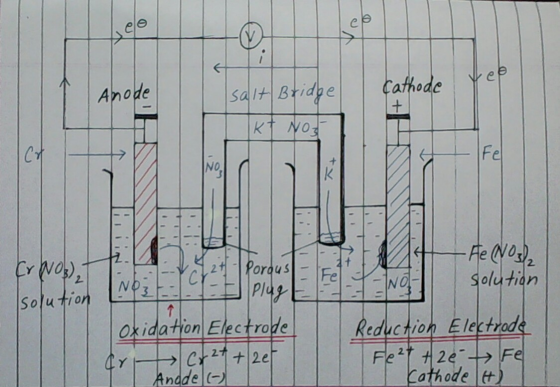
Draw your very own Galvanic cell. The process you will be using is that solid chromium releases two electrons, becoming chromium (II) ions. At the same time, iron (II) ions acquire there electrons, forming solid iron metal.
Make sure you label each part of your Galvanic cell. Do not forget site of oxidation, site of reduction, porous plug, wire, salt bridge, anode, cathode. Indicate the metal at each site and the resulting movement of ions.
Homework Answers
Answer:-
Galvanic Cells:-
The cells in which chemical energy is converted into electrical energy are called galvanic cells. These generate an electric current on account of a chemical reaction occurring within them.
Add Answer to:
Draw your very own Galvanic cell. The process you will be using
is that solid chromium...
2. What is the initial cell potential for a galvanic cell consisting of a IM Zn2+...
 2. What is the initial cell potential for a galvanic cell consisting of a IM Zn2+ solution with Zn solid as the anode and 1 M Cu?solution with Cu metal as the cathode? The electrodes are connected through a volt meter and the compartments are connected through a salt bridge. 3. What is the initial cell potential for a galvanic cell consisting of a 0.2 M Zn2+ solution with Zn solid as the anode and 0.01 M Cu"* solution with...
In a copper-zinc voltaic cell, one half-cell consists of a ZnZn electrode inserted in a solution...
 In a copper-zinc voltaic cell, one half-cell consists of a ZnZn
electrode inserted in a solution of zinc sulfate and the other
half-cell consists of a CuCu electrode inserted in a copper sulfate
solution. These two half-cells are separated by a salt bridge.
At the zinc electrode (anode), ZnZn metal undergoes oxidation by
losing two electrons and enters the solution as Zn2+Zn2+ ions. The
oxidation half-cell reaction that takes place at the anode is
Zn(s)→Zn2+(aq)+2e−Zn(s)→Zn2+(aq)+2e−
The CuCu ions undergo reduction...
In a copper-zinc voltaic cell, one half-cell consists of a ZnZn
electrode inserted in a solution of zinc sulfate and the other
half-cell consists of a CuCu electrode inserted in a copper sulfate
solution. These two half-cells are separated by a salt bridge.
At the zinc electrode (anode), ZnZn metal undergoes oxidation by
losing two electrons and enters the solution as Zn2+Zn2+ ions. The
oxidation half-cell reaction that takes place at the anode is
Zn(s)→Zn2+(aq)+2e−Zn(s)→Zn2+(aq)+2e−
The CuCu ions undergo reduction...
The CuCu ions undergo reduction by accepting two electrons from the copper electrode (cathode) and depositing...
 The CuCu ions undergo reduction by accepting two electrons from
the copper electrode (cathode) and depositing on the electrode as
Cu(s)Cu(s). The reduction half-cell reaction that takes place at
the cathode is
Cu^2+(aq)+2e^−→Cu(s)Cu^2+(aq)+2e^-→Cu(s)
The electrons lost by the ZnZn metal are gained by the CuCu ion.
The transfer of electrons between ZnZn metal and CuCu ions is made
possible by connecting the wire between the ZnZn electrode and the
CuCu electrode. Thus, in the voltaic cell, the electrons flow
through...
The CuCu ions undergo reduction by accepting two electrons from
the copper electrode (cathode) and depositing on the electrode as
Cu(s)Cu(s). The reduction half-cell reaction that takes place at
the cathode is
Cu^2+(aq)+2e^−→Cu(s)Cu^2+(aq)+2e^-→Cu(s)
The electrons lost by the ZnZn metal are gained by the CuCu ion.
The transfer of electrons between ZnZn metal and CuCu ions is made
possible by connecting the wire between the ZnZn electrode and the
CuCu electrode. Thus, in the voltaic cell, the electrons flow
through...
A galvanic (voltaic) cell consists of an electrode composed of chromium in a 1.0 M chromium(III)...
A galvanic (voltaic) cell consists of an electrode composed of chromium in a 1.0 M chromium(III) ion solution and another electrode composed of copper in a 1.0 M copper(I) ion solution, connected by a salt bridge. Calculate the standard potential for this cell at 25 °C. Standard reduction potentials can be found here. https://sites.google.com/site/chempendix/potentials
Questions Galvanic Cell Metal and Solution in Cathode Half-cell Cell Potential(v) Metal and Solution in Anode...
 Questions
Galvanic Cell Metal and Solution in Cathode Half-cell Cell Potential(v) Metal and Solution in Anode Half-cell Black Wire (-) Red Wire (+) -2.370 Pt/H2 and Nitric Acid Mg and Magnesium Nitrate #1 -0.143 Pt/ H2 and Nitric Acid Pb and Lead (II) Nitrate #2 -0.249 Pt/ H2 and Nitric Acid #3 Ni and Nickel (II) Nitrate 다 5. Based on your information above write the half reactions occurring in each half-cell. Ensure you are writing the correct oxidation or...
Questions
Galvanic Cell Metal and Solution in Cathode Half-cell Cell Potential(v) Metal and Solution in Anode Half-cell Black Wire (-) Red Wire (+) -2.370 Pt/H2 and Nitric Acid Mg and Magnesium Nitrate #1 -0.143 Pt/ H2 and Nitric Acid Pb and Lead (II) Nitrate #2 -0.249 Pt/ H2 and Nitric Acid #3 Ni and Nickel (II) Nitrate 다 5. Based on your information above write the half reactions occurring in each half-cell. Ensure you are writing the correct oxidation or...
A) The half-cell is a chamber in the voltaic cell where one half-cell is the site...
A) The half-cell is a chamber in the voltaic cell where one half-cell is the site of the oxidation reaction and the other half-cell is the site of the reduction reaction. Type the half-cell reaction that takes place at the anode for the chromium-silver voltaic cell. Indicate the physical states of atoms and ions using the abbreviation (s), (l), or (g) for solid, liquid, or gas, respectively. Use (aq) for an aqueous solution. Do not include phases for electrons. Express...
Magnesium metal is oxidized and silver ions are reduced in a voltaic cell using: Mg(s) |...
Magnesium metal is oxidized and silver ions are reduced in a voltaic cell using: Mg(s) | Mg2+ (aq, 1M) || Ag+ (aq, 1M) | Ag(s) a. Draw the voltaic cell. Label each part of the cell. b. Write the equations for the half-reactions occurring at the anode and cathode. c. Write the overall reaction for the cell. d. Draw arrows to show the movement of electrons in the external circuit. Assuming the salt bridge contains NaNO3, indicate the movement of...
Part A. The half-cell is a chamber in the voltaic cell where one half-cell is the...
Part A. The half-cell is a chamber in the voltaic cell where one half-cell is the site of the oxidation reaction and the other half-cell is the site of the reduction reaction. Type the half-cell reaction that takes place at the anode for the iron-silver voltaic cell. Indicate the physical states of atoms and ions using the abbreviation (s), (l), or (g) for solid, liquid, or gas, respectively. Use (aq) for an aqueous solution. Do not include phases for electrons....
11. If the galvanic cell below is constructed with a Pb/Pb2-electrode and a Fe/Fe2+ electrode. determine...
 11. If the galvanic cell below is constructed with a Pb/Pb2-electrode and a Fe/Fe2+ electrode. determine which electrode will be the cathode and which electrode will be the anode. Write each half cell reaction and the overall cell reaction. Oxidation: Reduction: Overall: Label the cell below with the following: a. the location of each substance (Pb, Pb2+, Fe, Fe2+) b. the cathode and anode C. the direction of electron flow d. If the salt bridge contains KCI, label the direction...
1) A standard galvanic cell is constructed with I2 | I- and H+ | H2 half...
1) A standard galvanic cell is constructed with I2 | I- and H+ | H2 half cell compartments connected by a salt bridge. Which of the following statements are correct? Hint: Refer to a table of standard reduction potentials. (Choose all that apply.) 1) In the external circuit, electrons flow from the H+|H2 compartment to the I2|I- compartment. 2) H2 is oxidized at the anode. 3) H+ is reduced at the cathode. 4) The cathode compartment is the I2|I- compartment....
 2. What is the initial cell potential for a galvanic cell consisting of a IM Zn2+ solution with Zn solid as the anode and 1 M Cu?solution with Cu metal as the cathode? The electrodes are connected through a volt meter and the compartments are connected through a salt bridge. 3. What is the initial cell potential for a galvanic cell consisting of a 0.2 M Zn2+ solution with Zn solid as the anode and 0.01 M Cu"* solution with...
 In a copper-zinc voltaic cell, one half-cell consists of a ZnZn
electrode inserted in a solution of zinc sulfate and the other
half-cell consists of a CuCu electrode inserted in a copper sulfate
solution. These two half-cells are separated by a salt bridge.
At the zinc electrode (anode), ZnZn metal undergoes oxidation by
losing two electrons and enters the solution as Zn2+Zn2+ ions. The
oxidation half-cell reaction that takes place at the anode is
Zn(s)→Zn2+(aq)+2e−Zn(s)→Zn2+(aq)+2e−
The CuCu ions undergo reduction...
In a copper-zinc voltaic cell, one half-cell consists of a ZnZn
electrode inserted in a solution of zinc sulfate and the other
half-cell consists of a CuCu electrode inserted in a copper sulfate
solution. These two half-cells are separated by a salt bridge.
At the zinc electrode (anode), ZnZn metal undergoes oxidation by
losing two electrons and enters the solution as Zn2+Zn2+ ions. The
oxidation half-cell reaction that takes place at the anode is
Zn(s)→Zn2+(aq)+2e−Zn(s)→Zn2+(aq)+2e−
The CuCu ions undergo reduction...
 The CuCu ions undergo reduction by accepting two electrons from
the copper electrode (cathode) and depositing on the electrode as
Cu(s)Cu(s). The reduction half-cell reaction that takes place at
the cathode is
Cu^2+(aq)+2e^−→Cu(s)Cu^2+(aq)+2e^-→Cu(s)
The electrons lost by the ZnZn metal are gained by the CuCu ion.
The transfer of electrons between ZnZn metal and CuCu ions is made
possible by connecting the wire between the ZnZn electrode and the
CuCu electrode. Thus, in the voltaic cell, the electrons flow
through...
The CuCu ions undergo reduction by accepting two electrons from
the copper electrode (cathode) and depositing on the electrode as
Cu(s)Cu(s). The reduction half-cell reaction that takes place at
the cathode is
Cu^2+(aq)+2e^−→Cu(s)Cu^2+(aq)+2e^-→Cu(s)
The electrons lost by the ZnZn metal are gained by the CuCu ion.
The transfer of electrons between ZnZn metal and CuCu ions is made
possible by connecting the wire between the ZnZn electrode and the
CuCu electrode. Thus, in the voltaic cell, the electrons flow
through...
 Questions
Galvanic Cell Metal and Solution in Cathode Half-cell Cell Potential(v) Metal and Solution in Anode Half-cell Black Wire (-) Red Wire (+) -2.370 Pt/H2 and Nitric Acid Mg and Magnesium Nitrate #1 -0.143 Pt/ H2 and Nitric Acid Pb and Lead (II) Nitrate #2 -0.249 Pt/ H2 and Nitric Acid #3 Ni and Nickel (II) Nitrate 다 5. Based on your information above write the half reactions occurring in each half-cell. Ensure you are writing the correct oxidation or...
Questions
Galvanic Cell Metal and Solution in Cathode Half-cell Cell Potential(v) Metal and Solution in Anode Half-cell Black Wire (-) Red Wire (+) -2.370 Pt/H2 and Nitric Acid Mg and Magnesium Nitrate #1 -0.143 Pt/ H2 and Nitric Acid Pb and Lead (II) Nitrate #2 -0.249 Pt/ H2 and Nitric Acid #3 Ni and Nickel (II) Nitrate 다 5. Based on your information above write the half reactions occurring in each half-cell. Ensure you are writing the correct oxidation or...
 11. If the galvanic cell below is constructed with a Pb/Pb2-electrode and a Fe/Fe2+ electrode. determine which electrode will be the cathode and which electrode will be the anode. Write each half cell reaction and the overall cell reaction. Oxidation: Reduction: Overall: Label the cell below with the following: a. the location of each substance (Pb, Pb2+, Fe, Fe2+) b. the cathode and anode C. the direction of electron flow d. If the salt bridge contains KCI, label the direction...
Most questions answered within 3 hours.
-
Where is the error in this code sequence?
String s1 = "Hello";
String s2 = "ello";...
asked 10 months ago -
Financial data for Joel de Paris, Inc., for last year
follow:
Joel de Paris, Inc.
Balance...
asked 10 months ago -
Consider this reaction:
Al2(SO4)3 (aq)+ BaCl3
(aq) Al2Cl6 (aq)- +
3BaSO4(s) . What is the...
asked 10 months ago -
Suppose that Savneet is considering increasing her
recent random sample from 20 car rentals to 40...
asked 10 months ago -
Trucks arrive at an unloading terminal at an average rate of 120
per hour.
Trucks arrive...
asked 10 months ago -
Why are methanol and ethanol completely soluble in water while
octanol is not very little soluble....
asked 10 months ago -
A facilities manager at a university reads in a research report
that the mean amount of...
asked 10 months ago -
When the CuSO4 is rehydrated by adding water to the anhydrous
compound, is this an endothermic...
asked 10 months ago -
A ray of sunlight is passing from diamond into crown glass; the
angle of incidence is...
asked 10 months ago -
A block of mass 0.249 kg is placed on top of a light, vertical
spring of...
asked 10 months ago -
how do the kidneys compensate in the presences of acidosis
a) trigger hyperventilate
b) reserve acid...
asked 10 months ago -
Question 501 pts
The rental rate of capital to the firm increases. Which of the
following...
asked 10 months ago