The isotope chlorine-35 has a mass of 34.969 amu , and the isotope chlorine-37 has a...
The isotope chlorine-35 has a mass of 34.969 amu , and the isotope chlorine-37 has a mass of 36.966 amu . Given that 75.5 % of all chlorine atoms found in nature are chlorine-35 and 24.5 % are chlorine-37, find the atomic mass of chlorine, Cl(atomic number 17).
Homework Answers
Average atomic mass is given by:
Avg mass = M_avg = (Amount of Cl-35*weight of Cl-35 + Amount of Cl-37*weight of Cl-37)/(total amount of Cl-35 and Cl-37 in nature)
Amount of Cl-35 in nature = 75.5% = 0.755
Amount of Cl-37 in nature = 24.5% = 0.245
Weight of Cl-35 = 34.969 amu
Weight of Cl-37 = 36.966 amu
Using above values:
M_avg = (0.755*34.969 + 0.245*36.966)/(0.755 + 0.245)
M_avg = 35.458 amu = atmoic mass of chlorine
Please Upvote.
Add Answer to:
The isotope chlorine-35 has a mass of 34.969 amu , and the
isotope chlorine-37 has a...
Chlorine is found as two isotopes, Cl-35 and Cl-37 (or and Cl). The atomic mass of...
Chlorine is found as two isotopes, Cl-35 and Cl-37 (or and Cl). The atomic mass of the Cl-35-isotope is 34,96885 amu while the Cl-37-isotope has an atomic mass equal to 36,96590 amu ( The textbook use this unit for atomic mass, we could as well have used the recommended unit «u»). In the Periodic Table given in the textbook the molar mass of Chlorine is given as 35,45 g/mol. What is the percentage abundance of the two chlorine isotopes?
Question 3 (2.5 points) Chlorine has two naturally occurring isotopes. The isotope C1-35 (mass = 35.0...
 Question 3 (2.5 points) Chlorine has two naturally occurring isotopes. The isotope C1-35 (mass = 35.0 amu) makes up 75.8% of the sample, and the isotope CH-37 (mass = 37.0 amu) makes up 24.2% of the sample. What is the average atomic mass for chlorine? A) 36.0 amu B) 35 amu C) 36.6 amu D) 35.5 amu E) 35.521 amu
There are two naturally occurring isotopes of chlorine. 35^CI has a mass of 34.9689 amu. 37^CI...
 There are two naturally occurring isotopes of chlorine. 35^CI has a mass of 34.9689 amu. 37^CI has a mass of 36.9659 amu. Determine the abundance of each isotope.
Chlorine has two isotopes. The lighter one has an atomic mass of 34.969 atomic mass units...
 Chlorine has two isotopes. The lighter one has an atomic mass of 34.969 atomic mass units (amu), and the heavier has a mass of 36.966 amu. If the average atomic mass on another planet is 35.625 amu, what percentage is the lighter isotope? Give your answer to the nearest whole percent.
Enter your answer in the provided box. Calculate the atomic mass of naturally occurring chlorine if...
 Enter your answer in the provided box. Calculate the atomic mass of naturally occurring chlorine if 77.93% of chlorine atoms are 35 Cl (chlorine-35) and 22.07% of chlorine atoms are CI (chlorine-37). 37 17 amu 9. If the field of view is 0.45 mm in diameter and three cells can fit lengthwise across the field of view. How long is one cell? a. 1.35 microns b. 1.35 mm c. 150 microns d. 1.5 mm
Calculate the atomic mass of the chlorine-37 nucleus in amu (to three decimal places) assuming that...
 Calculate the atomic mass of the chlorine-37 nucleus in amu (to three decimal places) assuming that the mass of a nucleon is 1.008 amu and the binding energy per nucleon is 1.326x10^12 J/nucleon. (1 kg = 6.022x1026 amu)
8. An element has two naturally occurring isotopes. Isotope 1 has a mass of 120.9038 amu...
 8. An element has two naturally occurring isotopes. Isotope 1 has a mass of 120.9038 amu and a relative abundance of 57.4%. Isotope 2 has a mass of 122.9042 amu. Find the atomic mass of this element and, by comparison to the periodic table, identify it.
1. An element has two naturally occurring isotopes. Isotope 1 has a mass of 120.9038 amu,...
 1. An element has two naturally occurring isotopes. Isotope 1 has a mass of 120.9038 amu, and a relative abundance of 57.4%. Isotope 2 has a mass of 122.9042, and a relative abundance of 42.6%. Find the atomic mass of this element and identify it by name and symbol.
Be sure to answer all parts. The atomic mass of Cl is 35.45 amu, and the atomic mass of Al is 26.98 amu. What are the masses in grams of 3.3275 mol of Cl atoms and of 3.8611 mol of Al atoms? g Cl...
 Be sure to answer all parts. The atomic mass of Cl is 35.45 amu, and the atomic mass of Al is 26.98 amu. What are the masses in grams of 3.3275 mol of Cl atoms and of 3.8611 mol of Al atoms? g Cl g Al K Prev 19 of 30Next >
Be sure to answer all parts. The atomic mass of Cl is 35.45 amu, and the atomic mass of Al is 26.98 amu. What are the masses in...
Be sure to answer all parts. The atomic mass of Cl is 35.45 amu, and the atomic mass of Al is 26.98 amu. What are the masses in grams of 3.3275 mol of Cl atoms and of 3.8611 mol of Al atoms? g Cl g Al K Prev 19 of 30Next >
Be sure to answer all parts. The atomic mass of Cl is 35.45 amu, and the atomic mass of Al is 26.98 amu. What are the masses in...
Which of the following is considered of Transition Metals Cu 17 Ti Fe a) All of...
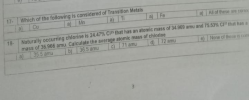 Which of the following is considered of Transition Metals Cu 17 Ti Fe a) All of these are core a) Mn Naturally occurring chlorine is 24.47% CI3 that has an atomic mass of 34.969 amu and 75.53% C mass of 36.966 amu. Calculate the average atomic mass of chlorine 35.5 amu that has a 18- d) 72 amu None of thee is core c) 71 amu e) 36.5 amu b)
 Question 3 (2.5 points) Chlorine has two naturally occurring isotopes. The isotope C1-35 (mass = 35.0 amu) makes up 75.8% of the sample, and the isotope CH-37 (mass = 37.0 amu) makes up 24.2% of the sample. What is the average atomic mass for chlorine? A) 36.0 amu B) 35 amu C) 36.6 amu D) 35.5 amu E) 35.521 amu
 There are two naturally occurring isotopes of chlorine. 35^CI has a mass of 34.9689 amu. 37^CI has a mass of 36.9659 amu. Determine the abundance of each isotope.
 Chlorine has two isotopes. The lighter one has an atomic mass of 34.969 atomic mass units (amu), and the heavier has a mass of 36.966 amu. If the average atomic mass on another planet is 35.625 amu, what percentage is the lighter isotope? Give your answer to the nearest whole percent.
 Enter your answer in the provided box. Calculate the atomic mass of naturally occurring chlorine if 77.93% of chlorine atoms are 35 Cl (chlorine-35) and 22.07% of chlorine atoms are CI (chlorine-37). 37 17 amu 9. If the field of view is 0.45 mm in diameter and three cells can fit lengthwise across the field of view. How long is one cell? a. 1.35 microns b. 1.35 mm c. 150 microns d. 1.5 mm
 Calculate the atomic mass of the chlorine-37 nucleus in amu (to three decimal places) assuming that the mass of a nucleon is 1.008 amu and the binding energy per nucleon is 1.326x10^12 J/nucleon. (1 kg = 6.022x1026 amu)
 8. An element has two naturally occurring isotopes. Isotope 1 has a mass of 120.9038 amu and a relative abundance of 57.4%. Isotope 2 has a mass of 122.9042 amu. Find the atomic mass of this element and, by comparison to the periodic table, identify it.
 1. An element has two naturally occurring isotopes. Isotope 1 has a mass of 120.9038 amu, and a relative abundance of 57.4%. Isotope 2 has a mass of 122.9042, and a relative abundance of 42.6%. Find the atomic mass of this element and identify it by name and symbol.
 Be sure to answer all parts. The atomic mass of Cl is 35.45 amu, and the atomic mass of Al is 26.98 amu. What are the masses in grams of 3.3275 mol of Cl atoms and of 3.8611 mol of Al atoms? g Cl g Al K Prev 19 of 30Next >
Be sure to answer all parts. The atomic mass of Cl is 35.45 amu, and the atomic mass of Al is 26.98 amu. What are the masses in...
Be sure to answer all parts. The atomic mass of Cl is 35.45 amu, and the atomic mass of Al is 26.98 amu. What are the masses in grams of 3.3275 mol of Cl atoms and of 3.8611 mol of Al atoms? g Cl g Al K Prev 19 of 30Next >
Be sure to answer all parts. The atomic mass of Cl is 35.45 amu, and the atomic mass of Al is 26.98 amu. What are the masses in...
 Which of the following is considered of Transition Metals Cu 17 Ti Fe a) All of these are core a) Mn Naturally occurring chlorine is 24.47% CI3 that has an atomic mass of 34.969 amu and 75.53% C mass of 36.966 amu. Calculate the average atomic mass of chlorine 35.5 amu that has a 18- d) 72 amu None of thee is core c) 71 amu e) 36.5 amu b)
Most questions answered within 3 hours.
-
Where is the error in this code sequence?
String s1 = "Hello";
String s2 = "ello";...
asked 11 months ago -
Financial data for Joel de Paris, Inc., for last year
follow:
Joel de Paris, Inc.
Balance...
asked 11 months ago -
Consider this reaction:
Al2(SO4)3 (aq)+ BaCl3
(aq) Al2Cl6 (aq)- +
3BaSO4(s) . What is the...
asked 11 months ago -
Suppose that Savneet is considering increasing her
recent random sample from 20 car rentals to 40...
asked 11 months ago -
Trucks arrive at an unloading terminal at an average rate of 120
per hour.
Trucks arrive...
asked 11 months ago -
Why are methanol and ethanol completely soluble in water while
octanol is not very little soluble....
asked 11 months ago -
A facilities manager at a university reads in a research report
that the mean amount of...
asked 11 months ago -
When the CuSO4 is rehydrated by adding water to the anhydrous
compound, is this an endothermic...
asked 11 months ago -
A ray of sunlight is passing from diamond into crown glass; the
angle of incidence is...
asked 11 months ago -
A block of mass 0.249 kg is placed on top of a light, vertical
spring of...
asked 11 months ago -
how do the kidneys compensate in the presences of acidosis
a) trigger hyperventilate
b) reserve acid...
asked 11 months ago -
Question 501 pts
The rental rate of capital to the firm increases. Which of the
following...
asked 11 months ago