1.) A ball is thrown straight up with an initial speed of 15.715.7 m/s. At what...
1.) A ball is thrown straight up with an initial speed of 15.715.7 m/s. At what height above its initial position will the ball have one‑half its initial speed?
2.) A child slides down a snow‑covered slope on a sled. At the top of the slope, her mother gives her a push to start her off with a speed of 1.101.10 m/s. The frictional force acting on the sled is one‑fifth of the combined weight of the child and the sled. If she travels for a distance of 27.527.5 m and her speed at the bottom is 4.054.05 m/s, calculate the angle that the slope makes with the horizontal.
Homework Answers
Part (a)
Given :
Vi =15.7 m/s
Vf =Vi/2
Let S be the hight where the velocity become half of initial velocity.
Now by using the equation of motion:
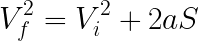
As the direction of velocity is upward where as the direction of acceleration due to gravity is downward so,
a = - g = - 9.8 m/s2
So,
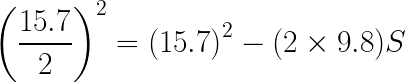
S = 9.43m
Part(b)
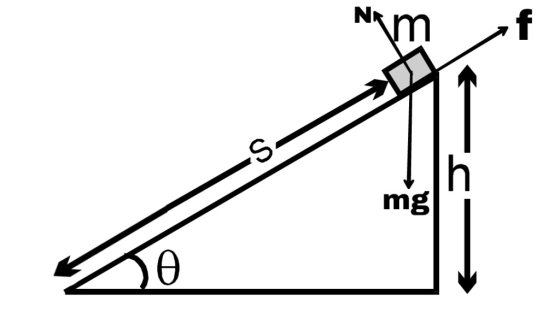
Let,
The child with sled as a block of mass 'm'
Hight of initial point is 'h'
Distance travlled 's'
Normal reaction 'N'
Friction force 'f'
Angle of slope is 
Initial velocity Vi
Final velocity Vf
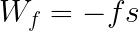
Now, by using work power energy theorem
Work done by all forces = change in kinetic energy

As from above diagram
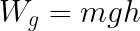

And by given information
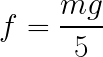
So,

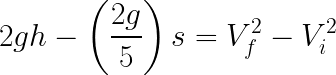
By putting the value in above equation we get



Now from the above diagram
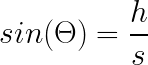
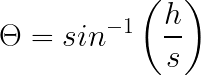
 13.19°
Add Answer to:
1.) A ball is thrown straight up with an initial speed of
15.715.7 m/s. At what...
A child slides down a snow‑covered slope on a sled. At the top of the slope,...
A child slides down a snow‑covered slope on a sled. At the top of the slope, her mother gives her a push to start her off with a speed of 0.70 m/s. The frictional force acting on the sled is one‑fifth of the combined weight of the child and the sled. If she travels for a distance of 24.5 m and her speed at the bottom is 4.25 m/s, calculate the angle that the slope makes with the horizontal.
A ball is thrown straight up with an initial speed of v m/s. The ball was...
A ball is thrown straight up with an initial speed of v m/s. The ball was released 1.2 m above the ground, but when it returns back down, it falls into a hole 14.2 m deep. If the ball’s speed at the bottom of the hole is 28 m/s, what was the initial speed v (in m/s) of the ball?
A ball is thrown straight up with an initial speed of 13.7 m/s. At what height...
A ball is thrown straight up with an initial speed of 13.7 m/s. At what height above its initial position will the ball have one‑half its initial speed?
A ball is thrown straight up with an initial speed of 14.3 m/s. At what height...
 A ball is thrown straight up with an initial speed of 14.3 m/s. At what height above its initial position will the ball have one-half its initial speed? height:
1. A ball is thrown straight up with an initial speed of 30 m/s. How much...
1. A ball is thrown straight up with an initial speed of 30 m/s. How much time does it take for the ball to reach the top of it's trajectory? 2. For 3.0s, Allison exerts a net force of 10.0 N on a 6.7-kg shopping cart that was initially at rest. Find the acceleration of the cart, and show that it moves a distance of 6.7m. 3. Suzie skydiver with her parachute has a mass of 50 kg. Before opening...
A ball is thrown straight up in the air with an initial speed of 40 m/s....
 A ball is thrown straight up in the air with an initial speed of 40 m/s. Ignore air resistance and take g - 10m/s2. What is the speed of the ball when it reach 40 m above the ground? 20 m/s 2012 m/s 2/20 m/s 3720 m/s 20/3 mis
A ball is thrown straight up into the air with an initial speed of 5 m/s...
A ball is thrown straight up into the air with an initial speed of 5 m/s and is then caught as it comes back down to the pitcher. How long does the ball remain in the air, in seconds?
help A 0.20 kg ball is thrown straight up into the air with an initial speed...
 help
A 0.20 kg ball is thrown straight up into the air with an initial speed of 17 m/s. Find the momentum of the ball at the following locations. (a) at its maximum height kg-m/s (b) halfway to its maximum height kg-m/s
help
A 0.20 kg ball is thrown straight up into the air with an initial speed of 17 m/s. Find the momentum of the ball at the following locations. (a) at its maximum height kg-m/s (b) halfway to its maximum height kg-m/s
DQuestion 7 14.3 pts A ball is thrown straight up with a speed of 10 m/s....
 DQuestion 7 14.3 pts A ball is thrown straight up with a speed of 10 m/s. What is the speed at the top of its flight 0 m/s 8 m/s Quiz saved at 1:19pmSubmit Quiz MacBook Air 2 3 caps lock
A 2.7-kg ball is thrown upward with an initial speed of 20.0 m/s from the edge...
A 2.7-kg ball is thrown upward with an initial speed of 20.0 m/s from the edge of a 45.0 m high cliff. At the instant the ball is thrown, a woman starts running away from the base of the cliff with a constant speed of 6.00 m/s. The woman runs in a straight line on level ground, and air resistance acting on the ball can be ignored. 1.At what angle above the horizontal should the ball be thrown so that...
 A ball is thrown straight up with an initial speed of 14.3 m/s. At what height above its initial position will the ball have one-half its initial speed? height:
 A ball is thrown straight up in the air with an initial speed of 40 m/s. Ignore air resistance and take g - 10m/s2. What is the speed of the ball when it reach 40 m above the ground? 20 m/s 2012 m/s 2/20 m/s 3720 m/s 20/3 mis
 help
A 0.20 kg ball is thrown straight up into the air with an initial speed of 17 m/s. Find the momentum of the ball at the following locations. (a) at its maximum height kg-m/s (b) halfway to its maximum height kg-m/s
help
A 0.20 kg ball is thrown straight up into the air with an initial speed of 17 m/s. Find the momentum of the ball at the following locations. (a) at its maximum height kg-m/s (b) halfway to its maximum height kg-m/s
 DQuestion 7 14.3 pts A ball is thrown straight up with a speed of 10 m/s. What is the speed at the top of its flight 0 m/s 8 m/s Quiz saved at 1:19pmSubmit Quiz MacBook Air 2 3 caps lock
Most questions answered within 3 hours.
-
Where is the error in this code sequence?
String s1 = "Hello";
String s2 = "ello";...
asked 10 months ago -
Financial data for Joel de Paris, Inc., for last year
follow:
Joel de Paris, Inc.
Balance...
asked 10 months ago -
Consider this reaction:
Al2(SO4)3 (aq)+ BaCl3
(aq) Al2Cl6 (aq)- +
3BaSO4(s) . What is the...
asked 10 months ago -
Suppose that Savneet is considering increasing her
recent random sample from 20 car rentals to 40...
asked 10 months ago -
Trucks arrive at an unloading terminal at an average rate of 120
per hour.
Trucks arrive...
asked 10 months ago -
Why are methanol and ethanol completely soluble in water while
octanol is not very little soluble....
asked 10 months ago -
A facilities manager at a university reads in a research report
that the mean amount of...
asked 10 months ago -
When the CuSO4 is rehydrated by adding water to the anhydrous
compound, is this an endothermic...
asked 10 months ago -
A ray of sunlight is passing from diamond into crown glass; the
angle of incidence is...
asked 10 months ago -
A block of mass 0.249 kg is placed on top of a light, vertical
spring of...
asked 10 months ago -
how do the kidneys compensate in the presences of acidosis
a) trigger hyperventilate
b) reserve acid...
asked 10 months ago -
Question 501 pts
The rental rate of capital to the firm increases. Which of the
following...
asked 10 months ago