The half-life of tritium is 12.3 years. What mass of a 48.0g sample remains after 24.6...
The half-life of tritium is 12.3 years. What mass of a 48.0g sample remains after 24.6 years? Answer using approximations, giving your best educated guess for answer (do not use equations).
Homework Answers
As asked in question we can do it without using formula
Half life is 12.3 years means whatever amount you take it will become half of the initially taken amount.
Here initial amount is given as 48.0 g
Time given is 24.6 years.
If we observe the given time 24.6 years it is equal to two times of 12.3 years.
Initial amount of tritium is 48.0g
After first 12.3 years the amount of tritium is 24.0g (half of initial amount)
Now for next 12.3 years initial amount is 24.0g
So after next 12.3 years that is after 24.6 years the amount of tritium remaining is 12.0g (half of the initial amount 24.0g)
Therefore the sample remains after 24.6 years is 12.0g
Add Answer to:
The half-life of tritium is 12.3 years. What mass of a 48.0g
sample remains after 24.6...
Hydrogen-3 is radioactive and has a half life of 12.3 years. What percentage of a sample...
 Hydrogen-3 is radioactive and has a half life of 12.3 years. What percentage of a sample would be left after 1.32 years? Round your answer to 2 significant digits.
6. Current nuclear arsenals use tritium warheads with a half-life of 12.26 years. What percentage of...
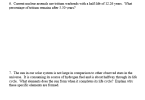 6. Current nuclear arsenals use tritium warheads with a half-life of 12.26 years. What percentage of tritium remains after 5.50 years? The sun in our solar system is not large in comparison to other observed stars in the universe. It is consuming its source of hydrogen fuel and is about halfway though its life cycle. What elements does the sun form when it completes its life cycle? Explain why these specific elements are formed.
Part A: Tritium is a radioactive isotope of the element hydrogen. Tritium has a half-life of...
Part A: Tritium is a radioactive isotope of the element hydrogen. Tritium has a half-life of 12.5 years. How many years would it take until only 3.22% of a sample remain? Answer should be in years. Part B: Radioactive Carbon-11 has a half life of only 20.3 minutes and an atomic mass number of 11 u. Calculate the activity of 3.58 g of Carbon-11. Answer should be in Bq.
A 1.6 mg sample of radioactive Ho-166 has a half-life of 26.8 years. What mass remains...
A 1.6 mg sample of radioactive Ho-166 has a half-life of 26.8 years. What mass remains after 12 years? All radioactive decay processes are 1st order reactions. t1/2 = 0.693/k ln [A]t = -kt + ln [A
studying for my final, help 12) (2 pts) the isotope, tritium, has a half-life of 12.3...
 studying for my final, help
12) (2 pts) the isotope, tritium, has a half-life of 12.3 years and atomic mass 3.016 amu. Assume we have 10 kg of the substance. What will be the disintegration constant (in s )? a. 5.6 x 10⁻² 5-1 b. 5.6 x 10⁸ s-1 c. 3.2 x 10's-1 d. 1.8 x 10⁻⁹ s-1 e. 1.6 x 10⁶ s-1
studying for my final, help
12) (2 pts) the isotope, tritium, has a half-life of 12.3 years and atomic mass 3.016 amu. Assume we have 10 kg of the substance. What will be the disintegration constant (in s )? a. 5.6 x 10⁻² 5-1 b. 5.6 x 10⁸ s-1 c. 3.2 x 10's-1 d. 1.8 x 10⁻⁹ s-1 e. 1.6 x 10⁶ s-1
studying for my final, help 13) (2 pts) The isotope, tritium, has a half-life of 12.3...
 studying for my final, help
13) (2 pts) The isotope, tritium, has a half-life of 12.3 years and atomic mass 3.016 amu. Assume we have 10 kg of the substance. What will be the initial decay rate, at t=0 (in decays/s)? a. 1.09 x 10¹⁴ decays/s b. 1.8 x 10⁻⁹ decays/s c. 5.6 x 10⁸ decays/s d. 3.6 x 10¹⁸ decays/s e. 3.6 x 10¹⁷ decays/s
studying for my final, help
13) (2 pts) The isotope, tritium, has a half-life of 12.3 years and atomic mass 3.016 amu. Assume we have 10 kg of the substance. What will be the initial decay rate, at t=0 (in decays/s)? a. 1.09 x 10¹⁴ decays/s b. 1.8 x 10⁻⁹ decays/s c. 5.6 x 10⁸ decays/s d. 3.6 x 10¹⁸ decays/s e. 3.6 x 10¹⁷ decays/s
+ 1/4 points Previous Answers SerCP11 29.3.P.020. My N Tritium has a half-life of 12.33 years....
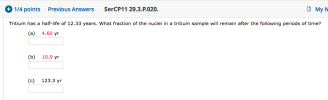 + 1/4 points Previous Answers SerCP11 29.3.P.020. My N Tritium has a half-life of 12.33 years. What fraction of the nuclei in a tritium sample will remain after the following periods of time? (a) 4.60 yr (b) 10.9 yr (c) 123.3 yr
h= half life a0 = original amount a(t) = amount present after t years t =...
 h= half life
a0 = original amount
a(t) = amount present after t years
t = time
What information do you need?
TH 100 - D100 Use equation : acca un Page 4 of 5 4. Suppose we have Xo amount of a certain radioactive substance. It has been observed that this substance losses 5% of its mass every 10 years. @ How much of the initial mass Xo remains after 10 years? What about 20 years? (b) Use the...
h= half life
a0 = original amount
a(t) = amount present after t years
t = time
What information do you need?
TH 100 - D100 Use equation : acca un Page 4 of 5 4. Suppose we have Xo amount of a certain radioactive substance. It has been observed that this substance losses 5% of its mass every 10 years. @ How much of the initial mass Xo remains after 10 years? What about 20 years? (b) Use the...
The half-life of a certain radioactive element is about 1000 years. After 3500 years, what percentage...
 The half-life of a certain radioactive element is about 1000 years. After 3500 years, what percentage P of a sample of this element remains ? About % of the sample remains. (Round to the nearest tenth as needed.)
5.3.131 The half-life of a certain radioactive element is about 1600 years. After 2900 years, what...
 5.3.131 The half-life of a certain radioactive element is about 1600 years. After 2900 years, what percentage P of a sample of this element remains? About % of the sample remains (Round to the nearest tenth as needed.)
 Hydrogen-3 is radioactive and has a half life of 12.3 years. What percentage of a sample would be left after 1.32 years? Round your answer to 2 significant digits.
 6. Current nuclear arsenals use tritium warheads with a half-life of 12.26 years. What percentage of tritium remains after 5.50 years? The sun in our solar system is not large in comparison to other observed stars in the universe. It is consuming its source of hydrogen fuel and is about halfway though its life cycle. What elements does the sun form when it completes its life cycle? Explain why these specific elements are formed.
 studying for my final, help
12) (2 pts) the isotope, tritium, has a half-life of 12.3 years and atomic mass 3.016 amu. Assume we have 10 kg of the substance. What will be the disintegration constant (in s )? a. 5.6 x 10⁻² 5-1 b. 5.6 x 10⁸ s-1 c. 3.2 x 10's-1 d. 1.8 x 10⁻⁹ s-1 e. 1.6 x 10⁶ s-1
studying for my final, help
12) (2 pts) the isotope, tritium, has a half-life of 12.3 years and atomic mass 3.016 amu. Assume we have 10 kg of the substance. What will be the disintegration constant (in s )? a. 5.6 x 10⁻² 5-1 b. 5.6 x 10⁸ s-1 c. 3.2 x 10's-1 d. 1.8 x 10⁻⁹ s-1 e. 1.6 x 10⁶ s-1
 studying for my final, help
13) (2 pts) The isotope, tritium, has a half-life of 12.3 years and atomic mass 3.016 amu. Assume we have 10 kg of the substance. What will be the initial decay rate, at t=0 (in decays/s)? a. 1.09 x 10¹⁴ decays/s b. 1.8 x 10⁻⁹ decays/s c. 5.6 x 10⁸ decays/s d. 3.6 x 10¹⁸ decays/s e. 3.6 x 10¹⁷ decays/s
studying for my final, help
13) (2 pts) The isotope, tritium, has a half-life of 12.3 years and atomic mass 3.016 amu. Assume we have 10 kg of the substance. What will be the initial decay rate, at t=0 (in decays/s)? a. 1.09 x 10¹⁴ decays/s b. 1.8 x 10⁻⁹ decays/s c. 5.6 x 10⁸ decays/s d. 3.6 x 10¹⁸ decays/s e. 3.6 x 10¹⁷ decays/s
 + 1/4 points Previous Answers SerCP11 29.3.P.020. My N Tritium has a half-life of 12.33 years. What fraction of the nuclei in a tritium sample will remain after the following periods of time? (a) 4.60 yr (b) 10.9 yr (c) 123.3 yr
 h= half life
a0 = original amount
a(t) = amount present after t years
t = time
What information do you need?
TH 100 - D100 Use equation : acca un Page 4 of 5 4. Suppose we have Xo amount of a certain radioactive substance. It has been observed that this substance losses 5% of its mass every 10 years. @ How much of the initial mass Xo remains after 10 years? What about 20 years? (b) Use the...
h= half life
a0 = original amount
a(t) = amount present after t years
t = time
What information do you need?
TH 100 - D100 Use equation : acca un Page 4 of 5 4. Suppose we have Xo amount of a certain radioactive substance. It has been observed that this substance losses 5% of its mass every 10 years. @ How much of the initial mass Xo remains after 10 years? What about 20 years? (b) Use the...
 The half-life of a certain radioactive element is about 1000 years. After 3500 years, what percentage P of a sample of this element remains ? About % of the sample remains. (Round to the nearest tenth as needed.)
 5.3.131 The half-life of a certain radioactive element is about 1600 years. After 2900 years, what percentage P of a sample of this element remains? About % of the sample remains (Round to the nearest tenth as needed.)
Most questions answered within 3 hours.
-
Where is the error in this code sequence?
String s1 = "Hello";
String s2 = "ello";...
asked 11 months ago -
Financial data for Joel de Paris, Inc., for last year
follow:
Joel de Paris, Inc.
Balance...
asked 11 months ago -
Consider this reaction:
Al2(SO4)3 (aq)+ BaCl3
(aq) Al2Cl6 (aq)- +
3BaSO4(s) . What is the...
asked 11 months ago -
Suppose that Savneet is considering increasing her
recent random sample from 20 car rentals to 40...
asked 11 months ago -
Trucks arrive at an unloading terminal at an average rate of 120
per hour.
Trucks arrive...
asked 11 months ago -
Why are methanol and ethanol completely soluble in water while
octanol is not very little soluble....
asked 11 months ago -
A facilities manager at a university reads in a research report
that the mean amount of...
asked 11 months ago -
When the CuSO4 is rehydrated by adding water to the anhydrous
compound, is this an endothermic...
asked 11 months ago -
A ray of sunlight is passing from diamond into crown glass; the
angle of incidence is...
asked 11 months ago -
A block of mass 0.249 kg is placed on top of a light, vertical
spring of...
asked 11 months ago -
how do the kidneys compensate in the presences of acidosis
a) trigger hyperventilate
b) reserve acid...
asked 11 months ago -
Question 501 pts
The rental rate of capital to the firm increases. Which of the
following...
asked 11 months ago