How is -89 represented using 8-bit two's compliment? (The answer should be 8 binary digits)
How is -89 represented using 8-bit two's compliment? (The answer should be 8 binary digits)
Homework Answers

Add Answer to:
How is -89 represented using 8-bit two's compliment? (The answer
should be 8 binary digits)
6. Convert .3710 to a binary fraction of 10 binary digits. 7. Use two's compliment arithmetic to perform the following 8 bit binary operations. a. 0010 1110 + 0001 1011 b. 0101 1101 – 0011 1010 c....
6. Convert .3710 to a binary fraction of 10 binary digits. 7. Use two's compliment arithmetic to perform the following 8 bit binary operations. a. 0010 1110 + 0001 1011 b. 0101 1101 – 0011 1010 c. 1011 1000 – 1000 1011 d. 1000 1100 – 1111 0111 8. Convert 150.8476562510 to IEEE Floating Point Standard. 9. Simplify the following Boolean expressions. a. xy + xy + xz b. (w + x)(x + y)(w + x + y + z)...
`1) How is -9 (base 10) represented in 8-bit two's complement notation? a) 00001001 b)11110111 c)11110110...
`1) How is -9 (base 10) represented in 8-bit two's complement notation? a) 00001001 b)11110111 c)11110110 d) 11111001 2) The binary addition of 1 + 1 + 1 + 1 = A) 1111(base 2) b) 0001(base2) C) 0100(base2) D) 1001(base2) 3) How is –1 (base 10) represented in 8-bit two's complement notation? A) 1111111- B) 111111111 C) 00000001 D) 00000010
5. Express (76) 10 and (-114)10 in 8-bit binary two's complement arithmetic and then add the...
 5. Express (76) 10 and (-114)10 in 8-bit binary two's complement arithmetic and then add the numbers. What would be the representation (0)10 in 16-bit binary two's complement? (be sure to show your work). 6. Create two 16-bit 2's complement integer such that their sum causes an overflow. Why does the sum of a negative 2's complement number and a positive 2's complement number never generate an overflow? Discuss.
(5 points) Convert the following decimal numbers to 8-bit two's complement binary numbers and carry out...
 (5 points) Convert the following decimal numbers to 8-bit two's complement binary numbers and carry out the additions in binary. Indicate whether the sum overflows the 8-bit result. If not show the result as a decimal number. a) 39 + (-78) b) -43 + (-92)
Lengthen the two's complement number (both shown in hex) E3 and 3E to 16 bits. (NOTE:...
Lengthen the two's complement number (both shown in hex) E3 and 3E to 16 bits. (NOTE: The values represented in each case should remain the same length after lengthening.) Your 16 bit answer in hex (for E3 in two's complement): Your 16 bit answer in hex (for 3E in two's complement): Shorten (if possible) the two's complement numbers (both shown in hex) E3 and 3E to the minimum number of bits needed. (Note 1: The values represented in each case...
Perform the following binary multiplications using 7-bit signed numbers in two's complement format. Convert them to...
 Perform the following binary multiplications using 7-bit signed numbers in two's complement format. Convert them to decimal, and verify the correct result of the operation.
4.4 Find the range of values that can be represented using a 10-bit binary number. Also,...
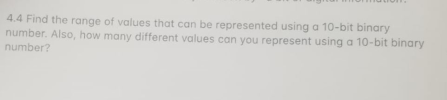 4.4 Find the range of values that can be represented using a 10-bit binary number. Also, how many different values can you represent using a 10-bit binary number?
Complete the subtraction 35 - 86 by using two's complement addition. Both numbers are to be...
Complete the subtraction 35 - 86 by using two's complement addition. Both numbers are to be stored as 8 bit signed binary values. Include all 8 bits of the result of the addition as your answer.
1. a) Perform the following binary subtractions of unsigned binary numbers. Convert your answer to decimal....
 1. a) Perform the following binary subtractions of unsigned binary numbers. Convert your answer to decimal. i) 101001012 - 01001001, ii) 110110102 - 100100112 b) Repeat the calculations above but for when the binary numbers are in two's complement form. Comment on the results of the two methods used, noting and discrepancies. 2. Find the sums of the following unsigned hexadecimal numbers. Indicate whether or not the sum overflows an equivalent 8-bit binary result. a) 1116 +2216 b) 1716 +3516...
(b) Convert -41 (written in decimal representation) into its signed integer 8-bit representation using the two's...
 (b) Convert -41 (written in decimal representation) into its signed integer 8-bit representation using the two's complement method. That is find the two's complement of -41, when the number of overall bits used are 8.
 5. Express (76) 10 and (-114)10 in 8-bit binary two's complement arithmetic and then add the numbers. What would be the representation (0)10 in 16-bit binary two's complement? (be sure to show your work). 6. Create two 16-bit 2's complement integer such that their sum causes an overflow. Why does the sum of a negative 2's complement number and a positive 2's complement number never generate an overflow? Discuss.
 (5 points) Convert the following decimal numbers to 8-bit two's complement binary numbers and carry out the additions in binary. Indicate whether the sum overflows the 8-bit result. If not show the result as a decimal number. a) 39 + (-78) b) -43 + (-92)
 Perform the following binary multiplications using 7-bit signed numbers in two's complement format. Convert them to decimal, and verify the correct result of the operation.
 4.4 Find the range of values that can be represented using a 10-bit binary number. Also, how many different values can you represent using a 10-bit binary number?
 1. a) Perform the following binary subtractions of unsigned binary numbers. Convert your answer to decimal. i) 101001012 - 01001001, ii) 110110102 - 100100112 b) Repeat the calculations above but for when the binary numbers are in two's complement form. Comment on the results of the two methods used, noting and discrepancies. 2. Find the sums of the following unsigned hexadecimal numbers. Indicate whether or not the sum overflows an equivalent 8-bit binary result. a) 1116 +2216 b) 1716 +3516...
 (b) Convert -41 (written in decimal representation) into its signed integer 8-bit representation using the two's complement method. That is find the two's complement of -41, when the number of overall bits used are 8.
Most questions answered within 3 hours.
-
Where is the error in this code sequence?
String s1 = "Hello";
String s2 = "ello";...
asked 10 months ago -
Financial data for Joel de Paris, Inc., for last year
follow:
Joel de Paris, Inc.
Balance...
asked 10 months ago -
Consider this reaction:
Al2(SO4)3 (aq)+ BaCl3
(aq) Al2Cl6 (aq)- +
3BaSO4(s) . What is the...
asked 10 months ago -
Suppose that Savneet is considering increasing her
recent random sample from 20 car rentals to 40...
asked 10 months ago -
Trucks arrive at an unloading terminal at an average rate of 120
per hour.
Trucks arrive...
asked 10 months ago -
Why are methanol and ethanol completely soluble in water while
octanol is not very little soluble....
asked 10 months ago -
A facilities manager at a university reads in a research report
that the mean amount of...
asked 10 months ago -
When the CuSO4 is rehydrated by adding water to the anhydrous
compound, is this an endothermic...
asked 10 months ago -
A ray of sunlight is passing from diamond into crown glass; the
angle of incidence is...
asked 10 months ago -
A block of mass 0.249 kg is placed on top of a light, vertical
spring of...
asked 10 months ago -
how do the kidneys compensate in the presences of acidosis
a) trigger hyperventilate
b) reserve acid...
asked 10 months ago -
Question 501 pts
The rental rate of capital to the firm increases. Which of the
following...
asked 10 months ago