According to the neoclassical theory of distribution, a worker’s real wage reflects their productivity. Let’s use...
According to the neoclassical theory of distribution, a worker’s real wage reflects their productivity. Let’s use this insight to examine the incomes of two groups: teachers and doctors. Let Wt and Wd be the nominal wages of teachers and doctors, Pt and Pd be the price of education and doctor visits, and MPt and MPd be the marginal productivity of teachers and doctors.
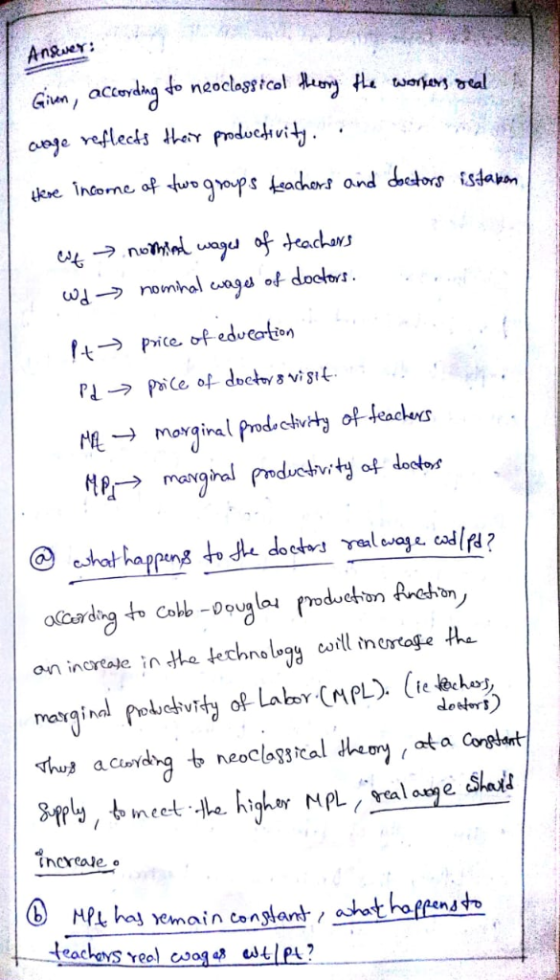
a. Over the past century, the productivity of doctors has risen substantially because of technological progress. According to neoclassical theory, what should happen to the doctors’ real wage, Wd/Pd ?
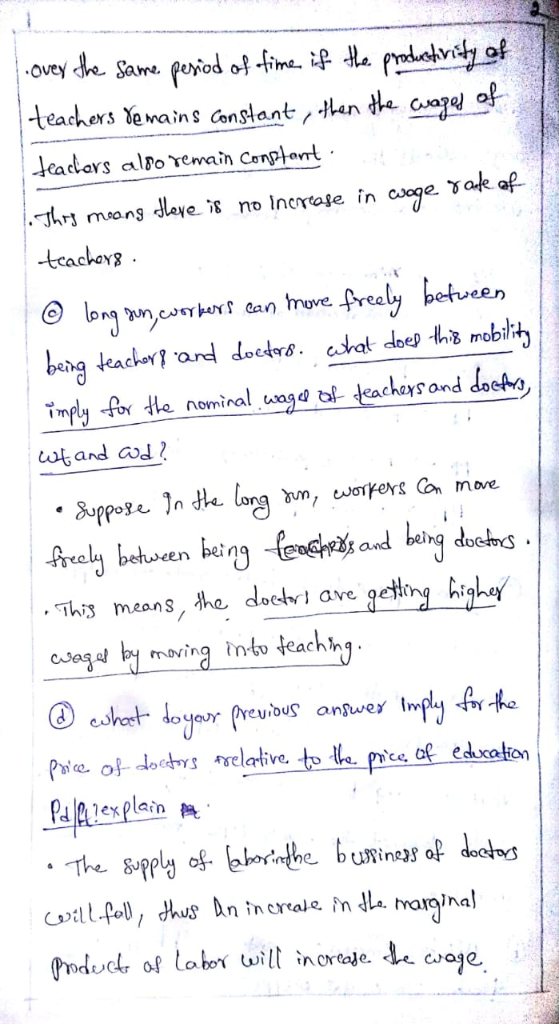
b. Over the same period, the productivity of teachers MPt has remained constant. What should happen to teachers’ real wages, Wt/Pt ?
c. Suppose in the long run, workers can move freely between being teachers and doctors. What does this mobility imply for the nominal wages of teachers and doctors, Wt and Wd?
d. What do your previous answers imply for the price of doctors relative to the price of education Pd ? Explain.
Pt
Homework Answers
Summary:
Given the details of income of two groups teachers and doctors.
based on this details the questions given are answered as below.

Add Answer to:
According to the neoclassical theory
of distribution, a worker’s real wage reflects their productivity.
Let’s use...
According to the neoclassical theory of distribution, in an economy described by a Cobb Douglas production...
According to the neoclassical theory of distribution, in an economy described by a Cobb Douglas production function, workers should experience high rates of real wage growth when a. marginal labor productivity is growing rapidly b. the capital stock is growing slowly c. the labor force is growing rapidly. d. labor productivity is growing slowly
According to human capital theory, a doctor is paid more than a elementary school teacher because...
 According to human capital theory, a doctor is paid more than a elementary school teacher because a) the doctor's services are more socially useful than those of the educator. b) the opportunity cost of receiving training as a doctor is higher. c) in a capitalist economy, doctors are treated as inputs, not valued as real human beings. d) the opportunity cost of leisure is higher for teachers. The theory that paying higher wages can raise productivity is known as a)...
 According to human capital theory, a doctor is paid more than a elementary school teacher because a) the doctor's services are more socially useful than those of the educator. b) the opportunity cost of receiving training as a doctor is higher. c) in a capitalist economy, doctors are treated as inputs, not valued as real human beings. d) the opportunity cost of leisure is higher for teachers. The theory that paying higher wages can raise productivity is known as a)...
Most questions answered within 3 hours.
-
Where is the error in this code sequence?
String s1 = "Hello";
String s2 = "ello";...
asked 10 months ago -
Financial data for Joel de Paris, Inc., for last year
follow:
Joel de Paris, Inc.
Balance...
asked 10 months ago -
Consider this reaction:
Al2(SO4)3 (aq)+ BaCl3
(aq) Al2Cl6 (aq)- +
3BaSO4(s) . What is the...
asked 10 months ago -
Suppose that Savneet is considering increasing her
recent random sample from 20 car rentals to 40...
asked 10 months ago -
Trucks arrive at an unloading terminal at an average rate of 120
per hour.
Trucks arrive...
asked 10 months ago -
Why are methanol and ethanol completely soluble in water while
octanol is not very little soluble....
asked 10 months ago -
A facilities manager at a university reads in a research report
that the mean amount of...
asked 10 months ago -
When the CuSO4 is rehydrated by adding water to the anhydrous
compound, is this an endothermic...
asked 10 months ago -
A ray of sunlight is passing from diamond into crown glass; the
angle of incidence is...
asked 10 months ago -
A block of mass 0.249 kg is placed on top of a light, vertical
spring of...
asked 10 months ago -
how do the kidneys compensate in the presences of acidosis
a) trigger hyperventilate
b) reserve acid...
asked 10 months ago -
Question 501 pts
The rental rate of capital to the firm increases. Which of the
following...
asked 10 months ago