How can you design a voltmeter to prevent load errors when measuring the voltage output from...
How can you design a voltmeter to prevent load errors when measuring the voltage output from a transducer?
Homework Answers

Add Answer to:
How can you design a voltmeter to prevent load errors when
measuring the voltage output from...
MEASUREMENT Reading a measurement from an analog Instrument What is the voltage this voltmeter is measuring?...
 MEASUREMENT Reading a measurement from an analog Instrument What is the voltage this voltmeter is measuring? Be sure your answer has a reasonable number of decimal places normal magnify 010 0.2 You can click on the other tab to see a magnified view. * ? Explanation Check 2020 McGraw H o cation. All Rights Reserved Term UITHUAT MEASUREMENT Reading a measurement from an analog instrument What is the voltage this voltmeter is measuring? Be sure your answer has a reasonable...
Create a multisim design creating an output voltage of 9v. Output voltage when performed on experimental...
Create a multisim design creating an output voltage of 9v. Output voltage when performed on experimental circuit should release the same value of 9v as an output voltage. Use Materials: Switch Transformer 220:12 V Diodes for rectifier (1N4007) Capacitors- 1000uF, 100uF, 0.1uF Zener Diode- 12V Resistors(you will assign what resistor is need to have an ooutput of 9v) Voltmeter Plug PCB (Printed Circuit Board) Using these matetials create and output voltage of 9v in multisim that is the same value...
In this experiment you will be measuring the resistance of several resistors by measuring the voltage...
In this experiment you will be measuring the resistance of several resistors by measuring the voltage across the resistor and the current through the resistor at the same. When carrying out measurements like this, you always have to be careful that your measuring doesn’t effect the experiment too much, or that if it does, you can correct for it. Current actually passes through both the ammeter and the voltmeter. Each device also has an intrinsic resistance. You may want to...
Buck Converter Design Design a buck converter to produce an output voltage of 18 V across a 10-Ω load resistor. The output voltage ripple must not exceed 0.5 percent. The de supply is 48 V. Design fo...
 Buck Converter Design Design a buck converter to produce an output voltage of 18 V across a 10-Ω load resistor. The output voltage ripple must not exceed 0.5 percent. The de supply is 48 V. Design for continuous inductor current. a. What is the limitation on the load resistance for continuous-current operation? b. What would be the range of output voltage for a load resistance range of 5 to 20 ohm? c. Redesign the converter so inductor current remains continuous...
Design a buck converter to produce an output voltage of 18 V across a 10-Ω load resistor.
Buck Converter Design Design a buck converter to produce an output voltage of 18 V across a 10-Ω load resistor. The output voltage ripple must not exceed 0.5 percent. The de supply is 48 V. Design for continuous inductor current. a. What is the limitation on the load resistance for continuous-current operation? b. What would be the range of output voltage for a load resistance range of 5 to 20 ohm? c. Redesign the converter so inductor current remains continuous for a load resistance...
Which of the following are errors that can occur when measuring the pH with a glass...
 Which of the following are errors that can occur when measuring
the pH with a glass combination electrode?
Which of the following are errors that can occur when measuring the pH with a glass combination electrode? small selectivity for H^+ over other ions uncertainty in the pH of the standard buffer solutions sodium error at high pH junction potential the variable potential of the internal Ag|AgCl reference electrode
Which of the following are errors that can occur when measuring
the pH with a glass combination electrode?
Which of the following are errors that can occur when measuring the pH with a glass combination electrode? small selectivity for H^+ over other ions uncertainty in the pH of the standard buffer solutions sodium error at high pH junction potential the variable potential of the internal Ag|AgCl reference electrode
Design a flyback converter for an input of 24 volts and an output of 40 volts. Assume a 40W load and keep the blocking voltage for the transistor to < 26 volts, For your design determine: a) The t...
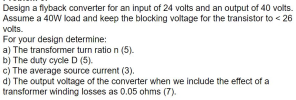 Design a flyback converter for an input of 24 volts and an output of 40 volts. Assume a 40W load and keep the blocking voltage for the transistor to < 26 volts, For your design determine: a) The transformer turn ratio n (5) b) The duty cycle D (5). c) The average source current (3). d) The output voltage of the converter when we include the effect of a transformer winding losses as 0.05 ohms (7)
Design a flyback converter...
Design a flyback converter for an input of 24 volts and an output of 40 volts. Assume a 40W load and keep the blocking voltage for the transistor to < 26 volts, For your design determine: a) The transformer turn ratio n (5) b) The duty cycle D (5). c) The average source current (3). d) The output voltage of the converter when we include the effect of a transformer winding losses as 0.05 ohms (7)
Design a flyback converter...
Design a flyback converter for an input of 24 volts and an output of 40 volts. Assume a 40W load and keep the blocking voltage for the transistor to < 26 volts. For your design determine: a) The tr...
 Design a flyback converter for an input of 24 volts and an
output of 40 volts. Assume a 40W load and keep the blocking voltage
for the transistor to < 26 volts.
For your design determine:
a) The transformer turn ratio n (5).
b) The duty cycle D (5).
c) The average source current (3).
d) The output voltage of the converter when we include the
effect of a transformer winding losses as 0.05 ohms (7).
Using a MOSFET and...
Design a flyback converter for an input of 24 volts and an
output of 40 volts. Assume a 40W load and keep the blocking voltage
for the transistor to < 26 volts.
For your design determine:
a) The transformer turn ratio n (5).
b) The duty cycle D (5).
c) The average source current (3).
d) The output voltage of the converter when we include the
effect of a transformer winding losses as 0.05 ohms (7).
Using a MOSFET and...
Batteries are not perfect. They can't deliver infinite current. As the current load on a battery...
 Batteries are not perfect. They can't deliver infinite current. As the current load on a battery gets larger, the voltage output gets smaller. We can represent this by treating batteries as if they have some small internal resistance. The circuit below shows a battery hooked up to a resistor, a voltmeter (for measuring voltages), and an ammeter (for measuring currents). When you put a measuring device on something, like a circuit, you don't want to change the circuit. So this...
Question 1: multimeter sampling when measuring voltage from a function generator A. How often do you...
Question 1: multimeter sampling when measuring voltage from a function generator A. How often do you think the meter samples? B. What do you thinking the steps are for the meter to take a sample, convert it into numerical measurement and display it on the screen?
 MEASUREMENT Reading a measurement from an analog Instrument What is the voltage this voltmeter is measuring? Be sure your answer has a reasonable number of decimal places normal magnify 010 0.2 You can click on the other tab to see a magnified view. * ? Explanation Check 2020 McGraw H o cation. All Rights Reserved Term UITHUAT MEASUREMENT Reading a measurement from an analog instrument What is the voltage this voltmeter is measuring? Be sure your answer has a reasonable...
 Buck Converter Design Design a buck converter to produce an output voltage of 18 V across a 10-Ω load resistor. The output voltage ripple must not exceed 0.5 percent. The de supply is 48 V. Design for continuous inductor current. a. What is the limitation on the load resistance for continuous-current operation? b. What would be the range of output voltage for a load resistance range of 5 to 20 ohm? c. Redesign the converter so inductor current remains continuous...
 Which of the following are errors that can occur when measuring
the pH with a glass combination electrode?
Which of the following are errors that can occur when measuring the pH with a glass combination electrode? small selectivity for H^+ over other ions uncertainty in the pH of the standard buffer solutions sodium error at high pH junction potential the variable potential of the internal Ag|AgCl reference electrode
Which of the following are errors that can occur when measuring
the pH with a glass combination electrode?
Which of the following are errors that can occur when measuring the pH with a glass combination electrode? small selectivity for H^+ over other ions uncertainty in the pH of the standard buffer solutions sodium error at high pH junction potential the variable potential of the internal Ag|AgCl reference electrode
 Design a flyback converter for an input of 24 volts and an output of 40 volts. Assume a 40W load and keep the blocking voltage for the transistor to < 26 volts, For your design determine: a) The transformer turn ratio n (5) b) The duty cycle D (5). c) The average source current (3). d) The output voltage of the converter when we include the effect of a transformer winding losses as 0.05 ohms (7)
Design a flyback converter...
Design a flyback converter for an input of 24 volts and an output of 40 volts. Assume a 40W load and keep the blocking voltage for the transistor to < 26 volts, For your design determine: a) The transformer turn ratio n (5) b) The duty cycle D (5). c) The average source current (3). d) The output voltage of the converter when we include the effect of a transformer winding losses as 0.05 ohms (7)
Design a flyback converter...
 Design a flyback converter for an input of 24 volts and an
output of 40 volts. Assume a 40W load and keep the blocking voltage
for the transistor to < 26 volts.
For your design determine:
a) The transformer turn ratio n (5).
b) The duty cycle D (5).
c) The average source current (3).
d) The output voltage of the converter when we include the
effect of a transformer winding losses as 0.05 ohms (7).
Using a MOSFET and...
Design a flyback converter for an input of 24 volts and an
output of 40 volts. Assume a 40W load and keep the blocking voltage
for the transistor to < 26 volts.
For your design determine:
a) The transformer turn ratio n (5).
b) The duty cycle D (5).
c) The average source current (3).
d) The output voltage of the converter when we include the
effect of a transformer winding losses as 0.05 ohms (7).
Using a MOSFET and...
 Batteries are not perfect. They can't deliver infinite current. As the current load on a battery gets larger, the voltage output gets smaller. We can represent this by treating batteries as if they have some small internal resistance. The circuit below shows a battery hooked up to a resistor, a voltmeter (for measuring voltages), and an ammeter (for measuring currents). When you put a measuring device on something, like a circuit, you don't want to change the circuit. So this...
Most questions answered within 3 hours.
-
Where is the error in this code sequence?
String s1 = "Hello";
String s2 = "ello";...
asked 10 months ago -
Financial data for Joel de Paris, Inc., for last year
follow:
Joel de Paris, Inc.
Balance...
asked 10 months ago -
Consider this reaction:
Al2(SO4)3 (aq)+ BaCl3
(aq) Al2Cl6 (aq)- +
3BaSO4(s) . What is the...
asked 10 months ago -
Suppose that Savneet is considering increasing her
recent random sample from 20 car rentals to 40...
asked 10 months ago -
Trucks arrive at an unloading terminal at an average rate of 120
per hour.
Trucks arrive...
asked 10 months ago -
Why are methanol and ethanol completely soluble in water while
octanol is not very little soluble....
asked 10 months ago -
A facilities manager at a university reads in a research report
that the mean amount of...
asked 10 months ago -
When the CuSO4 is rehydrated by adding water to the anhydrous
compound, is this an endothermic...
asked 10 months ago -
A ray of sunlight is passing from diamond into crown glass; the
angle of incidence is...
asked 10 months ago -
A block of mass 0.249 kg is placed on top of a light, vertical
spring of...
asked 10 months ago -
how do the kidneys compensate in the presences of acidosis
a) trigger hyperventilate
b) reserve acid...
asked 10 months ago -
Question 501 pts
The rental rate of capital to the firm increases. Which of the
following...
asked 10 months ago