Many ski resorts base their projection of revenues and profits on the assumption that the average...
Many ski resorts base their projection of revenues and profits on the assumption that the average skier skis 4 times per year. A random sample of 63 skiers is drawn and each skier is asked to indicate the number of times he or she skied the previous year. The dataset Qn9.1 contains the responses for each skier. Assume that the population standard deviation is 2. [ Hint: Use an appropriate Excel template from chapter 9 or formulas] a. Formulate the null and alternative hypothesis that can be used to test the assumption made by ski resorts. b. Compute the value of the test statistic c. What is the p-value? d. At α = .05, what is the critical value? e. At α = .05, what is your conclusion? Ski Days 4 6 5 5 6 2 6 5 1 9 7 5 2 6 5 7 1 6 6 5 6 3 5 5 4 4 5 6 0 4 1 5 6 4 7 6 3 5 6 8 6 6 1 5 4 6 8 1 5 5 5 3 6 4 7 2 10 3 6 6 2 4 8
Homework Answers
Ans:
a)


b)
n=63
Sample mean=4.841
Test statistic:
z=(4.841-4)/(2/SQRT(63))
z=3.34
c)
p-value(2 tailed)=2*P(z>3.34)=0.0008
d)critical z value=+/-1.96
e)
As,p-value<0.04,we reject the null hypothesis.
There is sufficient evidence to reject the claim that the average skier skis 4 times per year.
Add Answer to:
Many ski resorts base their projection of revenues and profits
on the assumption that the average...
Many Alpine ski centers base their projections of revenues and profits on the assumption that the average Alpine skier...
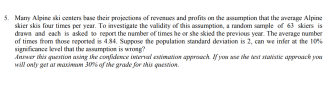 Many Alpine ski centers base their projections of revenues and profits on the assumption that the average Alpine skier skis four times per year. To investigate the validity of this assumption, a random sample of 63 skiers is drawn and each is asked to report the number of times he or she skied the previous year. The average number of times from those reported is 4.84. Suppose the population standard deviation is 2, can we infer at the 10% significance...
Many Alpine ski centers base their calculations of revenues and profits on the belief that the...
Many Alpine ski centers base their calculations of revenues and profits on the belief that the average skier ski’s four times a year with a population standard deviation of 2. To investigate this belief a random sample of 63 skiers was drawn and each participant was asked to report the number of times they skied last year. This yielded a mean of 4.84. Can we infer at the 10% significance level that the assumption of ski centers is wrong?
Many amusement parks base their projections of revenues and profits on the assumption that the average...
Many amusement parks base their projections of revenues and profits on the assumption that the average young adult visits an amusement park four times per year. To investigate the validity of this assumption, a random sample of 63 young adults is drawn and each is asked to report the number of times they skied the previous year. The sample yields an average of 4.841 and a sample standard deviation of 2, can we infer that the assumption is wrong with...
! Required information [The following information applies to the questions displayed below.] Vail Resorts, Inc., owns...
 ! Required information [The following information applies to the questions displayed below.] Vail Resorts, Inc., owns and operates 11 premier year-round ski resort properties (located in the Colorado Rocky Mountains, the Lake Tahoe area, the upper midwest, Vermont, and Australia). The company also owns a collection of luxury hotels, resorts, and lodging properties. The company sells lift tickets, ski lessons, and ski equipment. The following hypothetical December transactions are typical of those that occur at the resorts. a. Borrowed $2,700,000...
The following information applies to the questions displayed below.] Vail Resorts, Inc., owns and operates 11...
 The following information applies to the questions displayed below.] Vail Resorts, Inc., owns and operates 11 premier year-round ski resort properties (located in the Colorado Rocky Mountains, the Lake Tahoe area, the upper midwest, Vermont, and Australia). The company also owns a collection of luxury hotels. resorts, and lodging properties. The company sells lift tickets, ski lessons, and ski equipment. The following hypothetical December transactions are typical of those that occur at the resorts. 11:55 a. Borrowed $2,900,000 from the...
Required information [The following information applies to the questions displayed below.] Vail Resorts, Inc., owns and...
 Required information [The following information applies to the questions displayed below.] Vail Resorts, Inc., owns and operates 11 premier year-round ski resort properties (located in the Colorado Rocky Mountains, the Lake Tahoe area, the upper midwest, Vermont, and Australia). The company also owns a collection of luxury hotels, resorts, and lodging properties. The company sells lift tickets, ski lessons, and ski equipment. The following hypothetical December transactions are typical of those that occur at the resorts. a. Borrowed $4,200,000 from...
21.) A ski insurance company was conducting research and was interested in the pulse rate of...
21.) A ski insurance company was conducting research and was interested in the pulse rate of skiers. One scientist from the company wanted to know if skiing would lead to a reduction in an individual's pulse rate. In order to test this hypothesis, the scientist found 8 non-skiers who agreed to being a one month long all paid for skiing program. At the end of the month their pulse rates were determined and compared using earlier values throughout the tests...
What is the calculated F-value for this dataset? What is the critical F-value for this problem...
 What is the
calculated F-value for this dataset?
What is the
critical F-value for this problem (assuming an α-level
of 0.05?
1 7 1 7 4 2. 8 5 3 5 8 6 3 3 9 6 5 9 6 LO
What is the
calculated F-value for this dataset?
What is the
critical F-value for this problem (assuming an α-level
of 0.05?
1 7 1 7 4 2. 8 5 3 5 8 6 3 3 9 6 5 9 6 LO
Question 3 The Glory Mountain State Ski Area The Glory Mountain State Ski Area – owned...
Question 3 The Glory Mountain State Ski Area The Glory Mountain State Ski Area – owned and managed by a state public authority - expects to attract 292,500 skier days during the coming ski season. A skier day represents one skier at the mountain for one day. In addition to a $2,000,000 per year subsidy provided by the state, Glory currently earns its revenue from three sources: lift ticket sales, ski lessons, and food sales in the mountain’s lodges. Forty-five...
Mountain Ski Sports, a chain of ski-equipment shops in Colorado, purchases skis from a manufacturer each...
 Mountain Ski Sports, a chain of ski-equipment shops in Colorado, purchases skis from a manufacturer each summer for the coming winter season. The most popular intermediate model costs $150 and sells for $275. Any skis left over at the end of the winter are sold at the store's spring sale (for $100). Sales over the years are quite stable. Gathering data from all its stores, Mountain Ski Sports developed the following probability distribution for demand: Demand Probability 150 0.05 175...
 Many Alpine ski centers base their projections of revenues and profits on the assumption that the average Alpine skier skis four times per year. To investigate the validity of this assumption, a random sample of 63 skiers is drawn and each is asked to report the number of times he or she skied the previous year. The average number of times from those reported is 4.84. Suppose the population standard deviation is 2, can we infer at the 10% significance...
 ! Required information [The following information applies to the questions displayed below.] Vail Resorts, Inc., owns and operates 11 premier year-round ski resort properties (located in the Colorado Rocky Mountains, the Lake Tahoe area, the upper midwest, Vermont, and Australia). The company also owns a collection of luxury hotels, resorts, and lodging properties. The company sells lift tickets, ski lessons, and ski equipment. The following hypothetical December transactions are typical of those that occur at the resorts. a. Borrowed $2,700,000...
 The following information applies to the questions displayed below.] Vail Resorts, Inc., owns and operates 11 premier year-round ski resort properties (located in the Colorado Rocky Mountains, the Lake Tahoe area, the upper midwest, Vermont, and Australia). The company also owns a collection of luxury hotels. resorts, and lodging properties. The company sells lift tickets, ski lessons, and ski equipment. The following hypothetical December transactions are typical of those that occur at the resorts. 11:55 a. Borrowed $2,900,000 from the...
 Required information [The following information applies to the questions displayed below.] Vail Resorts, Inc., owns and operates 11 premier year-round ski resort properties (located in the Colorado Rocky Mountains, the Lake Tahoe area, the upper midwest, Vermont, and Australia). The company also owns a collection of luxury hotels, resorts, and lodging properties. The company sells lift tickets, ski lessons, and ski equipment. The following hypothetical December transactions are typical of those that occur at the resorts. a. Borrowed $4,200,000 from...
 What is the
calculated F-value for this dataset?
What is the
critical F-value for this problem (assuming an α-level
of 0.05?
1 7 1 7 4 2. 8 5 3 5 8 6 3 3 9 6 5 9 6 LO
What is the
calculated F-value for this dataset?
What is the
critical F-value for this problem (assuming an α-level
of 0.05?
1 7 1 7 4 2. 8 5 3 5 8 6 3 3 9 6 5 9 6 LO
 Mountain Ski Sports, a chain of ski-equipment shops in Colorado, purchases skis from a manufacturer each summer for the coming winter season. The most popular intermediate model costs $150 and sells for $275. Any skis left over at the end of the winter are sold at the store's spring sale (for $100). Sales over the years are quite stable. Gathering data from all its stores, Mountain Ski Sports developed the following probability distribution for demand: Demand Probability 150 0.05 175...
Most questions answered within 3 hours.
-
Where is the error in this code sequence?
String s1 = "Hello";
String s2 = "ello";...
asked 10 months ago -
Financial data for Joel de Paris, Inc., for last year
follow:
Joel de Paris, Inc.
Balance...
asked 10 months ago -
Consider this reaction:
Al2(SO4)3 (aq)+ BaCl3
(aq) Al2Cl6 (aq)- +
3BaSO4(s) . What is the...
asked 10 months ago -
Suppose that Savneet is considering increasing her
recent random sample from 20 car rentals to 40...
asked 10 months ago -
Trucks arrive at an unloading terminal at an average rate of 120
per hour.
Trucks arrive...
asked 10 months ago -
Why are methanol and ethanol completely soluble in water while
octanol is not very little soluble....
asked 10 months ago -
A facilities manager at a university reads in a research report
that the mean amount of...
asked 10 months ago -
When the CuSO4 is rehydrated by adding water to the anhydrous
compound, is this an endothermic...
asked 10 months ago -
A ray of sunlight is passing from diamond into crown glass; the
angle of incidence is...
asked 10 months ago -
A block of mass 0.249 kg is placed on top of a light, vertical
spring of...
asked 10 months ago -
how do the kidneys compensate in the presences of acidosis
a) trigger hyperventilate
b) reserve acid...
asked 10 months ago -
Question 501 pts
The rental rate of capital to the firm increases. Which of the
following...
asked 10 months ago