Energy, in the form of some type of light, applied to a sample can interact with...
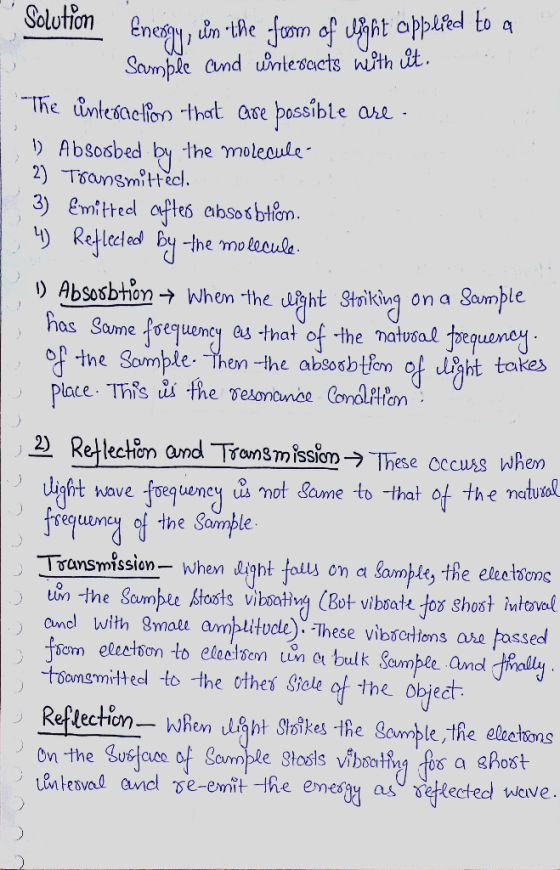
Energy, in the form of some type of light, applied to a sample can interact with the sample. Which interactions are possible?
A. Absorbed by the molecule
B. Transmitted (passes through, is not absorbed)
C. Emitted by the molecule after absorbtion
D. Reflected by the molecule
Choices are:
A and C
A and D
C and D
A, B, C, and D
Homework Answers
All four mentioned interactions are possible when light falls on the sample.

Add Answer to:
Energy, in the form of some type of light, applied to a sample
can interact with...
1/ Radiant energy travels in the form of _____. a. visible light b. unstable radioactive materials...
1/ Radiant energy travels in the form of _____. a. visible light b. unstable radioactive materials c. a medium, such as air, before being absorbed by solid objects and re-emitted d. waves that release energy when they are absorbed by an object 2/ Temperature is a measure _____. a. associated with the direction of atoms and molecules b. of heat contained in a given substance c. of the average speed of the atoms and molecules d. associated with the thermal...
Please Help. Last attempt left Absorbance can also be defined in terms of incident light (lo)...
 Please Help. Last attempt left
Absorbance can also be defined in terms of incident light (lo) and transmitted light (1) Incident light (lo) is the amount of light that comes out of the light source that strikes the sample. The light that passes through the sample without getting absorbed is called the transmitted light (1). A= log (lo/l) if the 99% of the light is getting absorbed by the sample (1 = 196), find the absorbance of this sample: Hint:...
Please Help. Last attempt left
Absorbance can also be defined in terms of incident light (lo) and transmitted light (1) Incident light (lo) is the amount of light that comes out of the light source that strikes the sample. The light that passes through the sample without getting absorbed is called the transmitted light (1). A= log (lo/l) if the 99% of the light is getting absorbed by the sample (1 = 196), find the absorbance of this sample: Hint:...
Sunlight hits the solar cell below and three things happen: some light is reflected by the...
 Sunlight hits the solar cell below and three things happen: some light is reflected by the solar cell; some light is converted to electrical energy; and the air around the solar cell heats up a bit. The energy flow diagram for the system that includes the sun and a photovoltaic (or solar) cell is shown below on the right A. Which form(s) of energy belong to the system? Note that Elight represents the light reflected by the solar cell. (Select...
1.. Suppose that you shine light of energy 1050 kJ/mol on an H atom in the...
1.. Suppose that you shine light of energy 1050 kJ/mol on an H atom in the ground state. What happens to the light and to the electron? Group of answer choices a. The light is not absorbed and the final energy of the electron is -1312 kJ/mol. b.. The light is absorbed and the final energy of the electron is −328 kJ/mol. c.. The light is not absorbed and the final energy of the electron is −1050 kJ/mol. d.. The...
4. Light passing through a liquid-filled test tube can be scattered, absorbed, or transmitted. a. Define...
 4. Light passing through a liquid-filled test tube can be scattered, absorbed, or transmitted. a. Define scattering, absorption, and transmission as they refer to light interacting with matter (the physics definition in some dictionaries). b. Which interaction(s) above will reduce the amount of light that reaches a detector?
A 0.5 m thick sample of um thick sample of In is illuminated with monochromatic light...
 A 0.5 m thick sample of um thick sample of In is illuminated with monochromatic light of hv=1.5 eV. The absorption coefficient 104 cm 1. The power incident on the sample is 15 mW. (a) Find the total energy absorbed by the sample per second (J/sec). (b) Find the rate of excess thermal energy given up by the electrons to the lattice before recombination (J/sec). (c) Find the number of photons per second given off from recombination events, assuming perfect...
With some manipulation, the Rydberg equation can be rewritten in the form E=constant×(1nf2−1ni2) which allows you...
With some manipulation, the Rydberg equation can be rewritten in the form E=constant×(1nf2−1ni2) which allows you to calculate the energy of the emitted light. Express this constant in terms of the constants h, c, and RH using relationships between wavelength and energy as well as the Rydberg equation from the introduction. Express the constant in terms of h and c, and RH.
Absorption and transmission: When a photon of light hits a molecule of gas or a particle...
 Absorption and transmission: When a photon of light hits a molecule of gas or a particle in the atmosphere, there are three possibilities: 1) it can be absorbed (the energy is converted to heat), 2) it can be reflected (it continues on but in a different direction), 3) or it can be transmitted. These processes determine our ability to see distant objects (such as the mountains around Los Angeles and Irvine) and the colors in the sky (such as blue...
Some plants develop flowers that are pollinated by fles.Such flowers are simple red flowers, have little...
 Some plants develop flowers that are pollinated by fles.Such flowers are simple red flowers, have little odor, and provide easy access to nectar (sugar) that t attracts flies. The flies recognize the flowers by their red color and the sugar by sensors in their feet. They draw up the liquid nectar using special sucking mouthp pollen from one plant to another arts. While for aging for the nectar, the their flies transfer 37.The production of nectar by the fowers and...
1.. Use the energy level diagram for He+ to predict the energy required to move an...
1.. Use the energy level diagram for He+ to predict the energy required to move an electron from n=1 to n=2. Group of answer choices a. 3936 kJ/mol b. 1312 kJ/mol c. 5248 kJ/mol 2.. Use the energy diagram above the for the He+ ion to decide which energies can be absorbed by He+? (Recall what happens if the energy of a photon overcomes the binding energy!) Group of answer choices a. 5500 kJ/mol b. 5500 kJ/mol and 5248 kJ/mol...
 Please Help. Last attempt left
Absorbance can also be defined in terms of incident light (lo) and transmitted light (1) Incident light (lo) is the amount of light that comes out of the light source that strikes the sample. The light that passes through the sample without getting absorbed is called the transmitted light (1). A= log (lo/l) if the 99% of the light is getting absorbed by the sample (1 = 196), find the absorbance of this sample: Hint:...
Please Help. Last attempt left
Absorbance can also be defined in terms of incident light (lo) and transmitted light (1) Incident light (lo) is the amount of light that comes out of the light source that strikes the sample. The light that passes through the sample without getting absorbed is called the transmitted light (1). A= log (lo/l) if the 99% of the light is getting absorbed by the sample (1 = 196), find the absorbance of this sample: Hint:...
 Sunlight hits the solar cell below and three things happen: some light is reflected by the solar cell; some light is converted to electrical energy; and the air around the solar cell heats up a bit. The energy flow diagram for the system that includes the sun and a photovoltaic (or solar) cell is shown below on the right A. Which form(s) of energy belong to the system? Note that Elight represents the light reflected by the solar cell. (Select...
 4. Light passing through a liquid-filled test tube can be scattered, absorbed, or transmitted. a. Define scattering, absorption, and transmission as they refer to light interacting with matter (the physics definition in some dictionaries). b. Which interaction(s) above will reduce the amount of light that reaches a detector?
 A 0.5 m thick sample of um thick sample of In is illuminated with monochromatic light of hv=1.5 eV. The absorption coefficient 104 cm 1. The power incident on the sample is 15 mW. (a) Find the total energy absorbed by the sample per second (J/sec). (b) Find the rate of excess thermal energy given up by the electrons to the lattice before recombination (J/sec). (c) Find the number of photons per second given off from recombination events, assuming perfect...
 Absorption and transmission: When a photon of light hits a molecule of gas or a particle in the atmosphere, there are three possibilities: 1) it can be absorbed (the energy is converted to heat), 2) it can be reflected (it continues on but in a different direction), 3) or it can be transmitted. These processes determine our ability to see distant objects (such as the mountains around Los Angeles and Irvine) and the colors in the sky (such as blue...
 Some plants develop flowers that are pollinated by fles.Such flowers are simple red flowers, have little odor, and provide easy access to nectar (sugar) that t attracts flies. The flies recognize the flowers by their red color and the sugar by sensors in their feet. They draw up the liquid nectar using special sucking mouthp pollen from one plant to another arts. While for aging for the nectar, the their flies transfer 37.The production of nectar by the fowers and...
Most questions answered within 3 hours.
-
Where is the error in this code sequence?
String s1 = "Hello";
String s2 = "ello";...
asked 11 months ago -
Financial data for Joel de Paris, Inc., for last year
follow:
Joel de Paris, Inc.
Balance...
asked 11 months ago -
Consider this reaction:
Al2(SO4)3 (aq)+ BaCl3
(aq) Al2Cl6 (aq)- +
3BaSO4(s) . What is the...
asked 11 months ago -
Suppose that Savneet is considering increasing her
recent random sample from 20 car rentals to 40...
asked 11 months ago -
Trucks arrive at an unloading terminal at an average rate of 120
per hour.
Trucks arrive...
asked 11 months ago -
Why are methanol and ethanol completely soluble in water while
octanol is not very little soluble....
asked 11 months ago -
A facilities manager at a university reads in a research report
that the mean amount of...
asked 11 months ago -
When the CuSO4 is rehydrated by adding water to the anhydrous
compound, is this an endothermic...
asked 11 months ago -
A ray of sunlight is passing from diamond into crown glass; the
angle of incidence is...
asked 11 months ago -
A block of mass 0.249 kg is placed on top of a light, vertical
spring of...
asked 11 months ago -
how do the kidneys compensate in the presences of acidosis
a) trigger hyperventilate
b) reserve acid...
asked 11 months ago -
Question 501 pts
The rental rate of capital to the firm increases. Which of the
following...
asked 11 months ago