List all liquids in order from the weakest to the strongest using their overall intermolecular forces...
List all liquids in order from the weakest to the strongest using their overall intermolecular forces of attraction, and give a brief description as to why: ethanol , 1-propanol, pentane, methanol , 1-butanol, hexane, and Water
Homework Answers

Add Answer to:
List all liquids in order from the weakest to the
strongest using their overall intermolecular forces...
In class work. Help? Date Lab Partner EXPERIMENT 12 Intermolecular Forces substance | tmax (°C) |...
 In class work. Help?
Date Lab Partner EXPERIMENT 12 Intermolecular Forces substance | tmax (°C) | tmin (°C) ?T (tmax-tmin) Ethanol l-propanol Predicted Explanation I-butanol npentane Methanol n-hexane The molecular weights for n-pentane and 1-butanol are similar but the liquids have significantly different ?? values. Explain why the values are different I. 2. Which of the alcohols studied has the strongest intermolecular forces of attraction? Explain
In class work. Help?
Date Lab Partner EXPERIMENT 12 Intermolecular Forces substance | tmax (°C) | tmin (°C) ?T (tmax-tmin) Ethanol l-propanol Predicted Explanation I-butanol npentane Methanol n-hexane The molecular weights for n-pentane and 1-butanol are similar but the liquids have significantly different ?? values. Explain why the values are different I. 2. Which of the alcohols studied has the strongest intermolecular forces of attraction? Explain
Can you order these based on highest to lowest intermolecular forces? Ethanol 1-Propanol Methanol 1-Butanol Pentane...
Can you order these based on highest to lowest intermolecular forces? Ethanol 1-Propanol Methanol 1-Butanol Pentane Hexane Acetone
rank the molecules in the table from weakest to strongest intermolecular forces and briefly justify the...
 rank the molecules in the table from weakest to strongest
intermolecular forces and briefly justify the ranking.
temperature 310 20 time (s) 40 Fig. 10.1. Sample data for an evaporative cooling process. Before You Come to Lab Based on what you know about the relationship between the structure of a molecule and the strength of its intermolecular forces, rank the molecules in the table below in order from the weakest to the strongest intermolecular forces and briefly justify your ranking...
rank the molecules in the table from weakest to strongest
intermolecular forces and briefly justify the ranking.
temperature 310 20 time (s) 40 Fig. 10.1. Sample data for an evaporative cooling process. Before You Come to Lab Based on what you know about the relationship between the structure of a molecule and the strength of its intermolecular forces, rank the molecules in the table below in order from the weakest to the strongest intermolecular forces and briefly justify your ranking...
Liquid Molar Mass (g/mol) Polarity (P, NP) Strongest type of Intermolecular Force Molecular structure Methanol Po...
 Liquid Molar Mass (g/mol) Polarity (P, NP) Strongest type of Intermolecular Force Molecular structure Methanol Polar hydrogen bonds Ethanol Ipolar 1-Propanol polar 11-Butanol Ipolar n-Hexane Inon- polar n-Heptane Inon- I polar n-octane non- polar Acetone Polar 2- propanol polar 1. Which liquid tested has the strongest intermolecular forces? Justify your answer. (pt) Table 2 (15pes total) Minimum AT Initial Liquid temperature (°C) Methanol 17.8°C Ethanol 20+C |- Propanol 19.5°C 1-Butanol 19.8°C In-Hexane 18.4°C n-Heptane 20.7°C In-octane 19.4°C | Acetone 20.1.0...
INTERMOLECULAR FORCES INTRODUCTION LEARNING OBJECTIVES To relate the effecet of intermolecular fo...
 INTERMOLECULAR FORCES INTRODUCTION LEARNING OBJECTIVES To relate the effecet of intermolecular forces on relative melting points and vapour pressures of some organic substances THEORY Weak attractive forces that occur between individual molecules in substances are called intermolecular forces. These include London dispersion forces, dipole-dipole forces and hydrogen-bonding forces. Collectively, the three types of intermolecular forces are referred to as Van der Waals forces. These attractive forces are much weaker than the chemical bonds between atoms in a molecule. Note that...
Rank the following in order of weakest to strongest intermolecular forces:
 Rank the following in order of weakest to strongest
intermolecular forces:
Rank the following in order of weakest to strongest
intermolecular forces:
which liquid has the strongest intermolecular forces? explain please methanol,ethanol,1-propanol,1-butane,n-hexane,n-heptane,n-octane,acetone,2-propanol
which liquid has the strongest intermolecular forces? explain please methanol,ethanol,1-propanol,1-butane,n-hexane,n-heptane,n-octane,acetone,2-propanol
question number 2&3 please 2. Identify the strongest type of intermolecular forces in acetone, ethanol, water...
 question number 2&3 please
2. Identify the strongest type of intermolecular forces in acetone, ethanol, water and hexane (Structures listed on page 15.) 3. Predict the relative strength of the intermolecular forces in the four liquids above.
question number 2&3 please
2. Identify the strongest type of intermolecular forces in acetone, ethanol, water and hexane (Structures listed on page 15.) 3. Predict the relative strength of the intermolecular forces in the four liquids above.
Based on the previous question and not have to predict the exact value; simply rank the...
 Based on the previous question and not have to predict the exact value; simply rank the liquids from greatest to least Al (Greatest AT = 1 and Lowest AT = 4) Substance Predicted AT Explanation (Why?) 1-butanol methanol n-pentane n-hexane Based on the previous question and table, Predict AT for the following liquids. You do not have to predict the exact value; simply rank the liquids from greatest to least AT (Greatest AT = 1 and Lowest AT = 4)...
also must rank the intermolecular forces from weakest to strongest please. Molecule Lewis Structure Type (ABE...
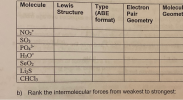 also must rank the intermolecular forces from weakest to strongest
please.
Molecule Lewis Structure Type (ABE format) Electron Pair Geometry Molecul Geomet NO2+ SO3 PO43- H30+ SeO2 Li2S CHC13 b) Rank the intermolecular forces from weakest to strongest:
also must rank the intermolecular forces from weakest to strongest
please.
Molecule Lewis Structure Type (ABE format) Electron Pair Geometry Molecul Geomet NO2+ SO3 PO43- H30+ SeO2 Li2S CHC13 b) Rank the intermolecular forces from weakest to strongest:
 In class work. Help?
Date Lab Partner EXPERIMENT 12 Intermolecular Forces substance | tmax (°C) | tmin (°C) ?T (tmax-tmin) Ethanol l-propanol Predicted Explanation I-butanol npentane Methanol n-hexane The molecular weights for n-pentane and 1-butanol are similar but the liquids have significantly different ?? values. Explain why the values are different I. 2. Which of the alcohols studied has the strongest intermolecular forces of attraction? Explain
In class work. Help?
Date Lab Partner EXPERIMENT 12 Intermolecular Forces substance | tmax (°C) | tmin (°C) ?T (tmax-tmin) Ethanol l-propanol Predicted Explanation I-butanol npentane Methanol n-hexane The molecular weights for n-pentane and 1-butanol are similar but the liquids have significantly different ?? values. Explain why the values are different I. 2. Which of the alcohols studied has the strongest intermolecular forces of attraction? Explain
 rank the molecules in the table from weakest to strongest
intermolecular forces and briefly justify the ranking.
temperature 310 20 time (s) 40 Fig. 10.1. Sample data for an evaporative cooling process. Before You Come to Lab Based on what you know about the relationship between the structure of a molecule and the strength of its intermolecular forces, rank the molecules in the table below in order from the weakest to the strongest intermolecular forces and briefly justify your ranking...
rank the molecules in the table from weakest to strongest
intermolecular forces and briefly justify the ranking.
temperature 310 20 time (s) 40 Fig. 10.1. Sample data for an evaporative cooling process. Before You Come to Lab Based on what you know about the relationship between the structure of a molecule and the strength of its intermolecular forces, rank the molecules in the table below in order from the weakest to the strongest intermolecular forces and briefly justify your ranking...
 Liquid Molar Mass (g/mol) Polarity (P, NP) Strongest type of Intermolecular Force Molecular structure Methanol Polar hydrogen bonds Ethanol Ipolar 1-Propanol polar 11-Butanol Ipolar n-Hexane Inon- polar n-Heptane Inon- I polar n-octane non- polar Acetone Polar 2- propanol polar 1. Which liquid tested has the strongest intermolecular forces? Justify your answer. (pt) Table 2 (15pes total) Minimum AT Initial Liquid temperature (°C) Methanol 17.8°C Ethanol 20+C |- Propanol 19.5°C 1-Butanol 19.8°C In-Hexane 18.4°C n-Heptane 20.7°C In-octane 19.4°C | Acetone 20.1.0...
 INTERMOLECULAR FORCES INTRODUCTION LEARNING OBJECTIVES To relate the effecet of intermolecular forces on relative melting points and vapour pressures of some organic substances THEORY Weak attractive forces that occur between individual molecules in substances are called intermolecular forces. These include London dispersion forces, dipole-dipole forces and hydrogen-bonding forces. Collectively, the three types of intermolecular forces are referred to as Van der Waals forces. These attractive forces are much weaker than the chemical bonds between atoms in a molecule. Note that...
 Rank the following in order of weakest to strongest
intermolecular forces:
Rank the following in order of weakest to strongest
intermolecular forces:
 question number 2&3 please
2. Identify the strongest type of intermolecular forces in acetone, ethanol, water and hexane (Structures listed on page 15.) 3. Predict the relative strength of the intermolecular forces in the four liquids above.
question number 2&3 please
2. Identify the strongest type of intermolecular forces in acetone, ethanol, water and hexane (Structures listed on page 15.) 3. Predict the relative strength of the intermolecular forces in the four liquids above.
 Based on the previous question and not have to predict the exact value; simply rank the liquids from greatest to least Al (Greatest AT = 1 and Lowest AT = 4) Substance Predicted AT Explanation (Why?) 1-butanol methanol n-pentane n-hexane Based on the previous question and table, Predict AT for the following liquids. You do not have to predict the exact value; simply rank the liquids from greatest to least AT (Greatest AT = 1 and Lowest AT = 4)...
 also must rank the intermolecular forces from weakest to strongest
please.
Molecule Lewis Structure Type (ABE format) Electron Pair Geometry Molecul Geomet NO2+ SO3 PO43- H30+ SeO2 Li2S CHC13 b) Rank the intermolecular forces from weakest to strongest:
also must rank the intermolecular forces from weakest to strongest
please.
Molecule Lewis Structure Type (ABE format) Electron Pair Geometry Molecul Geomet NO2+ SO3 PO43- H30+ SeO2 Li2S CHC13 b) Rank the intermolecular forces from weakest to strongest:
Most questions answered within 3 hours.
-
Where is the error in this code sequence?
String s1 = "Hello";
String s2 = "ello";...
asked 11 months ago -
Financial data for Joel de Paris, Inc., for last year
follow:
Joel de Paris, Inc.
Balance...
asked 11 months ago -
Consider this reaction:
Al2(SO4)3 (aq)+ BaCl3
(aq) Al2Cl6 (aq)- +
3BaSO4(s) . What is the...
asked 11 months ago -
Suppose that Savneet is considering increasing her
recent random sample from 20 car rentals to 40...
asked 11 months ago -
Trucks arrive at an unloading terminal at an average rate of 120
per hour.
Trucks arrive...
asked 11 months ago -
Why are methanol and ethanol completely soluble in water while
octanol is not very little soluble....
asked 11 months ago -
A facilities manager at a university reads in a research report
that the mean amount of...
asked 11 months ago -
When the CuSO4 is rehydrated by adding water to the anhydrous
compound, is this an endothermic...
asked 11 months ago -
A ray of sunlight is passing from diamond into crown glass; the
angle of incidence is...
asked 11 months ago -
A block of mass 0.249 kg is placed on top of a light, vertical
spring of...
asked 11 months ago -
how do the kidneys compensate in the presences of acidosis
a) trigger hyperventilate
b) reserve acid...
asked 11 months ago -
Question 501 pts
The rental rate of capital to the firm increases. Which of the
following...
asked 11 months ago