The action of enzymes is often described as following a two-step mechanism, named after the biochemists...
The action of enzymes is often described as following a two-step mechanism, named after the biochemists Michaelis and Menten, where in the first step the enzyme and the substrate form an intermediate complex, and in the second step the enzyme is released and the product is formed.
Schematically, E + S ⇆ ES (fast) , k1 and k-1 are the rate constants for the direct and reverse reactions respectively.
ES → E + P (slow), k2 is the rate constant for the reaction. where E=enzyme; S=substrate; ES=enzyme-substrate intermediate complex, and P=product.
If an enzymatic reaction follows this mechanism, what rate law is expected for the reaction?
Homework Answers


Add Answer to:
The action of enzymes is often described as following a two-step
mechanism, named after the biochemists...
Enzymes are often described as following a two-step mechanism: Where E = enzyme, S = substrate,...
Enzymes are often described as following a two-step mechanism: Where E = enzyme, S = substrate, ES = enzyme-substrate complex, and P = product. Write the balanced equation for the overall reaction. Identify and intermediates in the reaction mechanism. Derive an expression for the rate law.
Enzymes are often described as following the two-step mechanism: E+S⇌ES(fast) ES→E+P(slow) Where E = enzyme, S...
Enzymes are often described as following the two-step mechanism: E+S⇌ES(fast) ES→E+P(slow) Where E = enzyme, S = substrate, ES = enzyme-substrate complex and P = product. Question: Molecules that can bind to the active site of an enzyme but are not converted into product are called enzyme inhibitors.Write an additional elementary step to add into the preceding mechanism to account for the reaction of E with I, an inhibitor. Express your answer as a chemical equation.
Please answer all of those questions 7. Which of the followings is correct about the mechanisms of enzymatic reactions? General acid-base mechanism b. Metal elements mediated mechanism a. Covalent bo...
 Please answer all of those questions
7. Which of the followings is correct about the mechanisms of enzymatic reactions? General acid-base mechanism b. Metal elements mediated mechanism a. Covalent bonding mediated mechanism d. All above c. e. None a bove Which of the followings is correct about the meaning of the constant (Km) of Michaelis-Menten equation of enzyme catalyzed reactions? a. The constant and Michaelis-Menten equation is applicable only to the stage of reaction immediately after mixing of substrate(s) with...
Please answer all of those questions
7. Which of the followings is correct about the mechanisms of enzymatic reactions? General acid-base mechanism b. Metal elements mediated mechanism a. Covalent bonding mediated mechanism d. All above c. e. None a bove Which of the followings is correct about the meaning of the constant (Km) of Michaelis-Menten equation of enzyme catalyzed reactions? a. The constant and Michaelis-Menten equation is applicable only to the stage of reaction immediately after mixing of substrate(s) with...
(10 points) Michaelis-Menten kinetics. Consider ving enzymatic reaction, E + A H EA → E+ P...
 (10 points) Michaelis-Menten kinetics. Consider ving enzymatic reaction, E + A H EA → E+ P where E, A, and P are the concentrations of enzyme, substrate and product reen Show that rate and product respectively. V = "max [A] Km + [A]
Choose the correct answer from the list below. is a type of mathematical model that describes...
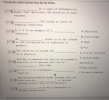 Choose the correct answer from the list below. is a type of mathematical model that describes the kinetics of many enzymes. The study of rates of chemical reactions. A -> P is an example of a reaction. A. Substrate B. first-order At , there is no net change in the concentration of substrate or product. C. Vmax D. k-2 The value Vo is called the of a reaction. E. initial velocity F. second-order - One way to measure the rate...
30. Describe the difference between transition state and intermediate using energy diagrams. 31. For enzymes in whic...
 30. Describe the difference between transition state and intermediate using energy diagrams. 31. For enzymes in which the slowest (rate-limiting) step is the reaction k2 ES P Km becomes equivalent to: A. Kcat- B. the [S], where Vo Vmax C. the dissociation constant, Ka, for the ES complex. D. the maximal velocity. E. the turnover number. 33. Draw a schematic for sequential mechanism 32. An enzyme "ABase" catalyzes the following reaction: A B. You found that for [E] 4 nM,...
A straight forward answer please Part A: For ing enzyme catalytic process Catalytic step E +P...
 A
straight forward answer please
Part A: For ing enzyme catalytic process Catalytic step E +P Substrate binding The forward rate constants are k1 and k2 and reverse rate constant is k.1 Express rate of complex [Enzyme.Substrate] formation and complex breakdown and determine the KM.
A
straight forward answer please
Part A: For ing enzyme catalytic process Catalytic step E +P Substrate binding The forward rate constants are k1 and k2 and reverse rate constant is k.1 Express rate of complex [Enzyme.Substrate] formation and complex breakdown and determine the KM.
For enzymes in which the slowest (rate-limiting) step is the reaction: K2 ES → E+P Km...
For enzymes in which the slowest (rate-limiting) step is the reaction: K2 ES → E+P Km becomes equivalent to: A) kcat. B) the [S] where V0 = Vmax. C) the dissociation constant, Kd, for the ES complex. D) the maximal velocity. E) the turnover number. The answer is C), could you please explain?
michaelis menten and kinetics help 2. A few years after Michaelis Menten published their work Briggs and Haldane came along and expanded it using the steady state assumption. i) Based on kinetic s...
 michaelis menten and kinetics help
2. A few years after Michaelis Menten published their work Briggs and Haldane came along and expanded it using the steady state assumption. i) Based on kinetic scheme 2 how many different ways can ES be produced? i) Using the rate constants in kinetic Scheme 2 at what rate is the ES complex being produced? sed eci iv) Using the rate constants in kinetic Scheme 2 at what rate is the ES complex being destroyed?...
michaelis menten and kinetics help
2. A few years after Michaelis Menten published their work Briggs and Haldane came along and expanded it using the steady state assumption. i) Based on kinetic scheme 2 how many different ways can ES be produced? i) Using the rate constants in kinetic Scheme 2 at what rate is the ES complex being produced? sed eci iv) Using the rate constants in kinetic Scheme 2 at what rate is the ES complex being destroyed?...
For the following questions, multiple answers may apply. 1) Enzyme activity in cells is controlled by...
For the following questions, multiple answers may apply. 1) Enzyme activity in cells is controlled by which processes: a) covalent modifications b) modulation of expression levels c) feedback inhibition d) binding to allosteric effectors 2) Which of the following statements about the concept of “induced fit” are true (2pts): a) Substrate binding induces either global or local conformational change in the enzyme, which then brings catalytic groups into proper orientation. b) When a substrate binds to an enzyme, the enzyme...
 Please answer all of those questions
7. Which of the followings is correct about the mechanisms of enzymatic reactions? General acid-base mechanism b. Metal elements mediated mechanism a. Covalent bonding mediated mechanism d. All above c. e. None a bove Which of the followings is correct about the meaning of the constant (Km) of Michaelis-Menten equation of enzyme catalyzed reactions? a. The constant and Michaelis-Menten equation is applicable only to the stage of reaction immediately after mixing of substrate(s) with...
Please answer all of those questions
7. Which of the followings is correct about the mechanisms of enzymatic reactions? General acid-base mechanism b. Metal elements mediated mechanism a. Covalent bonding mediated mechanism d. All above c. e. None a bove Which of the followings is correct about the meaning of the constant (Km) of Michaelis-Menten equation of enzyme catalyzed reactions? a. The constant and Michaelis-Menten equation is applicable only to the stage of reaction immediately after mixing of substrate(s) with...
 (10 points) Michaelis-Menten kinetics. Consider ving enzymatic reaction, E + A H EA → E+ P where E, A, and P are the concentrations of enzyme, substrate and product reen Show that rate and product respectively. V = "max [A] Km + [A]
 Choose the correct answer from the list below. is a type of mathematical model that describes the kinetics of many enzymes. The study of rates of chemical reactions. A -> P is an example of a reaction. A. Substrate B. first-order At , there is no net change in the concentration of substrate or product. C. Vmax D. k-2 The value Vo is called the of a reaction. E. initial velocity F. second-order - One way to measure the rate...
 30. Describe the difference between transition state and intermediate using energy diagrams. 31. For enzymes in which the slowest (rate-limiting) step is the reaction k2 ES P Km becomes equivalent to: A. Kcat- B. the [S], where Vo Vmax C. the dissociation constant, Ka, for the ES complex. D. the maximal velocity. E. the turnover number. 33. Draw a schematic for sequential mechanism 32. An enzyme "ABase" catalyzes the following reaction: A B. You found that for [E] 4 nM,...
 A
straight forward answer please
Part A: For ing enzyme catalytic process Catalytic step E +P Substrate binding The forward rate constants are k1 and k2 and reverse rate constant is k.1 Express rate of complex [Enzyme.Substrate] formation and complex breakdown and determine the KM.
A
straight forward answer please
Part A: For ing enzyme catalytic process Catalytic step E +P Substrate binding The forward rate constants are k1 and k2 and reverse rate constant is k.1 Express rate of complex [Enzyme.Substrate] formation and complex breakdown and determine the KM.
 michaelis menten and kinetics help
2. A few years after Michaelis Menten published their work Briggs and Haldane came along and expanded it using the steady state assumption. i) Based on kinetic scheme 2 how many different ways can ES be produced? i) Using the rate constants in kinetic Scheme 2 at what rate is the ES complex being produced? sed eci iv) Using the rate constants in kinetic Scheme 2 at what rate is the ES complex being destroyed?...
michaelis menten and kinetics help
2. A few years after Michaelis Menten published their work Briggs and Haldane came along and expanded it using the steady state assumption. i) Based on kinetic scheme 2 how many different ways can ES be produced? i) Using the rate constants in kinetic Scheme 2 at what rate is the ES complex being produced? sed eci iv) Using the rate constants in kinetic Scheme 2 at what rate is the ES complex being destroyed?...
Most questions answered within 3 hours.
-
Where is the error in this code sequence?
String s1 = "Hello";
String s2 = "ello";...
asked 11 months ago -
Financial data for Joel de Paris, Inc., for last year
follow:
Joel de Paris, Inc.
Balance...
asked 11 months ago -
Consider this reaction:
Al2(SO4)3 (aq)+ BaCl3
(aq) Al2Cl6 (aq)- +
3BaSO4(s) . What is the...
asked 11 months ago -
Suppose that Savneet is considering increasing her
recent random sample from 20 car rentals to 40...
asked 11 months ago -
Trucks arrive at an unloading terminal at an average rate of 120
per hour.
Trucks arrive...
asked 11 months ago -
Why are methanol and ethanol completely soluble in water while
octanol is not very little soluble....
asked 11 months ago -
A facilities manager at a university reads in a research report
that the mean amount of...
asked 11 months ago -
When the CuSO4 is rehydrated by adding water to the anhydrous
compound, is this an endothermic...
asked 11 months ago -
A ray of sunlight is passing from diamond into crown glass; the
angle of incidence is...
asked 11 months ago -
A block of mass 0.249 kg is placed on top of a light, vertical
spring of...
asked 11 months ago -
how do the kidneys compensate in the presences of acidosis
a) trigger hyperventilate
b) reserve acid...
asked 11 months ago -
Question 501 pts
The rental rate of capital to the firm increases. Which of the
following...
asked 11 months ago
> thnks
Danniel Georgia Thu, Jan 2, 2025 12:38 AM