Consider the reaction: A + B --> AB And let’s consider what happens if we run...
- Consider the reaction:
A + B --> AB
And let’s consider what happens if we run the reaction with the [A] = 0.01 M and with [B] = 0.5 M. At the end of the reaction, what will the concentrations of A and B become?
Homework Answers

Add Answer to:
Consider the reaction:
A + B --> AB
And let’s consider what happens if we run...
The following reaction was monitored as a function of time: AB→A+B A plot of 1/[AB] versus...
The following reaction was monitored as a function of time: AB→A+B A plot of 1/[AB] versus time yields a straight line with slope 5.9×10⁻² (M⋅s)−1 . If the initial concentration of AB is 0.210 M , and the reaction mixture initially contains no products, what are the concentrations of A and B after 80 s ?
Given the equilibrium reaction for a general reaction, A+B <->C, explain what happens to the reactants...
 Given the equilibrium reaction for a general reaction, A+B <->C, explain what happens to the reactants and products from time until the time at which the A reaction reaches equilibrium. (Choose any that are correct) Concentration (mol.dm-3) B С Time (s) Once products are formed in a reversible reaction, reactans can not be formed At equilibrium both the reactant and product concentration are the same At time 0, there are no products. At equilibrium all concentrations become constant As the...
Write, save, and run a Python program that will do the following when run: Let’s consider...
Write, save, and run a Python program that will do the following when run: Let’s consider the following assignment: a = 1 * 2 + 38 / 8 You want to change the precedence of the operators so that the addition operations are executed first. How would you re-write the assignment? Write a print statement to show the output. Let’s consider the following assignments: x = 'z' y= ['x', 'z', 'q'] Now, apparently x is a member of y. Write...
The following reaction was monitored as a function of time: AB→A+B A plot of 1/[AB] versus...
The following reaction was monitored as a function of time: AB→A+B A plot of 1/[AB] versus time yields a straight line with slope 5.7×10⁻² (M⋅s)−1 . 1) What is the value of the rate constant (k) for this reaction at this temperature? Express your answer using two significant figures. _____M-1S-1 2)Write the rate law for the reaction. Rate=k Rate=k[AB] Rate=k[AB]2 Rate=k[AB]3 3) What is the half-life when the initial concentration is 0.57 M ? Express your answer using two significant...
The following reaction was monitored as a function of time: AB→A+B A plot of 1/[AB] versus...
The following reaction was monitored as a function of time: AB→A+B A plot of 1/[AB] versus time yields a straight line with slope 5.8×10⁻² (M⋅s)−1 . You may want to reference (Page) section 13.4 while completing this problem. C. What is the half-life when the initial concentration is 0.53 M ? Express your answer using two significant figures. D. If the initial concentration of AB is 0.280 M , and the reaction mixture initially contains no products, what are the...
Consider the general reaction: AB AB (a) If Kc = 4.00, and if, initially, the...
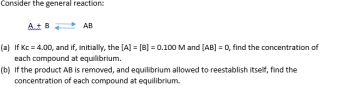
Consider the general reaction: AB AB (a) If Kc = 4.00, and if, initially, the [A] = [B] = 0.100 M and [AB] = 0, find the concentration of each compound at equilibrium. (b) If the product AB is removed, and equilibrium allowed to reestablish itself, find the concentration of each compound at equilibrium.
Consider the general reaction: AB AB (a) If Kc = 4.00, and if, initially, the [A] = [B] = 0.100 M and [AB] = 0, find the concentration of each compound at equilibrium. (b) If the product AB is removed, and equilibrium allowed to reestablish itself, find the concentration of each compound at equilibrium.
The following reaction was monitored as a function of time: AB→A+B A plot of 1/[AB] versus...
The following reaction was monitored as a function of time: AB→A+B A plot of 1/[AB] versus time yields a straight line with slope 5.8×10⁻² (M⋅s)−1 . You may want to reference (Page) section 13.4 while completing this problem. Part A Part complete What is the value of the rate constant (k) for this reaction at this temperature? Express your answer using two significant figures. -- SubmitPrevious AnswersRequest Answer Part B Part complete Write the rate law for the reaction. --...
Consider the following reaction: AB The average rate of appearance of B is given by A[B]At....
 Consider the following reaction: AB The average rate of appearance of B is given by A[B]At. Comparing the rate of appearance of B and the rate of disappearance of A, we get A[B]/At = * (-A[A]/At). A) +1 B) +2 C) -1 D) +1/2 E) -1/2
Consider the first order reaction, AB2 -> AB + B, which has a first order reaction...
 Consider the first order reaction, AB2 -> AB + B, which has a first order reaction rate constant of 0.00920 s'. If[AB2] = 0.0100 M at the beginning of the reaction, how many seconds will it take for the concentration to drop to 0.00250 M? a) 151 s b) 75.5 s c) 38.0 s d) 302 s Оа Ob Ос C
Consider the reaction: A <=> B. Under standard conditions at equiliubrium, the concentrations of the compounds are...
Consider the reaction: A <=> B. Under standard conditions at equiliubrium, the concentrations of the compounds are [A] = 1.5 M, and [B] = 0.5 M. Keq' for this reaction is ____ and ∆G°' is _____. (You should not need a calculator for this.) >1; >0 >1; < 0 <1; <0 <1; >0
 Given the equilibrium reaction for a general reaction, A+B <->C, explain what happens to the reactants and products from time until the time at which the A reaction reaches equilibrium. (Choose any that are correct) Concentration (mol.dm-3) B С Time (s) Once products are formed in a reversible reaction, reactans can not be formed At equilibrium both the reactant and product concentration are the same At time 0, there are no products. At equilibrium all concentrations become constant As the...
Consider the general reaction: AB AB (a) If Kc = 4.00, and if, initially, the [A] = [B] = 0.100 M and [AB] = 0, find the concentration of each compound at equilibrium. (b) If the product AB is removed, and equilibrium allowed to reestablish itself, find the concentration of each compound at equilibrium.
Consider the general reaction: AB AB (a) If Kc = 4.00, and if, initially, the [A] = [B] = 0.100 M and [AB] = 0, find the concentration of each compound at equilibrium. (b) If the product AB is removed, and equilibrium allowed to reestablish itself, find the concentration of each compound at equilibrium.
 Consider the following reaction: AB The average rate of appearance of B is given by A[B]At. Comparing the rate of appearance of B and the rate of disappearance of A, we get A[B]/At = * (-A[A]/At). A) +1 B) +2 C) -1 D) +1/2 E) -1/2
 Consider the first order reaction, AB2 -> AB + B, which has a first order reaction rate constant of 0.00920 s'. If[AB2] = 0.0100 M at the beginning of the reaction, how many seconds will it take for the concentration to drop to 0.00250 M? a) 151 s b) 75.5 s c) 38.0 s d) 302 s Оа Ob Ос C
Most questions answered within 3 hours.
-
Where is the error in this code sequence?
String s1 = "Hello";
String s2 = "ello";...
asked 10 months ago -
Financial data for Joel de Paris, Inc., for last year
follow:
Joel de Paris, Inc.
Balance...
asked 10 months ago -
Consider this reaction:
Al2(SO4)3 (aq)+ BaCl3
(aq) Al2Cl6 (aq)- +
3BaSO4(s) . What is the...
asked 10 months ago -
Suppose that Savneet is considering increasing her
recent random sample from 20 car rentals to 40...
asked 10 months ago -
Trucks arrive at an unloading terminal at an average rate of 120
per hour.
Trucks arrive...
asked 10 months ago -
Why are methanol and ethanol completely soluble in water while
octanol is not very little soluble....
asked 10 months ago -
A facilities manager at a university reads in a research report
that the mean amount of...
asked 10 months ago -
When the CuSO4 is rehydrated by adding water to the anhydrous
compound, is this an endothermic...
asked 10 months ago -
A ray of sunlight is passing from diamond into crown glass; the
angle of incidence is...
asked 10 months ago -
A block of mass 0.249 kg is placed on top of a light, vertical
spring of...
asked 10 months ago -
how do the kidneys compensate in the presences of acidosis
a) trigger hyperventilate
b) reserve acid...
asked 10 months ago -
Question 501 pts
The rental rate of capital to the firm increases. Which of the
following...
asked 10 months ago