Given an array with elements {2,4,11,5,3,8,10,1,3,7,15,12} draw recursive tree using Mergesort algorithm and label steps.
Given an array with elements {2,4,11,5,3,8,10,1,3,7,15,12} draw recursive tree using Mergesort algorithm and label steps.
Homework Answers
Dear Student,
I will describe steps of Merge sort before going into the recursive tree of merge sort.
A is the array
1) Get the middle point of the array, so that you can divide into two halves.
midPoint=(left+right)/2
2) Call merge sort for the first half of the array. Left array
sort(A,left,midPoint)
3) Call merge sort for the second half of the array.
sort(A,midPoint+1,right)
4) Merge two halves of the above.
merge(A,left,middle,right)
---------------------------------------------------------------------------------------------------------------------------------------------
Mergesort recursive tree: Generally recursive tree is for viewing the iterations. I will attach the image of the recursive tree for the Array, {2,4,11,5,3,8,10,1,3,7,15,12}
Please let me know if you find any difficulty in understanding
the merge sort. Reply in comments, so that I can respond to your
queries.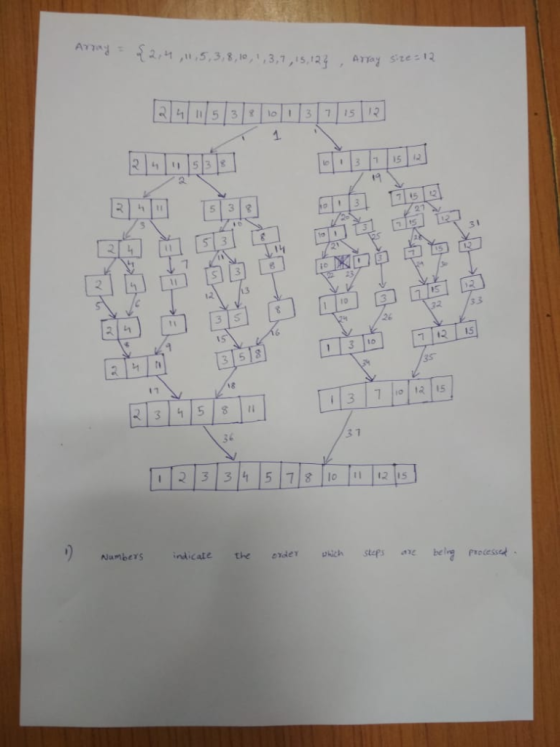
Add Answer to:
Given an array with elements
{2,4,11,5,3,8,10,1,3,7,15,12} draw recursive tree using Mergesort
algorithm and label steps.
Based on the recursive (2-way) mergesort given below, implement a 3-way recursive mergesort algorithm. In the...
 Based on the recursive (2-way) mergesort given below, implement a 3-way recursive mergesort algorithm. In the 3-way mergesort algorithm, the part of the array delimited by low and high will need to be divided into three subarrays and recursive calls made on each of them. Then the three subarrays will need to be merged into one sorted one. Also analyse the time complexity of the 3-way mergesort algorithm and compare it with that of (2-way) mergesort.
Consider a MergeSort-like algorithm in which the array is split into thirds, rather than halves. (a)...
Consider a MergeSort-like algorithm in which the array is split into thirds, rather than halves. (a) Write pseudo-code for your algorithm. You may assume a three-way merge algorithm is available. Your algorithm should work for general n, i.e., even if the size of the array is not a power of 3. (b) Use the tree method to analyze exactly how many comparisons your algorithm uses. You may assume that the size of the array is a power of 3. Assume...
1. Show the steps in order to sort {11,5,6,3,8,1,9,2} using Mergesort algorithm. 2. Show the element...
1. Show the steps in order to sort {11,5,6,3,8,1,9,2} using Mergesort algorithm. 2. Show the element sequences of running Shellsort on the input {15,2,8,1,10,7,4,3,9,11,12,6} at the increments {7, 3, 1}, respectively. 3. Show the steps in details of sorting {15, 2, 8, 1, 10, 7, 4, 3, 9, 11, 12, 6} using quicksort with median-of-three partitioning and a cutoff 3 (if the elements are less than 3, using insertion sort).
2. The mergesort is a recursive sort. What is the base case for the merge sort?...
2. The mergesort is a recursive sort. What is the base case for the merge sort? A.There is none. B. When right = left -1 C. When start = end D. When end - start = 1 3. Given the array [ 23, 83, 82, 92, 28, 21, 91, 17, 54, 32, 41, 14], what is the value of mid for the call mergesort (elements, 0, 5, temp) ? A. The value of mid is 3 B. The value of...
Write just Algorithm for Given an array of n elements, write an algorithm to find a...
Write just Algorithm for Given an array of n elements, write an algorithm to find a number that has a duplicate.
Suppose that you are given an array of N elements. Develop an optimum algorithm that finds...
Suppose that you are given an array of N elements. Develop an optimum algorithm that finds the minimum k elements of this array in at most nlogn time. Try your algorithm on an example N-sized array and some value of k.
1.Fix any tree T on 10 vertices. Draw the recursion tree of the algorithm Find-size-node when...
1.Fix any tree T on 10 vertices. Draw the recursion tree of the algorithm Find-size-node when run on the input T with a being the root of T. Can you use this to give a bound on the running time of T? 2. Consider the following problem. Check-BST • Input: A binary tree T • Output: 1 if T is a binary search tree, and 0 otherwise. Give an efficient algorithm for this problem. 3.Give a recursive algorithm for the...
4 Problem 4 -Extra Credit Given an array A, we say that elements A and Al...
 4 Problem 4 -Extra Credit Given an array A, we say that elements A and Al are swapped if J >「 but Alj]< A[i]. For example, if A - [8,5,9,7], then there are a total of3 swapped pairs, namely 8 and 5; 8 and 7; and 9 and 7 Describe a recursive algorithm that given an array A, determines the number of swapped pairs in the array in O(n log(n)) time. To analyze the algorithm, you must state the recurrence...
Show sorting decision tree for a sorting algorithm of your choice (SelectionSort, InsertionSort, MergeSort, Quicksort), for...
Show sorting decision tree for a sorting algorithm of your choice (SelectionSort, InsertionSort, MergeSort, Quicksort), for inputs of size 3 or 4.
Problem 5: Recurrence relations and detailed analysis of recursive algorithm efficiency g(n: non-negative integer)  
Problem 5: Recurrence relations and detailed analysis of recursive algorithm efficiency g(n: non-negative integer) 1. if n ≤ 1 then return n 2. else return (5 * g(n─1) ─ 6 * g(n─2)) MergeSort divides the array to be sorted into two equal halves, calls itself recursively on each half to sort that subarray, and then calls the Merge algorithm to merge the two sorted halves in linear time. This leads to its two recurrence relations T(n)=2T(n/2)+cn, n>1;...
 Based on the recursive (2-way) mergesort given below, implement a 3-way recursive mergesort algorithm. In the 3-way mergesort algorithm, the part of the array delimited by low and high will need to be divided into three subarrays and recursive calls made on each of them. Then the three subarrays will need to be merged into one sorted one. Also analyse the time complexity of the 3-way mergesort algorithm and compare it with that of (2-way) mergesort.
 4 Problem 4 -Extra Credit Given an array A, we say that elements A and Al are swapped if J >「 but Alj]< A[i]. For example, if A - [8,5,9,7], then there are a total of3 swapped pairs, namely 8 and 5; 8 and 7; and 9 and 7 Describe a recursive algorithm that given an array A, determines the number of swapped pairs in the array in O(n log(n)) time. To analyze the algorithm, you must state the recurrence...
Most questions answered within 3 hours.
-
Where is the error in this code sequence?
String s1 = "Hello";
String s2 = "ello";...
asked 10 months ago -
Financial data for Joel de Paris, Inc., for last year
follow:
Joel de Paris, Inc.
Balance...
asked 10 months ago -
Consider this reaction:
Al2(SO4)3 (aq)+ BaCl3
(aq) Al2Cl6 (aq)- +
3BaSO4(s) . What is the...
asked 10 months ago -
Suppose that Savneet is considering increasing her
recent random sample from 20 car rentals to 40...
asked 10 months ago -
Trucks arrive at an unloading terminal at an average rate of 120
per hour.
Trucks arrive...
asked 10 months ago -
Why are methanol and ethanol completely soluble in water while
octanol is not very little soluble....
asked 10 months ago -
A facilities manager at a university reads in a research report
that the mean amount of...
asked 10 months ago -
When the CuSO4 is rehydrated by adding water to the anhydrous
compound, is this an endothermic...
asked 10 months ago -
A ray of sunlight is passing from diamond into crown glass; the
angle of incidence is...
asked 10 months ago -
A block of mass 0.249 kg is placed on top of a light, vertical
spring of...
asked 10 months ago -
how do the kidneys compensate in the presences of acidosis
a) trigger hyperventilate
b) reserve acid...
asked 10 months ago -
Question 501 pts
The rental rate of capital to the firm increases. Which of the
following...
asked 10 months ago