Finding Probabilities in Uniform Distributions The probability density of a random variable X is given in...
Finding Probabilities in Uniform Distributions The probability density of a random variable X is given in the figure below. The random variable is uniformly distributed between 0 and 2.
From this density, find the probability that X is between 0.54 and 1.2.
Homework Answers
Solution :
Given that,
a = 0
b = 2
P(c < x < d) = (d - c) / (b - a)
P(0.54 < x < 1.2) = (1.2 - 0.54) / (2 - 0)=0.33
probability=0.33
Add Answer to:
Finding Probabilities in Uniform Distributions The probability
density of a random variable X is given in...
1. Properties of the uniform, normal, and exponential distributions Aa Aa Suppose that x1 is a...
 1. Properties of the uniform, normal, and exponential distributions Aa Aa Suppose that x1 is a uniformly distributed random variable, x2 is a normally distributed random variable, and x3 is an exponentially distributed random variable. For each of the following statements, indicate whether it applies to x1, x2, and/or x3. Check all that apply. x2 x3 (uniform) (normal) (exponential) The area under the graph of the probability density function to the right of the mean equals 0.5. Probabilities are given...
The probability density of a random variable X is given in the figure below. From this...
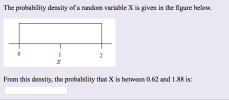 The probability density of a random variable X is given in the figure below. From this density, the probability that X is between 0.62 and 1.88 is:
A random variable is a uniform random variable between 0 and 8. The probability density is...
A random variable is a uniform random variable between 0 and 8. The probability density is 1/8, when 0<x<8 and 0 elsewhere. What is the probability that the random variable has a value greater than 2 ?
The probability density of a random variable X is given in the figure below. From this...
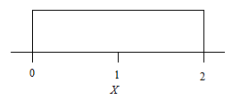 The probability density of a random variable X is given in the
figure below.
From this density, the probability that X > 1.66 or X <
0.34 is:
The probability density of a random variable X is given in the
figure below.
From this density, the probability that X > 1.66 or X <
0.34 is:
The probability density of a random variable X is given in the figure below. From this...
 The probability density of a random variable X is given in the figure below. From this density, the probability that X is between 0.76 and 1.54 is: Box 1: Enter your answer as an integer or decimal number. Examples: 3, 4, 5.5172 Enter DNE for Does Not Exist, oo for Infinity
2) Consider a random variable Z with a uniform probability density function given as UZ(-1,0) and...
 2) Consider a random variable Z with a uniform probability
density function given as UZ(-1,0) and X=4Z+4. a) Find and plot the
probability density function ( ) Xf x . b) Find and plot the
probability distribution function ( ) F x X . c) Find E[Z]. d) Find
E[X]. e) Find the correlation of Z and X. i. Are they correlated?
ii. Are they independent? Why?
2) Consider a random variable Z with a uniform probability density function given...
2) Consider a random variable Z with a uniform probability
density function given as UZ(-1,0) and X=4Z+4. a) Find and plot the
probability density function ( ) Xf x . b) Find and plot the
probability distribution function ( ) F x X . c) Find E[Z]. d) Find
E[X]. e) Find the correlation of Z and X. i. Are they correlated?
ii. Are they independent? Why?
2) Consider a random variable Z with a uniform probability density function given...
Let the random variable X be a random number with the uniform density curve in the...
 Let the random variable X be a random number with the uniform density curve in the figure below. Area = 0.4 Area = 0.5 Area = 0.2 Height = 1 0.3 0.7 0.5 0.8 P(X<0.5 or X > 0.8) P(0.3<X<0.7) (a) (b) Find the following probabilities. P(X 2 0.35) (a) (b) P(X = 0.35) P(0.35 < X < 1.25) (c) P(0.10 < X < 0.20 or 0.6 < X < 0.9) (d) X is not in the interval 0.5 to...
Random variable x has a uniform distribution defined by the probability density function below. Determine the...
Random variable x has a uniform distribution defined by the probability density function below. Determine the probability that x has a value of at least 220. f(x) = 1/100 for values of x between 200 and 300, and 0 everywhere else a)0.65 b)0.80 c)0.75 d)0.60
The uniform distribution of a random variable X is given in the figure below. From the...
 The uniform distribution of a random variable X is given in the
figure below.
From the figure, what is P(X>1.2) or P(X<0.14)?
Homework: Section 5.2 Score: 7/8 8/8 answered x Question 4 <> Score on last try: 0 of 1 pts. See Details for more. > Next question You can retry this question below The uniform distribution of a random variable X is given in the figure below. From the figure, what is P(x > 1.2) or P(X < 0.14)?...
The uniform distribution of a random variable X is given in the
figure below.
From the figure, what is P(X>1.2) or P(X<0.14)?
Homework: Section 5.2 Score: 7/8 8/8 answered x Question 4 <> Score on last try: 0 of 1 pts. See Details for more. > Next question You can retry this question below The uniform distribution of a random variable X is given in the figure below. From the figure, what is P(x > 1.2) or P(X < 0.14)?...
A random variable X has probability density function given by... Using the transformation theorem, find the...
 A random variable X has probability density function given
by...
Using the transformation theorem, find the density function for
the random variable Y = X^2
A random variable X has probability density function given by 5e-5z if x > 0 f (x) = otherwise. Using the transformation theorem, find the density function for the random variable Y = X².
A random variable X has probability density function given
by...
Using the transformation theorem, find the density function for
the random variable Y = X^2
A random variable X has probability density function given by 5e-5z if x > 0 f (x) = otherwise. Using the transformation theorem, find the density function for the random variable Y = X².
 1. Properties of the uniform, normal, and exponential distributions Aa Aa Suppose that x1 is a uniformly distributed random variable, x2 is a normally distributed random variable, and x3 is an exponentially distributed random variable. For each of the following statements, indicate whether it applies to x1, x2, and/or x3. Check all that apply. x2 x3 (uniform) (normal) (exponential) The area under the graph of the probability density function to the right of the mean equals 0.5. Probabilities are given...
 The probability density of a random variable X is given in the figure below. From this density, the probability that X is between 0.62 and 1.88 is:
 The probability density of a random variable X is given in the
figure below.
From this density, the probability that X > 1.66 or X <
0.34 is:
The probability density of a random variable X is given in the
figure below.
From this density, the probability that X > 1.66 or X <
0.34 is:
 The probability density of a random variable X is given in the figure below. From this density, the probability that X is between 0.76 and 1.54 is: Box 1: Enter your answer as an integer or decimal number. Examples: 3, 4, 5.5172 Enter DNE for Does Not Exist, oo for Infinity
 2) Consider a random variable Z with a uniform probability
density function given as UZ(-1,0) and X=4Z+4. a) Find and plot the
probability density function ( ) Xf x . b) Find and plot the
probability distribution function ( ) F x X . c) Find E[Z]. d) Find
E[X]. e) Find the correlation of Z and X. i. Are they correlated?
ii. Are they independent? Why?
2) Consider a random variable Z with a uniform probability density function given...
2) Consider a random variable Z with a uniform probability
density function given as UZ(-1,0) and X=4Z+4. a) Find and plot the
probability density function ( ) Xf x . b) Find and plot the
probability distribution function ( ) F x X . c) Find E[Z]. d) Find
E[X]. e) Find the correlation of Z and X. i. Are they correlated?
ii. Are they independent? Why?
2) Consider a random variable Z with a uniform probability density function given...
 Let the random variable X be a random number with the uniform density curve in the figure below. Area = 0.4 Area = 0.5 Area = 0.2 Height = 1 0.3 0.7 0.5 0.8 P(X<0.5 or X > 0.8) P(0.3<X<0.7) (a) (b) Find the following probabilities. P(X 2 0.35) (a) (b) P(X = 0.35) P(0.35 < X < 1.25) (c) P(0.10 < X < 0.20 or 0.6 < X < 0.9) (d) X is not in the interval 0.5 to...
 The uniform distribution of a random variable X is given in the
figure below.
From the figure, what is P(X>1.2) or P(X<0.14)?
Homework: Section 5.2 Score: 7/8 8/8 answered x Question 4 <> Score on last try: 0 of 1 pts. See Details for more. > Next question You can retry this question below The uniform distribution of a random variable X is given in the figure below. From the figure, what is P(x > 1.2) or P(X < 0.14)?...
The uniform distribution of a random variable X is given in the
figure below.
From the figure, what is P(X>1.2) or P(X<0.14)?
Homework: Section 5.2 Score: 7/8 8/8 answered x Question 4 <> Score on last try: 0 of 1 pts. See Details for more. > Next question You can retry this question below The uniform distribution of a random variable X is given in the figure below. From the figure, what is P(x > 1.2) or P(X < 0.14)?...
 A random variable X has probability density function given
by...
Using the transformation theorem, find the density function for
the random variable Y = X^2
A random variable X has probability density function given by 5e-5z if x > 0 f (x) = otherwise. Using the transformation theorem, find the density function for the random variable Y = X².
A random variable X has probability density function given
by...
Using the transformation theorem, find the density function for
the random variable Y = X^2
A random variable X has probability density function given by 5e-5z if x > 0 f (x) = otherwise. Using the transformation theorem, find the density function for the random variable Y = X².
Most questions answered within 3 hours.
-
Where is the error in this code sequence?
String s1 = "Hello";
String s2 = "ello";...
asked 10 months ago -
Financial data for Joel de Paris, Inc., for last year
follow:
Joel de Paris, Inc.
Balance...
asked 10 months ago -
Consider this reaction:
Al2(SO4)3 (aq)+ BaCl3
(aq) Al2Cl6 (aq)- +
3BaSO4(s) . What is the...
asked 10 months ago -
Suppose that Savneet is considering increasing her
recent random sample from 20 car rentals to 40...
asked 10 months ago -
Trucks arrive at an unloading terminal at an average rate of 120
per hour.
Trucks arrive...
asked 10 months ago -
Why are methanol and ethanol completely soluble in water while
octanol is not very little soluble....
asked 10 months ago -
A facilities manager at a university reads in a research report
that the mean amount of...
asked 10 months ago -
When the CuSO4 is rehydrated by adding water to the anhydrous
compound, is this an endothermic...
asked 10 months ago -
A ray of sunlight is passing from diamond into crown glass; the
angle of incidence is...
asked 10 months ago -
A block of mass 0.249 kg is placed on top of a light, vertical
spring of...
asked 10 months ago -
how do the kidneys compensate in the presences of acidosis
a) trigger hyperventilate
b) reserve acid...
asked 10 months ago -
Question 501 pts
The rental rate of capital to the firm increases. Which of the
following...
asked 10 months ago