1. Traditional monetary policy is conducted by managing : Group of answer choices the prime rate....
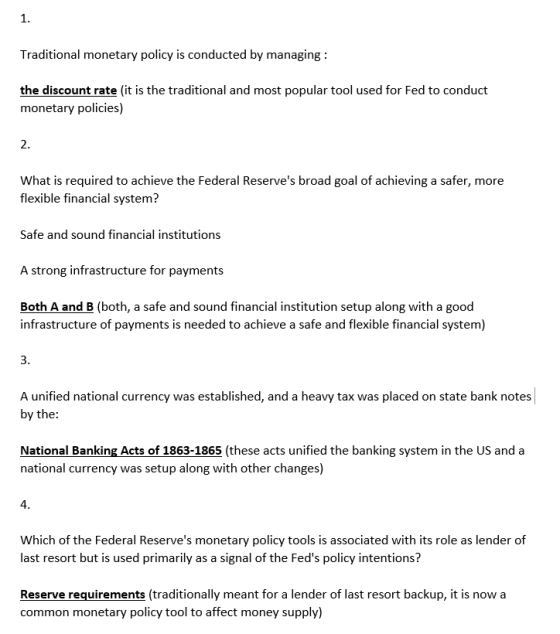
1.
Traditional monetary policy is conducted by managing :
Group of answer choices
the prime rate.
mortgage rates.
the federal funds rate.
the discount rate.
2.
What is required to achieve the Federal Reserve's broad goal of achieving a safer, more flexible financial system?
Group of answer choices
Safe and sound financial institutions
A strong infrastructure for payments
Both A and B
Congressional oversight of the banking system.
3.
A unified national currency was established and a heavy tax was placed on state bank notes by the:
Group of answer choices
Federal Reserve Act of 1913.
Emergency Banking Act of 1933.
National Banking Acts of 1863-1865.
Silver Purchase Act of 1890.
4.
Which of the Federal Reserve's monetary policy tools is associated with its role as lender of last resort but is used primarily as a signal of the Fed's policy intentions?
Group of answer choices
Open market operations
The discount rate
Reserve requirements
Interest on reserves
5.
If the inflation rate were falling and the unemployment rate were high and rising, the FOMC would likely respond by doing which of the following?
Group of answer choices
Increasing the federal funds target rate and selling government securities
Increasing the federal funds target rate and buying government securities
Decreasing the federal funds target rate and selling government securities
Decreasing the federal funds target rate and buying government securities
6.
Longer term interest rates:
Group of answer choices
are not important for investment decisions.
affect the economy and employment through their effect on investment.
have no effect on inflation.
all of the above.
7.
The charter of the First Bank was not renewed in 1811 due to political turmoil. What led to the founding of the Second Bank of the United States in 1816?
Group of answer choices
Continuous bank panics
The need for a larger economy
Large amounts of counterfeit currency in circulation
The government's financial problems after the War of 1812
8.
During the mid-1800s about one-third of the currency in circulation in the United States was:
Group of answer choices
counterfeit.
missing.
redesigned.
large in size.
9.
During the financial crisis of 2008, many of the Fed's actions were what type of policies?
Group of answer choices
Liquidity policies
Monetary policies
Credit policies
Fiscal policies
Homework Answers
As per HomeworkLib guidelines first four questions are answered below
Kindly ask rest of the questions in a separate post
Add Answer to:
1.
Traditional monetary policy is conducted by managing :
Group of answer choices
the prime rate....
1) What is real GDP? Group of answer choices It is the total market value of...
1) What is real GDP? Group of answer choices It is the total market value of final goods and services produced in an economy in a given year. It is a sustained increase in the average price level of goods and services. It is the total market value of all final goods and services produced in an economy in a given year, adjusted for inflation. It is an increase in the money supply. 2) The unemployment rate is: Group of...
1- Please list and briefly explain the goals and tools of monetary policy. 2- Suppose the current real...
1- Please list and briefly explain the goals and tools of monetary policy. 2- Suppose the current real federal funds rate in the economy is 2.0%, the current inflation rate is 1.0%, the Federal Reserve's target inflation rate is 2.0%, and the output gap is –2.0%. According to the Taylor Rule, how much should be the Federal Reserve's target federal funds rate? Please show your work
answer please 25. A bank borrows money from another bank on an overnight basis to meet...
 answer please
25. A bank borrows money from another bank on an overnight basis to meet reserve requirements in the: a. stock market. b. bond market. c. Federal funds market. d. U.S.Treasury bill market. 26. Fiscal policy in the United States is the responsibility of the: a. US Treasury b. Federal Reserve c. Internal Revenue Service d. US Congress and Administration 27. Monetary policy in the United States is the responsibility of the: b. Federal Reserve a. US Treasury c....
answer please
25. A bank borrows money from another bank on an overnight basis to meet reserve requirements in the: a. stock market. b. bond market. c. Federal funds market. d. U.S.Treasury bill market. 26. Fiscal policy in the United States is the responsibility of the: a. US Treasury b. Federal Reserve c. Internal Revenue Service d. US Congress and Administration 27. Monetary policy in the United States is the responsibility of the: b. Federal Reserve a. US Treasury c....
18. Suppose the Federal pose the Federal Reserve opted to implement monetary policy by decreasing the...
 18. Suppose the Federal pose the Federal Reserve opted to implement monetary policy by decreasing the interest id on excess reserves. This would be an example of a. Expansionary monetary policy b. Contractionary monetary policy c. Discretionary monetary policy d. Exemplary monetary policy 19, A policy decision by the Federal Reserve to sell short-run U.S. securities out of the New York branch would be an example of a. Expansionary monetary policy through decreasing the federal funds rate b. Contractionary monetary...
8. Federal funds rate targeting Aa Aa In conducting monetary policy, the Federal Open Market Committee (FOMC) targets a Federal funds rate and the Federal Reserve Bank of New York uses open-marke...
 8. Federal funds rate targeting Aa Aa In conducting monetary policy, the Federal Open Market Committee (FOMC) targets a Federal funds rate and the Federal Reserve Bank of New York uses open-market operations to achieve and maintain the target rate. Suppose that the following graph shows the demand for Federal funds. Use the orange line (square symbols) to plot the supply of Federal funds (also called "the supply of excess reserves") when the FOMC targets a Federal funds rate of...
The U.S. central bank that sets monetary policy and regulates the U.S. banking system is known...
The U.S. central bank that sets monetary policy and regulates the U.S. banking system is known as the: Select the correct answer Regional Central Bank The Federal Reserve Bank of New York The Congress Question 2 5 Points Which of the following is not a component of the Fed System? Select the correct answer Member Banks Federal Reserve District Banks Federal Open Market Committee Regional Committee Question 3 5 Points The function of setting reserve requirements and supervising member banks...
What are the three main tools the Federal Reserve (Fed) has at its disposal to carry out monetary policy? setting...
 What are the three main tools the Federal Reserve (Fed) has at its disposal to carry out monetary policy? setting the discount rate, increasing taxes, and building highways conducting open market operations, increasing spending by the federal government, and decreasing taxes conducting open market operations, setting the discount rate, and paying interest on reserves O paying interest on reserves, conducting open market operations, and controlling money demand During the financial crisis of 2007-2008, the Fed engaged in lending to certain...
The monetary base consists of Group of answer choices a-the securities the Fed owns plus its...
The monetary base consists of Group of answer choices a-the securities the Fed owns plus its reserves. b-the securities the Fed owns plus the discount loans owed to the Fed. c-the securities the Fed owns plus currency in circulation. d-the discount loans owed to the Fed plus its reserves.
If you were the Federal Reserve chairman, which monetary policy would you advise the federal government...
If you were the Federal Reserve chairman, which monetary policy would you advise the federal government to adopt? Explain why. o Return to the classical gold standard o A gold price targeting policy o A monetary rule (i.e., increase the M2 money supply at a steady rate equal to the long-term real GDP growth rate, and allow interest rates to fluctuate without interference. o Price inflation target, i.e., set a maximum price inflation target, based on the Consumer Price Index...
need all 5 answeres If the monetary base is $1,000 billion, checkable deposits are $2,000 billion,...
 need all 5 answeres
If the monetary base is $1,000 billion, checkable deposits are $2,000 billion, the required reserve ratio is 10%, and excess reserves are $500 billion, then the currency in circulation are $500 billion, then 92,000 billion. A) $200 billion B) $300 billion. C) $450 billion. D) $700 billion. When the Federal Reserve wants to raise interest rates after banks have accumulated large amounts of excess reserves (i.e., when the supply curve intersects the demand curve at the...
need all 5 answeres
If the monetary base is $1,000 billion, checkable deposits are $2,000 billion, the required reserve ratio is 10%, and excess reserves are $500 billion, then the currency in circulation are $500 billion, then 92,000 billion. A) $200 billion B) $300 billion. C) $450 billion. D) $700 billion. When the Federal Reserve wants to raise interest rates after banks have accumulated large amounts of excess reserves (i.e., when the supply curve intersects the demand curve at the...
 answer please
25. A bank borrows money from another bank on an overnight basis to meet reserve requirements in the: a. stock market. b. bond market. c. Federal funds market. d. U.S.Treasury bill market. 26. Fiscal policy in the United States is the responsibility of the: a. US Treasury b. Federal Reserve c. Internal Revenue Service d. US Congress and Administration 27. Monetary policy in the United States is the responsibility of the: b. Federal Reserve a. US Treasury c....
answer please
25. A bank borrows money from another bank on an overnight basis to meet reserve requirements in the: a. stock market. b. bond market. c. Federal funds market. d. U.S.Treasury bill market. 26. Fiscal policy in the United States is the responsibility of the: a. US Treasury b. Federal Reserve c. Internal Revenue Service d. US Congress and Administration 27. Monetary policy in the United States is the responsibility of the: b. Federal Reserve a. US Treasury c....
 18. Suppose the Federal pose the Federal Reserve opted to implement monetary policy by decreasing the interest id on excess reserves. This would be an example of a. Expansionary monetary policy b. Contractionary monetary policy c. Discretionary monetary policy d. Exemplary monetary policy 19, A policy decision by the Federal Reserve to sell short-run U.S. securities out of the New York branch would be an example of a. Expansionary monetary policy through decreasing the federal funds rate b. Contractionary monetary...
 8. Federal funds rate targeting Aa Aa In conducting monetary policy, the Federal Open Market Committee (FOMC) targets a Federal funds rate and the Federal Reserve Bank of New York uses open-market operations to achieve and maintain the target rate. Suppose that the following graph shows the demand for Federal funds. Use the orange line (square symbols) to plot the supply of Federal funds (also called "the supply of excess reserves") when the FOMC targets a Federal funds rate of...
 What are the three main tools the Federal Reserve (Fed) has at its disposal to carry out monetary policy? setting the discount rate, increasing taxes, and building highways conducting open market operations, increasing spending by the federal government, and decreasing taxes conducting open market operations, setting the discount rate, and paying interest on reserves O paying interest on reserves, conducting open market operations, and controlling money demand During the financial crisis of 2007-2008, the Fed engaged in lending to certain...
 need all 5 answeres
If the monetary base is $1,000 billion, checkable deposits are $2,000 billion, the required reserve ratio is 10%, and excess reserves are $500 billion, then the currency in circulation are $500 billion, then 92,000 billion. A) $200 billion B) $300 billion. C) $450 billion. D) $700 billion. When the Federal Reserve wants to raise interest rates after banks have accumulated large amounts of excess reserves (i.e., when the supply curve intersects the demand curve at the...
need all 5 answeres
If the monetary base is $1,000 billion, checkable deposits are $2,000 billion, the required reserve ratio is 10%, and excess reserves are $500 billion, then the currency in circulation are $500 billion, then 92,000 billion. A) $200 billion B) $300 billion. C) $450 billion. D) $700 billion. When the Federal Reserve wants to raise interest rates after banks have accumulated large amounts of excess reserves (i.e., when the supply curve intersects the demand curve at the...
Most questions answered within 3 hours.
-
Where is the error in this code sequence?
String s1 = "Hello";
String s2 = "ello";...
asked 10 months ago -
Financial data for Joel de Paris, Inc., for last year
follow:
Joel de Paris, Inc.
Balance...
asked 10 months ago -
Consider this reaction:
Al2(SO4)3 (aq)+ BaCl3
(aq) Al2Cl6 (aq)- +
3BaSO4(s) . What is the...
asked 10 months ago -
Suppose that Savneet is considering increasing her
recent random sample from 20 car rentals to 40...
asked 10 months ago -
Trucks arrive at an unloading terminal at an average rate of 120
per hour.
Trucks arrive...
asked 10 months ago -
Why are methanol and ethanol completely soluble in water while
octanol is not very little soluble....
asked 10 months ago -
A facilities manager at a university reads in a research report
that the mean amount of...
asked 10 months ago -
When the CuSO4 is rehydrated by adding water to the anhydrous
compound, is this an endothermic...
asked 10 months ago -
A ray of sunlight is passing from diamond into crown glass; the
angle of incidence is...
asked 10 months ago -
A block of mass 0.249 kg is placed on top of a light, vertical
spring of...
asked 10 months ago -
how do the kidneys compensate in the presences of acidosis
a) trigger hyperventilate
b) reserve acid...
asked 10 months ago -
Question 501 pts
The rental rate of capital to the firm increases. Which of the
following...
asked 10 months ago