There are typically 5 categories in the chart of accounts- assets, liabilities, owner's equity, revenue, and...
There are typically 5 categories in the chart of accounts- assets, liabilities, owner's equity, revenue, and expenses.
If you set up an account that is not defined, what
kind of unethical behavior could it lead to?
This is for my study guide and I need a 175 words count or
more.
Thank you very much for your time in advance.
Homework Answers
Assets are properties (like building, equipment, cash, receivables, etc.) those give future benefits.
Liabilities are obligations (like bank loan, accruals, accounts payable, etc.) those are met in future.
Owner’s equities are ownership’s rights (common stock, preferred stock, etc.).
Revenues are earnings of a firm in the normal course of business by fulfilling the main objectives.
Expenses are spending required for generating revenues.
Unethical behaviour:
If the account is set up but not defined or clear, it may lead to wrong interpretations to stakeholders (like, shareholders, tax authorities, lenders, etc.). This is absolutely an unethical behaviour, since stakeholders must not be misguided. This is the reason why only technical persons are involved in accounting – they prepare accounts based on standards and rules. Some instances are below:
#) Suppose a revenue account is prepared where the sale of asset is also included. It will certainly increase the total revenue and as well as the net income. At higher net income, investors want to invest more in the company, although the actual situation is not like that. The sale of asset should not be included in the revenue as per the rule; it should be recorded in the respective asset account.
#) Suppose a liability (accounts payable) account is prepared where a long-term debt is also included. This thing increases current liability and decreases working capital, which is the difference of current assets and current liabilities. This is the case of declining liquidity of the firm unnecessary – the firm may not get loan from banks.
Add Answer to:
There are typically 5 categories in the chart of
accounts- assets, liabilities, owner's equity, revenue, and...
The chart of accounts usually lists a company's accounts in what order? assets, liabilities, shareholders' equity,...
 The chart of accounts usually lists a company's accounts in what order? assets, liabilities, shareholders' equity, expenses, revenue assets, revenues, expenses, liabilities, shareholders' equity assets, liabilities, shareholders' equity, revenues, expenses O assets, liabilities, revenues, expenses, shareholders' equity
Home Work II State whether the items are assets, liabilities, Owner's Equity, Revenue or expense accounts....
 Home Work II State whether the items are assets, liabilities, Owner's Equity, Revenue or expense accounts. State whether they are income statement or balance sheet accounts, State whether they are permanent or temporary account. What is the normal balance for the following accounts is a debit or credit: a. Cash b. Supplies C. Notes payable d. Land e. Service revenue f. Accounts receivable & Rent expense h. Furniture i. Accounts payable j. Equipment k. Owner's Equity I. Inventory m. Rent...
Which of the following accounts is an owner's equity account? Cash Accounts Payable Prepaid Insurance Ross...
Which of the following accounts is an owner's equity account? Cash Accounts Payable Prepaid Insurance Ross Morris, Capital 2. The gross increases in owner's equity attributable to business activities are called a. assets b. liabilities c. revenues d. expenses 3. The debit side of an account a. depends on whether the account is an asset, liability, or owner's equity b. can be either side of the account depending on how the accountant set up the system c. is the right...
Mark which account categories apply to the transactions. Assets Liabilities Equity Revenue Expense 1. Purchased computer...
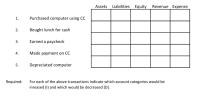 Mark which account categories apply to the
transactions.
Assets Liabilities Equity Revenue Expense 1. Purchased computer using CC 2. Bought lunch for cash 3. Earned a paycheck 4. Made payment on CC 5. Depreciated computer For each of the above transactions indicate which account categories would be inreased (I) and which would be decreased (D) Required:
Mark which account categories apply to the
transactions.
Assets Liabilities Equity Revenue Expense 1. Purchased computer using CC 2. Bought lunch for cash 3. Earned a paycheck 4. Made payment on CC 5. Depreciated computer For each of the above transactions indicate which account categories would be inreased (I) and which would be decreased (D) Required:
3. Determine the missing amount for each of the following: Assets Liabilities Owner's Equity (a) $13,000...
 3. Determine the missing amount for each of the following: Assets Liabilities Owner's Equity (a) $13,000 $16,000 $55,000 (0) $34,000 $39,000 $ 17,000 ) 4. Selected transactions completed by a proprietorship are described below. Indicate the effects of each transaction on assets, liabilities, and owner's equity by inserting "+" for increase and for decrease in the appropriate columns at the right. If appropriate, you may insert more than one symbol in a column. - ALOE ka) Received cash from owner...
CHART OF ACCOUNTS Cole Designs General Ledger ASSETS REVENUE 11 Cash 41 Fees Earned 12 Accounts...
 CHART OF ACCOUNTS Cole Designs General Ledger ASSETS REVENUE 11 Cash 41 Fees Earned 12 Accounts Receivable 14 Supplies EXPENSES 15 Prepaid Insurance 51 Wages Expense 18 Equipment 52 Supplies Expense 55 Insurance Expense 19 Accumulated Depreciation-Equipment 56 Depreciation Expense 18 Equipment 52 Supplies Expense 19 Accumulated Depreciation-Equipment 55 Insurance Expense 56 Depreciation Expense LIABILITIES 22 Wages Payable 23 Unearned Fees EQUITY 31 Ann Cole, Capital 32 Ann Cole, Drawing These financial statements were prepared from the unadjusted trial balance....
TEST 1A (Concluded) 5. The owner of equity in a partnership is called (n)... 6. The authoritative...
 TEST 1A (Concluded) 5. The owner of equity in a partnership is called (n)... 6. The authoritative body that currenty has primary responsibilty for the develpment of GAAP is The excess of expenses over revenues is refered to as 8. Amounts owed by a business to others are reterred to as 9. Resources consumed or services used in the process of earning revenue are called 10. Land was offered for sale at $75,000. If you paid $65,000 for the land,...
Mookie, Inc. had the following assets, liabilities, and stockholders' equity balances at 12/31/X1: Accounts Payable, 72;...
 Mookie, Inc. had the following assets, liabilities, and stockholders' equity balances at 12/31/X1: Accounts Payable, 72; Accounts Receivable, 145; Buildings, 545; Cash, 77 Common Stock, 110; Land, 220; -Notes Payable, 468; Retained Earnings, ??? Unearned Revenue, 98; Supplies, 59. What is the Retained Earnings balance? Report your answer to the nearest dollar. с G Search or type URL Giancarlo Stanton opened a consulting firm, Stanton Consulting. During its first month of business, the following transactions were completed: 1) Giancarlo invested...
SECTION 4: DEBITS/CREDITS (30 points) Chart of accounts Assets 101: cash Liabilities 200: AP Owners' equity...
 SECTION 4: DEBITS/CREDITS (30 points) Chart of accounts Assets 101: cash Liabilities 200: AP Owners' equity Revenue 300: capital 400: sales income 301: drawing 102:AR 201: notes payable 103: equipment expenses 500: rent expense 501: telephone expense 502: electricity expense 503: advertising expense 104: Land Instructions: For each transaction, identify which account(s) is/are debited and which is/are credited and enter them below. Do not put the account numbers Transaction #: 1 Mike put $35,000 into his business Purchased equipment for...
question 4 & 5 k Show Me How Calculator Instructions Chart of Accounts Journal T Accounts...
 question 4 & 5
k Show Me How Calculator Instructions Chart of Accounts Journal T Accounts V E nstructions Jan. 1 2 3 Sharon Matthews transferred cash from a personal bank account to an account to be used for the business, $40,000 Paid rent on office and equipment for the month, $6,000. Purchased supplies on account, $3,200. Paid creditor on account, $1,750. Earned fees, receiving cash, $18,250. Paid automobile expenses (including rental charge) for month, $1,880, and miscellaneous expenses, 4...
question 4 & 5
k Show Me How Calculator Instructions Chart of Accounts Journal T Accounts V E nstructions Jan. 1 2 3 Sharon Matthews transferred cash from a personal bank account to an account to be used for the business, $40,000 Paid rent on office and equipment for the month, $6,000. Purchased supplies on account, $3,200. Paid creditor on account, $1,750. Earned fees, receiving cash, $18,250. Paid automobile expenses (including rental charge) for month, $1,880, and miscellaneous expenses, 4...
 The chart of accounts usually lists a company's accounts in what order? assets, liabilities, shareholders' equity, expenses, revenue assets, revenues, expenses, liabilities, shareholders' equity assets, liabilities, shareholders' equity, revenues, expenses O assets, liabilities, revenues, expenses, shareholders' equity
 Home Work II State whether the items are assets, liabilities, Owner's Equity, Revenue or expense accounts. State whether they are income statement or balance sheet accounts, State whether they are permanent or temporary account. What is the normal balance for the following accounts is a debit or credit: a. Cash b. Supplies C. Notes payable d. Land e. Service revenue f. Accounts receivable & Rent expense h. Furniture i. Accounts payable j. Equipment k. Owner's Equity I. Inventory m. Rent...
 Mark which account categories apply to the
transactions.
Assets Liabilities Equity Revenue Expense 1. Purchased computer using CC 2. Bought lunch for cash 3. Earned a paycheck 4. Made payment on CC 5. Depreciated computer For each of the above transactions indicate which account categories would be inreased (I) and which would be decreased (D) Required:
Mark which account categories apply to the
transactions.
Assets Liabilities Equity Revenue Expense 1. Purchased computer using CC 2. Bought lunch for cash 3. Earned a paycheck 4. Made payment on CC 5. Depreciated computer For each of the above transactions indicate which account categories would be inreased (I) and which would be decreased (D) Required:
 3. Determine the missing amount for each of the following: Assets Liabilities Owner's Equity (a) $13,000 $16,000 $55,000 (0) $34,000 $39,000 $ 17,000 ) 4. Selected transactions completed by a proprietorship are described below. Indicate the effects of each transaction on assets, liabilities, and owner's equity by inserting "+" for increase and for decrease in the appropriate columns at the right. If appropriate, you may insert more than one symbol in a column. - ALOE ka) Received cash from owner...
 CHART OF ACCOUNTS Cole Designs General Ledger ASSETS REVENUE 11 Cash 41 Fees Earned 12 Accounts Receivable 14 Supplies EXPENSES 15 Prepaid Insurance 51 Wages Expense 18 Equipment 52 Supplies Expense 55 Insurance Expense 19 Accumulated Depreciation-Equipment 56 Depreciation Expense 18 Equipment 52 Supplies Expense 19 Accumulated Depreciation-Equipment 55 Insurance Expense 56 Depreciation Expense LIABILITIES 22 Wages Payable 23 Unearned Fees EQUITY 31 Ann Cole, Capital 32 Ann Cole, Drawing These financial statements were prepared from the unadjusted trial balance....
 TEST 1A (Concluded) 5. The owner of equity in a partnership is called (n)... 6. The authoritative body that currenty has primary responsibilty for the develpment of GAAP is The excess of expenses over revenues is refered to as 8. Amounts owed by a business to others are reterred to as 9. Resources consumed or services used in the process of earning revenue are called 10. Land was offered for sale at $75,000. If you paid $65,000 for the land,...
 Mookie, Inc. had the following assets, liabilities, and stockholders' equity balances at 12/31/X1: Accounts Payable, 72; Accounts Receivable, 145; Buildings, 545; Cash, 77 Common Stock, 110; Land, 220; -Notes Payable, 468; Retained Earnings, ??? Unearned Revenue, 98; Supplies, 59. What is the Retained Earnings balance? Report your answer to the nearest dollar. с G Search or type URL Giancarlo Stanton opened a consulting firm, Stanton Consulting. During its first month of business, the following transactions were completed: 1) Giancarlo invested...
 SECTION 4: DEBITS/CREDITS (30 points) Chart of accounts Assets 101: cash Liabilities 200: AP Owners' equity Revenue 300: capital 400: sales income 301: drawing 102:AR 201: notes payable 103: equipment expenses 500: rent expense 501: telephone expense 502: electricity expense 503: advertising expense 104: Land Instructions: For each transaction, identify which account(s) is/are debited and which is/are credited and enter them below. Do not put the account numbers Transaction #: 1 Mike put $35,000 into his business Purchased equipment for...
 question 4 & 5
k Show Me How Calculator Instructions Chart of Accounts Journal T Accounts V E nstructions Jan. 1 2 3 Sharon Matthews transferred cash from a personal bank account to an account to be used for the business, $40,000 Paid rent on office and equipment for the month, $6,000. Purchased supplies on account, $3,200. Paid creditor on account, $1,750. Earned fees, receiving cash, $18,250. Paid automobile expenses (including rental charge) for month, $1,880, and miscellaneous expenses, 4...
question 4 & 5
k Show Me How Calculator Instructions Chart of Accounts Journal T Accounts V E nstructions Jan. 1 2 3 Sharon Matthews transferred cash from a personal bank account to an account to be used for the business, $40,000 Paid rent on office and equipment for the month, $6,000. Purchased supplies on account, $3,200. Paid creditor on account, $1,750. Earned fees, receiving cash, $18,250. Paid automobile expenses (including rental charge) for month, $1,880, and miscellaneous expenses, 4...
Most questions answered within 3 hours.
-
Where is the error in this code sequence?
String s1 = "Hello";
String s2 = "ello";...
asked 10 months ago -
Financial data for Joel de Paris, Inc., for last year
follow:
Joel de Paris, Inc.
Balance...
asked 10 months ago -
Consider this reaction:
Al2(SO4)3 (aq)+ BaCl3
(aq) Al2Cl6 (aq)- +
3BaSO4(s) . What is the...
asked 10 months ago -
Suppose that Savneet is considering increasing her
recent random sample from 20 car rentals to 40...
asked 10 months ago -
Trucks arrive at an unloading terminal at an average rate of 120
per hour.
Trucks arrive...
asked 10 months ago -
Why are methanol and ethanol completely soluble in water while
octanol is not very little soluble....
asked 10 months ago -
A facilities manager at a university reads in a research report
that the mean amount of...
asked 10 months ago -
When the CuSO4 is rehydrated by adding water to the anhydrous
compound, is this an endothermic...
asked 10 months ago -
A ray of sunlight is passing from diamond into crown glass; the
angle of incidence is...
asked 10 months ago -
A block of mass 0.249 kg is placed on top of a light, vertical
spring of...
asked 10 months ago -
how do the kidneys compensate in the presences of acidosis
a) trigger hyperventilate
b) reserve acid...
asked 10 months ago -
Question 501 pts
The rental rate of capital to the firm increases. Which of the
following...
asked 10 months ago