Organic question
1.propose a mechanism for the acid catalayzed reaction of cyclohexanone with two equivalent s of methanol to give cyclohexanone dimethyl acetal?
2.propose s mechanism to the acid catalayzed rxn of benzaldehyde with methanol to yield benzaldehyde dimethyl acetal?
Homework Answers
Request Answer!
We need at least 10 more requests to produce the answer.
0 / 10 have requested this problem solution
The more requests, the faster the answer.
The equation for the reaction of benzaldehyde (C7H6O) with methanol (CH4O) to give benzaldehyde dimethyl acetal...
The equation for the reaction of benzaldehyde (C7H6O) with methanol (CH4O) to give benzaldehyde dimethyl acetal (C9H12O2) and water is given below. A catalyst is also used in the reaction but does not affect the stoichiometry. C7H6O + 2 CH4O → C9H12O2 + H2O In a reaction, 10.0 g of benzaldehyde are mixed with 2.69 g of methanol. What is the theoretical yield of benzaldehyde dimethyl acetal in grams?
4. List two different sets of reagents (each set consisting of a carbonyl compound and a...
 4. List two different sets of reagents (each set consisting of a carbonyl compound and a Grignard reagent) that could be used to synthesize each of the following secondary alcohols. [4 points each] 3H 5. Reaction of cyclohexanone with ethylene glycol in the presence of an acid catalyst gives the cyclic acetal shown. Propose a mechanism for this reaction. [8 points]
Draw the mechanism and the product(s)for the acid-catalyzed reaction of (S)-4-chloro 2-pentanone with 2 moles of...
Draw the mechanism and the product(s)for the acid-catalyzed reaction of (S)-4-chloro 2-pentanone with 2 moles of methanol; indicate which is the hemiacetal and the acetal structures. Consider how would the mechanism and the product be different if the same ketone underwent acid hydrolysis in the absence of methanol? Also, consider the reversibility of the above mechanisms.
Give a detailed mechanism using curly arrow notation for each of the following rxns. a. Cyclohexanone...
Give a detailed mechanism using curly arrow notation for each of the following rxns. a. Cyclohexanone with aniline b. 1,2-dimethylcyclopentane-1,2-diol with an acid catalyst c. 2-ethyl-3-methyl-1-butene with boron trifluoride: water complex as catalyst d. acetic acid with methanol and an acid catalyst e. butylacetoacetate with sodium ethoxide followed by n-hexylbromide then treatment with aqueous sodium hydroxide and heat f. 2,5-dimethyl-1,3-cyclohexanedione with lithiumdiisopropylamide the vinyl methyl ketone followed by sodium hydroxide and heat
this question has parts to it. i will rate. 1. 2. 3. 4. 5. What is...
 this question has parts to it. i will rate.
1.
2.
3.
4.
5.
What is the major organic product obtained from the following reaction? NCH он NH2 NaBH-CN CH,NH2 CH,OH NHCH3 NHCHs o a. 1 b. 2 C. 3 d. 4 What is the major organic product obtained from the following reaction? NNH2 NH2 H2NNH2 NHNH2 3 a. 1 O b. 2 o d. 4 What is the major organic product obtained from the following reaction? OH 人人一人人 H2NNH2...
this question has parts to it. i will rate.
1.
2.
3.
4.
5.
What is the major organic product obtained from the following reaction? NCH он NH2 NaBH-CN CH,NH2 CH,OH NHCH3 NHCHs o a. 1 b. 2 C. 3 d. 4 What is the major organic product obtained from the following reaction? NNH2 NH2 H2NNH2 NHNH2 3 a. 1 O b. 2 o d. 4 What is the major organic product obtained from the following reaction? OH 人人一人人 H2NNH2...
For 1 mole of benzaldehyde, Cannizzarro reaction can only give 0.5 mole of each product, benzoic...
For 1 mole of benzaldehyde, Cannizzarro reaction can only give 0.5 mole of each product, benzoic acid and benzyl alcohol respectively. Using the same starting material, benzaldehyde, propose a reaction to get a high yield of only one product, either benzyl alcohol or benzoic acid.
Predict the major product of the acid-catalyzed dehydration of 2,2-dimethyl-1-hexanol. Then propose a mechanism with curved...
 Predict the major product of the acid-catalyzed dehydration of
2,2-dimethyl-1-hexanol. Then propose a mechanism with curved arrows
of this reaction.
20) Predict the major product of the acid-catalyzed dehydration of 2.2-dimethyl-1-hexanol. Then propose a mechanism with curved arrows of this reaction. H2SO4 LOH heat
Predict the major product of the acid-catalyzed dehydration of
2,2-dimethyl-1-hexanol. Then propose a mechanism with curved arrows
of this reaction.
20) Predict the major product of the acid-catalyzed dehydration of 2.2-dimethyl-1-hexanol. Then propose a mechanism with curved arrows of this reaction. H2SO4 LOH heat
Please analyze this reaction for me by stating details about what happened, which group was the...
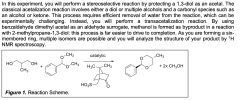 Please analyze this reaction for
me by stating details about what happened, which group was the
protecting group, and how it lead to the final product being
formed.
In this experiment, you will perform a stereoselective reaction by protecting a 1,3-diol as an acetal. The classical acetalization reaction involves either a diol or multiple alcohols and a carbonyl species such as an alcohol or ketone. This process requires efficient removal of water from the reaction, which can be experimentally challenging....
Please analyze this reaction for
me by stating details about what happened, which group was the
protecting group, and how it lead to the final product being
formed.
In this experiment, you will perform a stereoselective reaction by protecting a 1,3-diol as an acetal. The classical acetalization reaction involves either a diol or multiple alcohols and a carbonyl species such as an alcohol or ketone. This process requires efficient removal of water from the reaction, which can be experimentally challenging....
How many products would you expect from the reaction of (S)-2-methylcyclohexanone with methyl magnesium bromide (include...
 How many products would you expect from the reaction of (S)-2-methylcyclohexanone with methyl magnesium bromide (include the stereoisomers)? Draw the stereoisomers of the product and specify the relationship between them. Following is a cyclic acetal formed from cyclohexanone. What are the reagents required for this reaction? Also write a stepwise mechanism for the formation of this acetal from cyclohexanone. Show how to synthesize the following compounds using a Wittig reaction. Design the synthesis of compound A (5-(1-hydroxycyclohexyl)pentan-2-one) starting from cyclohexanone...
Postlab Assignment for Minilab 34 “Preparation of Aldol Condensation Produ...
Postlab Assignment for Minilab 34 “Preparation of Aldol Condensation Products” 1. Explain why benzaldehyde is expected to be the most reactive aldehyde among the three aldehydes used in this experiment. (used benzaldehyde, 4-methylbenzaldehyde, and 4-methoxybenzaldehyde) 2. What is the role of aqueous NaOH used in the experiment you carried out? 3. How would you change the procedures in this experiment if you wished to synthesize benzalacetophenone (C6H5CH=CHCOC6H5). Just indicate the two main organic starting materials. 4. Write a mechanism for...
 4. List two different sets of reagents (each set consisting of a carbonyl compound and a Grignard reagent) that could be used to synthesize each of the following secondary alcohols. [4 points each] 3H 5. Reaction of cyclohexanone with ethylene glycol in the presence of an acid catalyst gives the cyclic acetal shown. Propose a mechanism for this reaction. [8 points]
 this question has parts to it. i will rate.
1.
2.
3.
4.
5.
What is the major organic product obtained from the following reaction? NCH он NH2 NaBH-CN CH,NH2 CH,OH NHCH3 NHCHs o a. 1 b. 2 C. 3 d. 4 What is the major organic product obtained from the following reaction? NNH2 NH2 H2NNH2 NHNH2 3 a. 1 O b. 2 o d. 4 What is the major organic product obtained from the following reaction? OH 人人一人人 H2NNH2...
this question has parts to it. i will rate.
1.
2.
3.
4.
5.
What is the major organic product obtained from the following reaction? NCH он NH2 NaBH-CN CH,NH2 CH,OH NHCH3 NHCHs o a. 1 b. 2 C. 3 d. 4 What is the major organic product obtained from the following reaction? NNH2 NH2 H2NNH2 NHNH2 3 a. 1 O b. 2 o d. 4 What is the major organic product obtained from the following reaction? OH 人人一人人 H2NNH2...
 Predict the major product of the acid-catalyzed dehydration of
2,2-dimethyl-1-hexanol. Then propose a mechanism with curved arrows
of this reaction.
20) Predict the major product of the acid-catalyzed dehydration of 2.2-dimethyl-1-hexanol. Then propose a mechanism with curved arrows of this reaction. H2SO4 LOH heat
Predict the major product of the acid-catalyzed dehydration of
2,2-dimethyl-1-hexanol. Then propose a mechanism with curved arrows
of this reaction.
20) Predict the major product of the acid-catalyzed dehydration of 2.2-dimethyl-1-hexanol. Then propose a mechanism with curved arrows of this reaction. H2SO4 LOH heat
 Please analyze this reaction for
me by stating details about what happened, which group was the
protecting group, and how it lead to the final product being
formed.
In this experiment, you will perform a stereoselective reaction by protecting a 1,3-diol as an acetal. The classical acetalization reaction involves either a diol or multiple alcohols and a carbonyl species such as an alcohol or ketone. This process requires efficient removal of water from the reaction, which can be experimentally challenging....
Please analyze this reaction for
me by stating details about what happened, which group was the
protecting group, and how it lead to the final product being
formed.
In this experiment, you will perform a stereoselective reaction by protecting a 1,3-diol as an acetal. The classical acetalization reaction involves either a diol or multiple alcohols and a carbonyl species such as an alcohol or ketone. This process requires efficient removal of water from the reaction, which can be experimentally challenging....
 How many products would you expect from the reaction of (S)-2-methylcyclohexanone with methyl magnesium bromide (include the stereoisomers)? Draw the stereoisomers of the product and specify the relationship between them. Following is a cyclic acetal formed from cyclohexanone. What are the reagents required for this reaction? Also write a stepwise mechanism for the formation of this acetal from cyclohexanone. Show how to synthesize the following compounds using a Wittig reaction. Design the synthesis of compound A (5-(1-hydroxycyclohexyl)pentan-2-one) starting from cyclohexanone...
Most questions answered within 3 hours.
-
Where is the error in this code sequence?
String s1 = "Hello";
String s2 = "ello";...
asked 10 months ago -
Financial data for Joel de Paris, Inc., for last year
follow:
Joel de Paris, Inc.
Balance...
asked 10 months ago -
Consider this reaction:
Al2(SO4)3 (aq)+ BaCl3
(aq) Al2Cl6 (aq)- +
3BaSO4(s) . What is the...
asked 10 months ago -
Suppose that Savneet is considering increasing her
recent random sample from 20 car rentals to 40...
asked 10 months ago -
Trucks arrive at an unloading terminal at an average rate of 120
per hour.
Trucks arrive...
asked 10 months ago -
Why are methanol and ethanol completely soluble in water while
octanol is not very little soluble....
asked 10 months ago -
A facilities manager at a university reads in a research report
that the mean amount of...
asked 10 months ago -
When the CuSO4 is rehydrated by adding water to the anhydrous
compound, is this an endothermic...
asked 10 months ago -
A ray of sunlight is passing from diamond into crown glass; the
angle of incidence is...
asked 10 months ago -
A block of mass 0.249 kg is placed on top of a light, vertical
spring of...
asked 10 months ago -
how do the kidneys compensate in the presences of acidosis
a) trigger hyperventilate
b) reserve acid...
asked 10 months ago -
Question 501 pts
The rental rate of capital to the firm increases. Which of the
following...
asked 10 months ago