Identify the locations for chelation on ethylenediaminetetraacetic acid. (EDTA)
Identify the locations for chelation on ethylenediaminetetraacetic acid. (EDTA)
Homework Answers
Request Answer!
We need at least 10 more requests to produce the answer.
0 / 10 have requested this problem solution
The more requests, the faster the answer.
Add Answer to:
Identify the locations for chelation on
ethylenediaminetetraacetic acid. (EDTA)
2. Ethylenediaminetetraacetic acid (EDTA) is used for a range of applications because of its ability to...
 2. Ethylenediaminetetraacetic acid (EDTA) is used for a range of applications because of its ability to strongly bind metal ions via its six ligating groups. EDTA is used in the paper industry to bind Mn2+ (and other metal) ions from catalyzing the decomposition of hydrogen peroxide (H2O2), which is an important chemical for bleaching the pulp. In this example, we are going to focus on the chelation of free Mn2+ ions in a solution at pH = 7. a) If...
Ethylenediaminetetraacetic acid (EDTA) is used for a range of applications because of its ability to strongly...
 Ethylenediaminetetraacetic acid (EDTA) is used for a range of applications because of its ability to strongly bind metal ions via its six ligating groups. EDTA is used in the paper industry to bind Mn2+ (and other metal) ions from catalyzing the decomposition of hydrogen peroxide (H2O2), which is an important chemical for bleaching the pulp. In this example, we are going to focus on the chelation of free Mn2+ ions in a solution at pH = 7. (a) If there...
EDTA (ethylenediaminetetraacetic acid), a widely used complexing agent, is a tetraprotic acid with the following pK_a...
 EDTA (ethylenediaminetetraacetic acid), a widely used complexing agent, is a tetraprotic acid with the following pK_a values: pK_a1 = 2.16; pK_a2 = 3.12; pK_a3 = 6.27; pK_a4 = 10.95. Write the expressions for alpha_1, alpha_2, alpha_3, and alpha_4 and determine the numerical value of each at pH 7.0.
Ethylenediaminetetraacetic acid (EDTA) is a hexaprotic acid with the following structure and pK values. HOOC- COOH...
 Ethylenediaminetetraacetic acid (EDTA) is a hexaprotic acid with the following structure and pK values. HOOC- COOH - NHA THN PK 0.000 PK 1.500 PK 1.991 PK, 2.669 PK 6.160 PK, 10.259 HOOC COOH For simplicity, the fully protonated form of the acid is commonly represented as HY”. The fully deprotonated form of EDTA (Y") reacts with a variety of metal cations to produce complex ions, M" (aq) +Y+ (aq) MY(aq) K= aK where K is the formation constant for the...
IS Ethylenediaminetetraacetic acid, EDTA, may be considered a tetraprotic acid (HAEDTA) 1) Weinha wid and the...
 IS Ethylenediaminetetraacetic acid, EDTA, may be considered a tetraprotic acid (HAEDTA) 1) Weinha wid and the four base equilibria associated with this aqueous system; 2) write the equilibrium constant anreccions: Kat, Kaka, Kat, Khl, Kb2, Kby, Kod and 3) prove and define four expressions for: K. in terms of the four acid and four base equilibrium constants.
EDTA (ethylenediaminetetraacetic acid) is the most widely used metal chelator in analytical chemistry, which forms strong...
EDTA (ethylenediaminetetraacetic acid) is the most widely used metal chelator in analytical chemistry, which forms strong 1:1 complexes with most metal ions. Water hardness can be determined by titrating Ca2+, Mg2+ and other metal ions with EDTA. During the titration, ammonium-ammonium chloride buffer is often used. Which of the following descriptions about the function of ammonium-ammonium chloride is/are correct? To act as a masking agent To form complex with Ca2+ and Mg2+ To be used as a metal ion indicator...
10. EDTA (C10H16N208) is an aminopolycarboxylic acid, widely used for scavenging metal ions. EDTA has high...
 10. EDTA (C10H16N208) is an aminopolycarboxylic acid, widely used for scavenging metal ions. EDTA has high denticity, and can displace the H2O ligands that bind to hydrated metal cations. For example: [Fe(H2O).]3+ (aq) + EDTA (aq) → Fe-EDTA'(aq) + 6H20 (1) Explain conceptually, what you think drives the aforementioned reaction (enthalpy or entropy), and why.
I know that i must make an ice chart and when i do, i get zero for both of the products.
 I know that i must make an ice chart and when i do, i get zero
for both of the products.
11. Ethylenediamminetetraacetic acid (EDTA ) binds metals ions to form complexes, thus can be used to determine concentrations of metal ions, as well as for use in chelation therapy. Calculate the concentration of [Co2] in solution after the addition of 48.0 mL of 0.050 M EDTA to a 50.00-ml sample of 0.048 M [Co]. 10 pts
11. Ethylenediamminetetraacetic acid...
I know that i must make an ice chart and when i do, i get zero
for both of the products.
11. Ethylenediamminetetraacetic acid (EDTA ) binds metals ions to form complexes, thus can be used to determine concentrations of metal ions, as well as for use in chelation therapy. Calculate the concentration of [Co2] in solution after the addition of 48.0 mL of 0.050 M EDTA to a 50.00-ml sample of 0.048 M [Co]. 10 pts
11. Ethylenediamminetetraacetic acid...
Find information on: 1. DDT 2. EDTA 3. orotic acid 4. carboplatin 2. Propose the approximate...
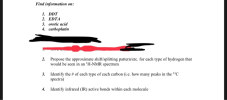 Find information on: 1. DDT 2. EDTA 3. orotic acid 4. carboplatin 2. Propose the approximate shift/splitting pattern/etc. for each type of hydrogen that would be seen in an 'H-NMR spectrum Identify the # of each type of each carbon (i.e. how many peaks in the "c spectra) 4. Identify infrared (IR) active bonds within each molecule
Nitrilotriacetic acid is a tetraprotic acid and a tetradentate ligand, that unlike EDTA is biodegradable. It...
 Nitrilotriacetic acid is a tetraprotic acid and a tetradentate
ligand, that unlike EDTA is biodegradable. It is used as a water
softener in detergents to bind multiply charged cations such as
Ca2+ and Fe3+. K1 = 0.100; K2= 1.55E-2; K3=3.02E-3; K4=3.47E-10.
The active species for binding metals is the tetradeprotonated
form, so calculate α4for pH = 8.847. (the
pH's have 3 significant figures in case the trailing zero is
lost)
Nitrilotriacetic acid is a tetraprotic acid and a tetradentate
ligand, that unlike EDTA is biodegradable. It is used as a water
softener in detergents to bind multiply charged cations such as
Ca2+ and Fe3+. K1 = 0.100; K2= 1.55E-2; K3=3.02E-3; K4=3.47E-10.
The active species for binding metals is the tetradeprotonated
form, so calculate α4for pH = 8.847. (the
pH's have 3 significant figures in case the trailing zero is
lost)
 2. Ethylenediaminetetraacetic acid (EDTA) is used for a range of applications because of its ability to strongly bind metal ions via its six ligating groups. EDTA is used in the paper industry to bind Mn2+ (and other metal) ions from catalyzing the decomposition of hydrogen peroxide (H2O2), which is an important chemical for bleaching the pulp. In this example, we are going to focus on the chelation of free Mn2+ ions in a solution at pH = 7. a) If...
 Ethylenediaminetetraacetic acid (EDTA) is used for a range of applications because of its ability to strongly bind metal ions via its six ligating groups. EDTA is used in the paper industry to bind Mn2+ (and other metal) ions from catalyzing the decomposition of hydrogen peroxide (H2O2), which is an important chemical for bleaching the pulp. In this example, we are going to focus on the chelation of free Mn2+ ions in a solution at pH = 7. (a) If there...
 EDTA (ethylenediaminetetraacetic acid), a widely used complexing agent, is a tetraprotic acid with the following pK_a values: pK_a1 = 2.16; pK_a2 = 3.12; pK_a3 = 6.27; pK_a4 = 10.95. Write the expressions for alpha_1, alpha_2, alpha_3, and alpha_4 and determine the numerical value of each at pH 7.0.
 Ethylenediaminetetraacetic acid (EDTA) is a hexaprotic acid with the following structure and pK values. HOOC- COOH - NHA THN PK 0.000 PK 1.500 PK 1.991 PK, 2.669 PK 6.160 PK, 10.259 HOOC COOH For simplicity, the fully protonated form of the acid is commonly represented as HY”. The fully deprotonated form of EDTA (Y") reacts with a variety of metal cations to produce complex ions, M" (aq) +Y+ (aq) MY(aq) K= aK where K is the formation constant for the...
 IS Ethylenediaminetetraacetic acid, EDTA, may be considered a tetraprotic acid (HAEDTA) 1) Weinha wid and the four base equilibria associated with this aqueous system; 2) write the equilibrium constant anreccions: Kat, Kaka, Kat, Khl, Kb2, Kby, Kod and 3) prove and define four expressions for: K. in terms of the four acid and four base equilibrium constants.
 10. EDTA (C10H16N208) is an aminopolycarboxylic acid, widely used for scavenging metal ions. EDTA has high denticity, and can displace the H2O ligands that bind to hydrated metal cations. For example: [Fe(H2O).]3+ (aq) + EDTA (aq) → Fe-EDTA'(aq) + 6H20 (1) Explain conceptually, what you think drives the aforementioned reaction (enthalpy or entropy), and why.
 I know that i must make an ice chart and when i do, i get zero
for both of the products.
11. Ethylenediamminetetraacetic acid (EDTA ) binds metals ions to form complexes, thus can be used to determine concentrations of metal ions, as well as for use in chelation therapy. Calculate the concentration of [Co2] in solution after the addition of 48.0 mL of 0.050 M EDTA to a 50.00-ml sample of 0.048 M [Co]. 10 pts
11. Ethylenediamminetetraacetic acid...
I know that i must make an ice chart and when i do, i get zero
for both of the products.
11. Ethylenediamminetetraacetic acid (EDTA ) binds metals ions to form complexes, thus can be used to determine concentrations of metal ions, as well as for use in chelation therapy. Calculate the concentration of [Co2] in solution after the addition of 48.0 mL of 0.050 M EDTA to a 50.00-ml sample of 0.048 M [Co]. 10 pts
11. Ethylenediamminetetraacetic acid...
 Find information on: 1. DDT 2. EDTA 3. orotic acid 4. carboplatin 2. Propose the approximate shift/splitting pattern/etc. for each type of hydrogen that would be seen in an 'H-NMR spectrum Identify the # of each type of each carbon (i.e. how many peaks in the "c spectra) 4. Identify infrared (IR) active bonds within each molecule
 Nitrilotriacetic acid is a tetraprotic acid and a tetradentate
ligand, that unlike EDTA is biodegradable. It is used as a water
softener in detergents to bind multiply charged cations such as
Ca2+ and Fe3+. K1 = 0.100; K2= 1.55E-2; K3=3.02E-3; K4=3.47E-10.
The active species for binding metals is the tetradeprotonated
form, so calculate α4for pH = 8.847. (the
pH's have 3 significant figures in case the trailing zero is
lost)
Nitrilotriacetic acid is a tetraprotic acid and a tetradentate
ligand, that unlike EDTA is biodegradable. It is used as a water
softener in detergents to bind multiply charged cations such as
Ca2+ and Fe3+. K1 = 0.100; K2= 1.55E-2; K3=3.02E-3; K4=3.47E-10.
The active species for binding metals is the tetradeprotonated
form, so calculate α4for pH = 8.847. (the
pH's have 3 significant figures in case the trailing zero is
lost)
Most questions answered within 3 hours.
-
Where is the error in this code sequence?
String s1 = "Hello";
String s2 = "ello";...
asked 10 months ago -
Financial data for Joel de Paris, Inc., for last year
follow:
Joel de Paris, Inc.
Balance...
asked 10 months ago -
Consider this reaction:
Al2(SO4)3 (aq)+ BaCl3
(aq) Al2Cl6 (aq)- +
3BaSO4(s) . What is the...
asked 10 months ago -
Suppose that Savneet is considering increasing her
recent random sample from 20 car rentals to 40...
asked 10 months ago -
Trucks arrive at an unloading terminal at an average rate of 120
per hour.
Trucks arrive...
asked 10 months ago -
Why are methanol and ethanol completely soluble in water while
octanol is not very little soluble....
asked 10 months ago -
A facilities manager at a university reads in a research report
that the mean amount of...
asked 10 months ago -
When the CuSO4 is rehydrated by adding water to the anhydrous
compound, is this an endothermic...
asked 10 months ago -
A ray of sunlight is passing from diamond into crown glass; the
angle of incidence is...
asked 10 months ago -
A block of mass 0.249 kg is placed on top of a light, vertical
spring of...
asked 10 months ago -
how do the kidneys compensate in the presences of acidosis
a) trigger hyperventilate
b) reserve acid...
asked 10 months ago -
Question 501 pts
The rental rate of capital to the firm increases. Which of the
following...
asked 10 months ago