You are given the following: C = 1.0Q2 + 40Q +75 and p = 160 -...
You are given the following:
C = 1.0Q2 + 40Q +75
and
p = 160 - 1Q
where Q is output, p is price, and C is the total cost of production. Determine the profit-maximizing price and output for a monopoly.
Homework Answers
A monopolist maximizes profit according to the rule: MR = MC
MC = dC/dQ = 2(1Q) + 40 = 2Q + 40
p = 160 - Q
So, Total Revenue, TR = P*Q = (160 - Q)*Q = 160Q -
Q2
So, Marginal Revenue, MR = d(TR)/dQ = 160 - 2Q
Now, MR = MC gives,
160 - 2Q = 2Q + 40
So, 2Q + 2Q = 160 - 40
So, 4Q = 120
So, Q = 120/4
So, Q = 30
P = 160 - Q = 160 - 30 = 130
Thus, P = 130
You are given the following: Cost = 3.0q2 + 209 + F, Marginal Cost = c...
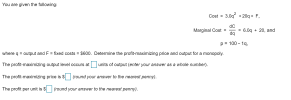 You are given the following: Cost = 3.0q2 + 209 + F, Marginal Cost = c = 6.0q + 20, and p = 100 – 19, where q = output and F = fixed costs = $600. Determine the profit-maximizing price and output for a monopoly. The profit-maximizing output level occurs at units of output (enter your answer as a whole number). The profit-maximizing price is $ (round your answer to the nearest penny). The profit per unit is $...
4. In a market for dry cleaning, the inverse market demand function is given by P=160-10...
 4. In a market for dry cleaning, the inverse market demand function is given by P=160-10 and the (private) marginal cost of production for the aggregation of all dry dleaning firms is given by MC- 10+1Q. Finally, the pollution generated by the dry cleaning process creates external damages given by the marginal external cost curve MEC 1Q Calculate the output and price of dry cleaning if it is produced under competitive cond tions without regulation. The competitive equilbrium quanity is...
Given the equation P=$6.00 - $.40Q,where P is the price of the good and Q is...
Given the equation P=$6.00 - $.40Q,where P is the price of the good and Q is the quantity of the Good demanded,how many units will this consumer demand if the price is $3.60?
The monopoly’s cost is a function of its output, which is C(Q)=Q2+12, and the monopoly faces...
The monopoly’s cost is a function of its output, which is C(Q)=Q2+12, and the monopoly faces the linear inverse demand function: P=24—Q (1) Calculate the following items: marginal cost, average fixed cost, average variable cost, average total cost, and marginal revenue (2) Calculate profit-maximizing output and profit-maximizing price, determine its economic profit
Assume a (natural) monopolist operates with total costs C = 600+40Q. Market demand for their product...
Assume a (natural) monopolist operates with total costs C = 600+40Q. Market demand for their product is Q = 120 – P (hint: a diagram will help you with this question). a) If a regulator sets price at marginal cost in this market, what is themonopolist’s profit? Show your work. b) Suppose that in the absence of regulation, average cost pricing is chosen by the monopolist instead of MC pricing. Find market price, output and deadweight loss compared to the...
A monopoly's cost function (C) is: C=0.2Q^3-8.0Q^2+380Q+50 where Q is output. Demand is: p=560-2Q Determine the...
A monopoly's cost function (C) is: C=0.2Q^3-8.0Q^2+380Q+50 where Q is output. Demand is: p=560-2Q Determine the profit maximizing price and output for the monopolist. The profit-maximizing output level is _ units of output. The profit-maximizing price is _
How do I solve this problem? 4. Benson's Park is a monopolist in the local camping market in the town of West Anderson. They face an inverse demand curve given by P-400-8Q, where Q is the number o...
 How do I solve this problem?
4. Benson's Park is a monopolist in the local camping market in the town of West Anderson. They face an inverse demand curve given by P-400-8Q, where Q is the number of tickets they sell. The park's cost function is C(Q)-100+160 Write down Benson's profit function (2 point) Find the first-order condition for profit maximization. (2 points) Find the profit-maximizing price and quantity, and the maximum profit. (3 points) a. b. c. d. Calculate...
How do I solve this problem?
4. Benson's Park is a monopolist in the local camping market in the town of West Anderson. They face an inverse demand curve given by P-400-8Q, where Q is the number of tickets they sell. The park's cost function is C(Q)-100+160 Write down Benson's profit function (2 point) Find the first-order condition for profit maximization. (2 points) Find the profit-maximizing price and quantity, and the maximum profit. (3 points) a. b. c. d. Calculate...
2. Suppose that a firm faces the demand curve. P 300-40. where P denotes price in...
 2. Suppose that a firm faces the demand curve. P 300-40. where P denotes price in dollars and O denotes total unit sales. The cost equation is TC 300+92Q. a. Determine the firm's profit-maximizing output and price. 2 points b. Given the output (Q) value from part a, compute Total cost and Marginal cost when the cost equation is TC 300+92Q: 1 point c. Suppose that there is a change in the production process so that the cost equation becomes...
Fill in the Table for a monopoly. Q P TR TC Profit MR MC 10 $20...
Fill in the Table for a monopoly. Q P TR TC Profit MR MC 10 $20 $150 11 19 155 12 18 161 13 17 170 14 16 185 39 15 15 210 What is the highest profit possible? What is the profit maximizing level of output? What is the profit maximizing price? Draw the graph for a monopoly below, find the profit maximizing level of output Q*, the profit maximizing price P*, the average total cost ATC*, the profit...
1. A perfectly competitive firm sells its product for $360/unit and has an average total cost...
1. A perfectly competitive firm sells its product for $360/unit and has an average total cost function given by: ATC(Q) = 1000/Q + 30 + 1.5Q. a. What are this firm’s fixed costs? Explain. b. Determine this firm’s profit maximizing level of output. c. Calculate this firm’s profits. 2. A perfectly competitive firm sells its product for $200/unit and has a total cost of production given by: C(Q) = 1500 + 40Q+5Q2 . a. What are this firm’s fixed costs?...
 You are given the following: Cost = 3.0q2 + 209 + F, Marginal Cost = c = 6.0q + 20, and p = 100 – 19, where q = output and F = fixed costs = $600. Determine the profit-maximizing price and output for a monopoly. The profit-maximizing output level occurs at units of output (enter your answer as a whole number). The profit-maximizing price is $ (round your answer to the nearest penny). The profit per unit is $...
 4. In a market for dry cleaning, the inverse market demand function is given by P=160-10 and the (private) marginal cost of production for the aggregation of all dry dleaning firms is given by MC- 10+1Q. Finally, the pollution generated by the dry cleaning process creates external damages given by the marginal external cost curve MEC 1Q Calculate the output and price of dry cleaning if it is produced under competitive cond tions without regulation. The competitive equilbrium quanity is...
 How do I solve this problem?
4. Benson's Park is a monopolist in the local camping market in the town of West Anderson. They face an inverse demand curve given by P-400-8Q, where Q is the number of tickets they sell. The park's cost function is C(Q)-100+160 Write down Benson's profit function (2 point) Find the first-order condition for profit maximization. (2 points) Find the profit-maximizing price and quantity, and the maximum profit. (3 points) a. b. c. d. Calculate...
How do I solve this problem?
4. Benson's Park is a monopolist in the local camping market in the town of West Anderson. They face an inverse demand curve given by P-400-8Q, where Q is the number of tickets they sell. The park's cost function is C(Q)-100+160 Write down Benson's profit function (2 point) Find the first-order condition for profit maximization. (2 points) Find the profit-maximizing price and quantity, and the maximum profit. (3 points) a. b. c. d. Calculate...
 2. Suppose that a firm faces the demand curve. P 300-40. where P denotes price in dollars and O denotes total unit sales. The cost equation is TC 300+92Q. a. Determine the firm's profit-maximizing output and price. 2 points b. Given the output (Q) value from part a, compute Total cost and Marginal cost when the cost equation is TC 300+92Q: 1 point c. Suppose that there is a change in the production process so that the cost equation becomes...
Most questions answered within 3 hours.
-
Where is the error in this code sequence?
String s1 = "Hello";
String s2 = "ello";...
asked 11 months ago -
Financial data for Joel de Paris, Inc., for last year
follow:
Joel de Paris, Inc.
Balance...
asked 11 months ago -
Consider this reaction:
Al2(SO4)3 (aq)+ BaCl3
(aq) Al2Cl6 (aq)- +
3BaSO4(s) . What is the...
asked 11 months ago -
Suppose that Savneet is considering increasing her
recent random sample from 20 car rentals to 40...
asked 11 months ago -
Trucks arrive at an unloading terminal at an average rate of 120
per hour.
Trucks arrive...
asked 11 months ago -
Why are methanol and ethanol completely soluble in water while
octanol is not very little soluble....
asked 11 months ago -
A facilities manager at a university reads in a research report
that the mean amount of...
asked 11 months ago -
When the CuSO4 is rehydrated by adding water to the anhydrous
compound, is this an endothermic...
asked 11 months ago -
A ray of sunlight is passing from diamond into crown glass; the
angle of incidence is...
asked 11 months ago -
A block of mass 0.249 kg is placed on top of a light, vertical
spring of...
asked 11 months ago -
how do the kidneys compensate in the presences of acidosis
a) trigger hyperventilate
b) reserve acid...
asked 11 months ago -
Question 501 pts
The rental rate of capital to the firm increases. Which of the
following...
asked 11 months ago