#include <iostream> using namespace std; class BinarySearchTree{ public: int size; int...
#include <iostream>
using namespace std;
class BinarySearchTree{
public:
int size;
int *array;
BinarySearchTree(int size){
int newSize =
extendSize(size);
array = new
int[newSize];
for(int x = 0; x
< size; ++x){
array[x] = NULL;
}
}
}
Given the code above implement the following:
5. Write a function that displays all the left sub
roots of that tree.
6. Write a function that counts and displays the
number of leafs in the tree.
7. Write a function that displays only the leafs of
the tree.
Homework Answers
#include <iostream>

using namespace std;

class BinarySearchTree{
   public:
       int size;
       int *array;


       BinarySearchTree(int size){
           int newSize = extendSize(size);
           array = new int[newSize];
           for(int x = 0; x < size; ++x){
               array[x] = NULL;
           }
                   this->size = newSize;
       }

           void printLeftSubroots() {
                        int start = 0;

                        while(start < size) {
                                cout << array[start];
                                start = 2*start + 1;
                        }
           }


           void countLeafs() {
                        int count = 0;
                        for(int i=size-1; i>=0; i++) {
                                if(array[i] != NULL) {
                                        int l = 2*i + 1;
                                        int r = 2*i + 2;

                                        // if no left and right child present, then it is a leaf
                                        if(l >= size && r>= size) {
                                                count++;
                                        }
                                }
                        }
                        cout << "num Leafs: " << count << endl;
           }

           void printLeafs() {
                        int count = 0;
                        for(int i=size-1; i>=0; i++) {
                                if(array[i] != NULL) {
                                        int l = 2*i + 1;
                                        int r = 2*i + 2;

                                        if(l >= size && r>= size) {
                                                cout << array[i] << endl;
                                        }
                                }
                        }
           }
}
Add Answer to:
#include <iostream>
using namespace std;
class BinarySearchTree{
public:
int size;
int...
#include <iostream> #include <cstddef> using std::cout; using std::endl; class Node { int value; public: Node* left;...
#include <iostream> #include <cstddef> using std::cout; using std::endl; class Node { int value; public: Node* left; // left child Node* right; // right child Node* p; // parent Node(int data) { value = data; left = NULL; right = NULL; p = NULL; } ~Node() { } int d() { return value; } void print() { std::cout << value << std::endl; } }; int main(int argc, const char * argv[]) { } function insert(Node *insert_node, Node *tree_root){ //Your code here...
#include <iostream> using namespace std; int * newZeroArray(int size) { //your code here } int main()...
 #include <iostream>
using namespace std;
int * newZeroArray(int size) {
//your code here
}
int main() {
int size = 10;
int * A = newZeroArray(size);
for(int i = 0; i < size; i++)
cout << A[i] << " ";
cout << endl;
}Write a function that takes a size, creates a new array of that size with all zeros, and returns the array. If the size is not a valid size for an array, do not return a valid...
#include <iostream>
using namespace std;
int * newZeroArray(int size) {
//your code here
}
int main() {
int size = 10;
int * A = newZeroArray(size);
for(int i = 0; i < size; i++)
cout << A[i] << " ";
cout << endl;
}Write a function that takes a size, creates a new array of that size with all zeros, and returns the array. If the size is not a valid size for an array, do not return a valid...
#include<iostream> using namespace std; class TNode { public: int val; TNode(){} TNode(int v){val = v;} TNode...
 #include<iostream>
using namespace std;
class TNode
{
public:
int val;
TNode(){}
TNode(int v){val = v;}
TNode * left;
TNode * right;
TNode * parent;
};
class BTree
{
public:
//constructors and destructor
BTree();
BTree(TNode *r);// initialize BTree with the root r. r is the
only node.
BTree(const BTree & t); // copy constructor
BTree(const int *p, const int n);// similar to the copy
constructor, but your input is of the array form.
// input is given an array that denotes...
#include<iostream>
using namespace std;
class TNode
{
public:
int val;
TNode(){}
TNode(int v){val = v;}
TNode * left;
TNode * right;
TNode * parent;
};
class BTree
{
public:
//constructors and destructor
BTree();
BTree(TNode *r);// initialize BTree with the root r. r is the
only node.
BTree(const BTree & t); // copy constructor
BTree(const int *p, const int n);// similar to the copy
constructor, but your input is of the array form.
// input is given an array that denotes...
Analyze the following code. #include <iostream> using namespace std; class B { public: B() { };...
Analyze the following code. #include <iostream> using namespace std; class B { public: B() { }; int k; }; int main() { B b; cout << b.k << endl; return 0; } The program has a compile error because b.k cannot be accessed. The program has a runtime error because b.k does not have a value. The program displays unpredictable number. The program displays 1.
use c++ and complete this lab #include <iostream> using namespace std; class FibObj { public: void...
use c++ and complete this lab #include <iostream> using namespace std; class FibObj { public: void setSize() { cout << "Enter an integer larger than 2: "; cin >> size; } int getSize() { return size; } void fibTerms(int x) // Write a recursive function { } explicit FibObj() // Default constructor was made explicit to avoid possible implicit type conversion { setSize(); int *arr; arr = new int[getSize()]; arr[0] = 1; arr[1] = 1; // Call recursive function here...
#include <iostream> using namespace std; int main(void) { int SIZE; cout<<"Enter the size of the...
#include <iostream> using namespace std; int main(void) { int SIZE; cout<<"Enter the size of the array"<<endl; cin>>SIZE; int *numlist = new int[SIZE]; // Read SIZE integers from the keyboard for (int i = 0; i<SIZE; i++ ) { cout << "Enter value #" << i+1 << ": "; cin >> numlist[i]; } // Display the numbers in a reverse order for (int i = SIZE; i > 0; i--...
What is the output of this program? #include <iostream> using namespace std; class rect { int...
What is the output of this program? #include <iostream> using namespace std; class rect { int x, y; public: void val (int, int); int area () { return (x * y); } }; void rect::val (int a, int b) { x = a; y = b; } int main () { rect rect; rect.val (3, 4); cout << "rect area: " << rect.area(); return 0; } a) rect area:7 b) rect area: 12 c) rect area:24 d) none of the...
What is printed by the following program? (read the code carefully) #include <iostream> using namespace std;...
What is printed by the following program? (read the code carefully) #include <iostream> using namespace std; class A { public: int x; }; int main() { A *a = new A; A *b = new A; a->x=1; b->x=1; if (a == b) { cout << "black"; } else { cout << "white"; } delete a; delete b; return 0; }
(10 pts)3-1. Given the following piece of code #define SIZE 10 include <iostream> using namespace std;...
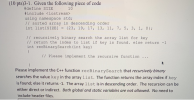 (10 pts)3-1. Given the following piece of code #define SIZE 10 include <iostream> using namespace std; // sorted array in descending order int list[SIZE] (23, 19, 17, 13, 11, 7, 5, 3, 1, 0); // recursively binary search the array list for key // return the index to list if key is found. else return -1 int recBinarySearch (int key) // Please implement the recursive function.. Please implement the C++ function recBinarySearch that recursively binary searches the value key in...
One dimensional array What this code print #include <iostream> using namespace std; int main () {...
 One dimensional array What this code print #include <iostream> using namespace std; int main () { const int SIZE = 7; int numbers [SIZE] = {1, 2, 4, 8): // Initialize first 4 elements cout << Here are the contents of the array:\n"; for (int index = 0; index < SIZE: index++} cout << numbers[index] << ; cout << endl; return 0; }
 #include <iostream>
using namespace std;
int * newZeroArray(int size) {
//your code here
}
int main() {
int size = 10;
int * A = newZeroArray(size);
for(int i = 0; i < size; i++)
cout << A[i] << " ";
cout << endl;
}Write a function that takes a size, creates a new array of that size with all zeros, and returns the array. If the size is not a valid size for an array, do not return a valid...
#include <iostream>
using namespace std;
int * newZeroArray(int size) {
//your code here
}
int main() {
int size = 10;
int * A = newZeroArray(size);
for(int i = 0; i < size; i++)
cout << A[i] << " ";
cout << endl;
}Write a function that takes a size, creates a new array of that size with all zeros, and returns the array. If the size is not a valid size for an array, do not return a valid...
 #include<iostream>
using namespace std;
class TNode
{
public:
int val;
TNode(){}
TNode(int v){val = v;}
TNode * left;
TNode * right;
TNode * parent;
};
class BTree
{
public:
//constructors and destructor
BTree();
BTree(TNode *r);// initialize BTree with the root r. r is the
only node.
BTree(const BTree & t); // copy constructor
BTree(const int *p, const int n);// similar to the copy
constructor, but your input is of the array form.
// input is given an array that denotes...
#include<iostream>
using namespace std;
class TNode
{
public:
int val;
TNode(){}
TNode(int v){val = v;}
TNode * left;
TNode * right;
TNode * parent;
};
class BTree
{
public:
//constructors and destructor
BTree();
BTree(TNode *r);// initialize BTree with the root r. r is the
only node.
BTree(const BTree & t); // copy constructor
BTree(const int *p, const int n);// similar to the copy
constructor, but your input is of the array form.
// input is given an array that denotes...
 (10 pts)3-1. Given the following piece of code #define SIZE 10 include <iostream> using namespace std; // sorted array in descending order int list[SIZE] (23, 19, 17, 13, 11, 7, 5, 3, 1, 0); // recursively binary search the array list for key // return the index to list if key is found. else return -1 int recBinarySearch (int key) // Please implement the recursive function.. Please implement the C++ function recBinarySearch that recursively binary searches the value key in...
 One dimensional array What this code print #include <iostream> using namespace std; int main () { const int SIZE = 7; int numbers [SIZE] = {1, 2, 4, 8): // Initialize first 4 elements cout << Here are the contents of the array:\n"; for (int index = 0; index < SIZE: index++} cout << numbers[index] << ; cout << endl; return 0; }
Most questions answered within 3 hours.
-
Where is the error in this code sequence?
String s1 = "Hello";
String s2 = "ello";...
asked 11 months ago -
Financial data for Joel de Paris, Inc., for last year
follow:
Joel de Paris, Inc.
Balance...
asked 11 months ago -
Consider this reaction:
Al2(SO4)3 (aq)+ BaCl3
(aq) Al2Cl6 (aq)- +
3BaSO4(s) . What is the...
asked 11 months ago -
Suppose that Savneet is considering increasing her
recent random sample from 20 car rentals to 40...
asked 11 months ago -
Trucks arrive at an unloading terminal at an average rate of 120
per hour.
Trucks arrive...
asked 11 months ago -
Why are methanol and ethanol completely soluble in water while
octanol is not very little soluble....
asked 11 months ago -
A facilities manager at a university reads in a research report
that the mean amount of...
asked 11 months ago -
When the CuSO4 is rehydrated by adding water to the anhydrous
compound, is this an endothermic...
asked 11 months ago -
A ray of sunlight is passing from diamond into crown glass; the
angle of incidence is...
asked 11 months ago -
A block of mass 0.249 kg is placed on top of a light, vertical
spring of...
asked 11 months ago -
how do the kidneys compensate in the presences of acidosis
a) trigger hyperventilate
b) reserve acid...
asked 11 months ago -
Question 501 pts
The rental rate of capital to the firm increases. Which of the
following...
asked 11 months ago