Consider a shell-and-tube heat exchanger. Air with a flow rate of 1.5 kg/s at 500°C and...
Consider a shell-and-tube heat exchanger. Air with a flow rate
of
1.5 kg/s at 500°C and at atmospheric pressure flows through
200
parallel tubes. Each tube has an internal diameter of 2 cm
and
length of 4 m. Assume that the D/D0 = 0.5 data can be used
for
the contraction and enlargement. The outlet temperature of
the
cooled air is 100°C. Calculate the pressure drop for
a. The abrupt contraction
b. Friction
c. Acceleration
d. Enlargement
and compare the total pressure drop with the frictional
pressure
drop.
Homework Answers
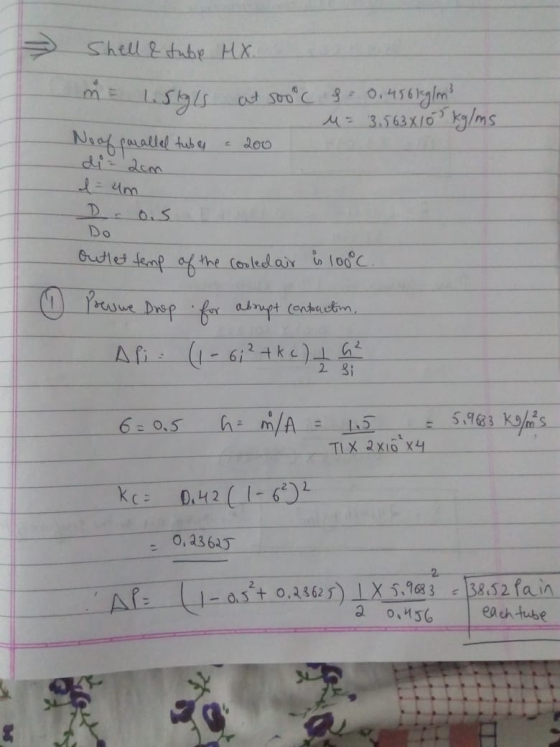
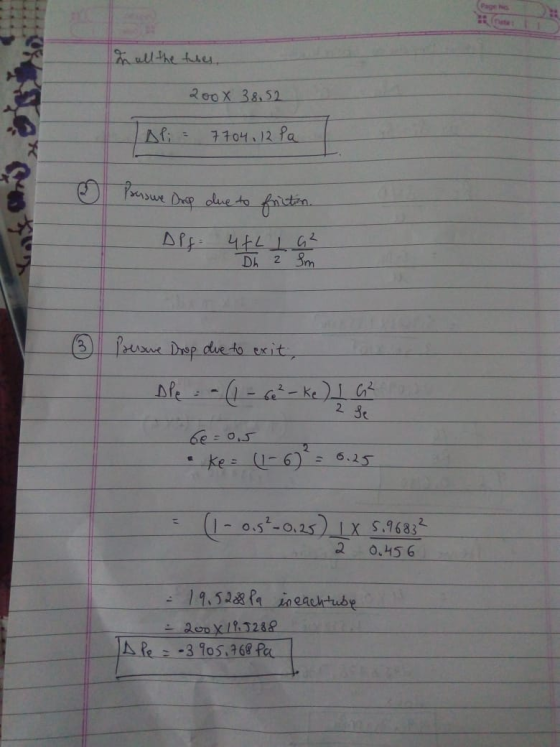
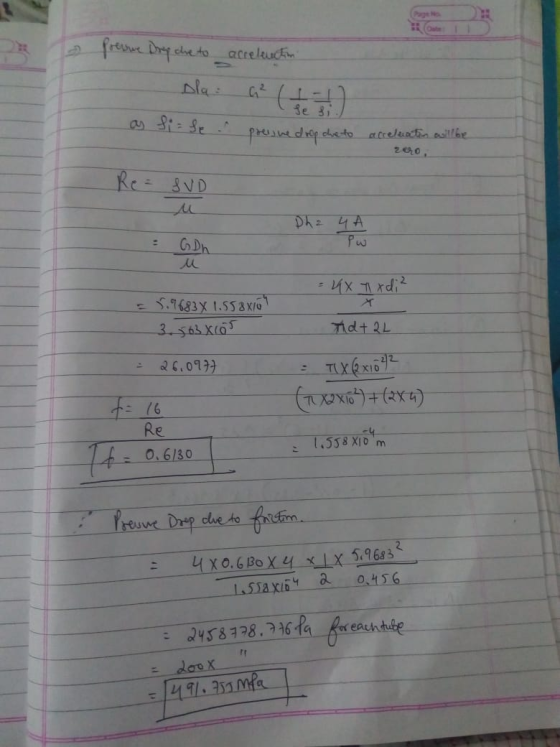
 here mainly the pressure drop
is due to friction only we can compare it with the answer too.
here mainly the pressure drop
is due to friction only we can compare it with the answer too.
Add Answer to:
Consider a shell-and-tube heat exchanger. Air with a flow rate
of
1.5 kg/s at 500°C and...
A shell and tube heat exchanger with one shell pass and two tube passes is used...
 A shell and tube heat exchanger with one shell pass and two tube passes is used to heat 8.82 kg/s of fluid from 15.6 °C to 60 °C by using saturated steam at 150 kPa. The steam is condensing on the outside of the tubes with h= 15 kW/m2.K. There are 50 tubes with an outside diameter of 1.91 cm and a wall thickness of 0.211 cm. If the fouling coefficient on the inside of the tubes is 5678 W/m2.K,...
A shell and tube heat exchanger with one shell pass and one tube pass will be...
A shell and tube heat exchanger with one shell pass and one tube pass will be used to condense the steam to saturated liquid, which enters the shell side as a saturated vapor at 400 K. The tube side contains R-134a refrigerant with an inlet temperature of 300 K and a mean velocity of 0.4 m/s. The steam flow rate is 1.5 kg/s. The tubes are made from AISI 302 stainless steel and have a 1" nominal diameter (Di =...
1. A shell-and-tube heat exchanger with 1 shell and 10 tubes is used to heat glycerine...
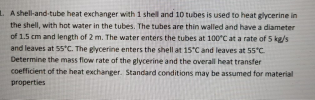 1. A shell-and-tube heat exchanger with 1 shell and 10 tubes is used to heat glycerine in the shell, with hot water in the tubes. The tubes are thin walled and have a diameter of 1.5 cm and length of 2 m. The water enters the tubes at 100°C at a rate of 5 kg/s and leaves at 55°C. The glycerine enters the shell at 15°C and leaves at 55°C. Determine the mass flow rate of the glycerine and the...
1 CPD4701 Assignment 2/2019 Question 2 shell and-tube heat exchanger was designed for the following service: Cold strea...
 1 CPD4701 Assignment 2/2019 Question 2 shell and-tube heat exchanger was designed for the following service: Cold stream Hot stream Crude Oil Fluid Cooling water Tube side Stream allocation Shell side Mass flow rate (kg/s) 110 30 Inlet temperature (C) 90 Outlet temperature (C) Heat capacity (J/kg K) Density (kg/m2) Viscosity (Pa-s) Thermal conductivity (W/m-K) Fouling factor (m2 CW) 40 50 2177 4187 787 995 0.72-10 1.89-103 0.122 0.59 0.0002 0.0004 The shell and tube heat exchanger has the following...
1 CPD4701 Assignment 2/2019 Question 2 shell and-tube heat exchanger was designed for the following service: Cold strea...
 1 CPD4701 Assignment 2/2019 Question 2 shell and-tube heat exchanger was designed for the following service: Cold stream Hot stream Crude Oil Fluid Cooling water Tube side Stream allocation Shell side Mass flow rate (kg/s) 110 30 Inlet temperature (C) 90 Outlet temperature (C) Heat capacity (J/kg K) Density (kg/m2) Viscosity (Pa-s) Thermal conductivity (W/m-K) Fouling factor (m2 CW) 40 50 2177 4187 787 995 0.72-10 1.89-103 0.122 0.59 0.0002 0.0004 The shell and tube heat exchanger has the following...
A shell and tube heat exchanger with one shell pass and one tube pass will be...
A shell and tube heat exchanger with one shell pass and one tube pass will be used to condense the steam to saturated liquid, which enters the shell side as a saturated vapor at 400 K. The tube side contains R-134a refrigerant with an inlet temperature of 300 K and a mean velocity of 0.4 m/s. The steam flow rate is 1.5 kg/s. The tubes are made from AISI 302 stainless steel and have a 1" nominal diameter (Di =...
Q2. Shell-and-tube heat exchangers with hundreds of tubes housed in a shell are commonly used in...
 Q2. Shell-and-tube heat exchangers with hundreds of tubes housed in a shell are commonly used in practice for heat transfer between two fluids (shown in Figure 1). Such a heat exchanger used in an active solar hot-water system transfers heat from a water-antifreeze solution flowing through the shell and the solar collector to fresh water flowing through the tubes at an average temperature of 60°C at a rate of 15 L/S. The heat exchanger contains 80 brass tubes 1 cm...
2. (35P) Ashell-and-tube heat exchanger with 1-shell pass and 20-tube passes is used to heat glycerin...
 2. (35P) Ashell-and-tube heat exchanger with 1-shell pass and 20-tube passes is used to heat glycerin (Cp = 2480 J/kg) in the shell, with hot water in the tubes. The tubes are thinwalled and have a diameter of 1.5 cm and length of 2 m per pass. The hot water (Cp=4180 J/kg Centers the tubes at 102°C at a rate of 9 kg/s and leaves at 55°C. Overall heat transfer coefficient U=13900 W/m2C. The glycerin enters the shell at 15°C...
Water flowing at a rate of 10 kg/s through 50 tubes in a double-pass shell-and-tube heat...
 Water flowing at a rate of 10 kg/s through 50 tubes in a double-pass shell-and-tube heat exchanger heats air which flows on the shell side. The tubes are bras with outside diameter of 2.6 cm and are 6.7m long. The heat transfer coefficients on the inside and outside tube surfaces are 470 W/m2K and 210 W/m2K, respectively. Air enters the unit at 15°C with a flow rate of 16 kg/s. The entering water temperature is 350K. A) Draw and label...
Required information A shell-and-tube heat exchanger is used for cooling 47 kg/s of a process stream...
 Required information A shell-and-tube heat exchanger is used for cooling 47 kg/s of a process stream flowing through the tubes from 160°C to 136°C. This heat exchanger has a total of 100 identical tubes. each with an inside diameter of 2.5 cm and negligible wall thickness. The average properties of the process stream are: p = 950 kg/m”, k = 0.50 W/mK, Cp=3.5 kJ/kg.K, and -20 mPas The coolant stream is water (cp=4.18 kJ/kg K) at a flow rate of...
 A shell and tube heat exchanger with one shell pass and two tube passes is used to heat 8.82 kg/s of fluid from 15.6 °C to 60 °C by using saturated steam at 150 kPa. The steam is condensing on the outside of the tubes with h= 15 kW/m2.K. There are 50 tubes with an outside diameter of 1.91 cm and a wall thickness of 0.211 cm. If the fouling coefficient on the inside of the tubes is 5678 W/m2.K,...
 1. A shell-and-tube heat exchanger with 1 shell and 10 tubes is used to heat glycerine in the shell, with hot water in the tubes. The tubes are thin walled and have a diameter of 1.5 cm and length of 2 m. The water enters the tubes at 100°C at a rate of 5 kg/s and leaves at 55°C. The glycerine enters the shell at 15°C and leaves at 55°C. Determine the mass flow rate of the glycerine and the...
 1 CPD4701 Assignment 2/2019 Question 2 shell and-tube heat exchanger was designed for the following service: Cold stream Hot stream Crude Oil Fluid Cooling water Tube side Stream allocation Shell side Mass flow rate (kg/s) 110 30 Inlet temperature (C) 90 Outlet temperature (C) Heat capacity (J/kg K) Density (kg/m2) Viscosity (Pa-s) Thermal conductivity (W/m-K) Fouling factor (m2 CW) 40 50 2177 4187 787 995 0.72-10 1.89-103 0.122 0.59 0.0002 0.0004 The shell and tube heat exchanger has the following...
 1 CPD4701 Assignment 2/2019 Question 2 shell and-tube heat exchanger was designed for the following service: Cold stream Hot stream Crude Oil Fluid Cooling water Tube side Stream allocation Shell side Mass flow rate (kg/s) 110 30 Inlet temperature (C) 90 Outlet temperature (C) Heat capacity (J/kg K) Density (kg/m2) Viscosity (Pa-s) Thermal conductivity (W/m-K) Fouling factor (m2 CW) 40 50 2177 4187 787 995 0.72-10 1.89-103 0.122 0.59 0.0002 0.0004 The shell and tube heat exchanger has the following...
 Q2. Shell-and-tube heat exchangers with hundreds of tubes housed in a shell are commonly used in practice for heat transfer between two fluids (shown in Figure 1). Such a heat exchanger used in an active solar hot-water system transfers heat from a water-antifreeze solution flowing through the shell and the solar collector to fresh water flowing through the tubes at an average temperature of 60°C at a rate of 15 L/S. The heat exchanger contains 80 brass tubes 1 cm...
 2. (35P) Ashell-and-tube heat exchanger with 1-shell pass and 20-tube passes is used to heat glycerin (Cp = 2480 J/kg) in the shell, with hot water in the tubes. The tubes are thinwalled and have a diameter of 1.5 cm and length of 2 m per pass. The hot water (Cp=4180 J/kg Centers the tubes at 102°C at a rate of 9 kg/s and leaves at 55°C. Overall heat transfer coefficient U=13900 W/m2C. The glycerin enters the shell at 15°C...
 Water flowing at a rate of 10 kg/s through 50 tubes in a double-pass shell-and-tube heat exchanger heats air which flows on the shell side. The tubes are bras with outside diameter of 2.6 cm and are 6.7m long. The heat transfer coefficients on the inside and outside tube surfaces are 470 W/m2K and 210 W/m2K, respectively. Air enters the unit at 15°C with a flow rate of 16 kg/s. The entering water temperature is 350K. A) Draw and label...
 Required information A shell-and-tube heat exchanger is used for cooling 47 kg/s of a process stream flowing through the tubes from 160°C to 136°C. This heat exchanger has a total of 100 identical tubes. each with an inside diameter of 2.5 cm and negligible wall thickness. The average properties of the process stream are: p = 950 kg/m”, k = 0.50 W/mK, Cp=3.5 kJ/kg.K, and -20 mPas The coolant stream is water (cp=4.18 kJ/kg K) at a flow rate of...
Most questions answered within 3 hours.
-
Where is the error in this code sequence?
String s1 = "Hello";
String s2 = "ello";...
asked 11 months ago -
Financial data for Joel de Paris, Inc., for last year
follow:
Joel de Paris, Inc.
Balance...
asked 11 months ago -
Consider this reaction:
Al2(SO4)3 (aq)+ BaCl3
(aq) Al2Cl6 (aq)- +
3BaSO4(s) . What is the...
asked 11 months ago -
Suppose that Savneet is considering increasing her
recent random sample from 20 car rentals to 40...
asked 11 months ago -
Trucks arrive at an unloading terminal at an average rate of 120
per hour.
Trucks arrive...
asked 11 months ago -
Why are methanol and ethanol completely soluble in water while
octanol is not very little soluble....
asked 11 months ago -
A facilities manager at a university reads in a research report
that the mean amount of...
asked 11 months ago -
When the CuSO4 is rehydrated by adding water to the anhydrous
compound, is this an endothermic...
asked 11 months ago -
A ray of sunlight is passing from diamond into crown glass; the
angle of incidence is...
asked 11 months ago -
A block of mass 0.249 kg is placed on top of a light, vertical
spring of...
asked 11 months ago -
how do the kidneys compensate in the presences of acidosis
a) trigger hyperventilate
b) reserve acid...
asked 11 months ago -
Question 501 pts
The rental rate of capital to the firm increases. Which of the
following...
asked 11 months ago