Calculate the amount, in moles, of Ag+ present at equilibrium when excess Ag3PO4(s) is added to...
Calculate the amount, in moles, of Ag+ present at equilibrium when excess Ag3PO4(s) is added to 40.0 mL 0.22 M Li3PO4(aq). Assume no change in volume. For Ag3PO4, Ksp = 8.89×10⁻¹⁷.
Homework Answers

Add Answer to:
Calculate the amount, in moles, of Ag+ present at equilibrium
when excess Ag3PO4(s) is added to...
"calculate the concentration of Ag+ present in a solution at equilibrium when concentrated ammonia is added...
"calculate the concentration of Ag+ present in a solution at equilibrium when concentrated ammonia is added to a 0.010m solution of AgNO3 to give an equilibrium concentration of (NH3)= 0.20 m. Neglect the small volume change that occurs when NH3 is added
Calculate [Ag+] at equilibrium when 0.220 M concentrated ammonia, NH3, is added to 0.020 M AgNO3....
Calculate [Ag+] at equilibrium when 0.220 M concentrated ammonia, NH3, is added to 0.020 M AgNO3. Assume AgNO3 dissociates completely. Neglect volume change.
Temperature effect Data Table 52-50 ml Amount of 1M Naci Amount of AgCl(s) added (mL) formed...
 Temperature effect Data Table 52-50 ml Amount of 1M Naci Amount of AgCl(s) added (mL) formed (R) 25 ML 11.12%bg 25 mL 1064 25 ML 1.12966 1-12 06 25 ml u inerissed to 220 26:02C the ingrase no change in tempo no change in temp Calculations Total Volume of 1M NaCl added (mL) Total Volume of 1M NaCl added (L) Final Amount of AgCl(s) formed (s) Moles of AgCl(s) formed Moles of Ag+ present in original solution Molarity of AgNO,...
A solution of Na3PO4 is added dropwise to a solution that is 0.0810 M in Ag+...
A solution of Na3PO4 is added dropwise to a solution that is 0.0810 M in Ag+ and 0.00171 M in Cu2+. The Ksp of Ag3PO4 is 8.89e-17. The Ksp of Cu3(PO4)2 is 1.4e-37. (a) What concentration of PO43- is necessary to begin precipitation? (Neglect volume changes.) [PO43-] = M. (b) Which cation precipitates first? Ag+ Cu2+ (c) What is the concentration of PO43- when the second cation begins to precipitate? [PO43-] = M.
equilibrium help!! What is the equilibrium constant for the reaction CO(g) + 3 H2(g) - CH4(g)...
 equilibrium help!!
What is the equilibrium constant for the reaction CO(g) + 3 H2(g) - CH4(g) + H2O(g) if at 20 °C the equilibrium molar concentrations are [CO] -0.613, [H2] = 1.839, (CH4) = 0.387, and [H20) - 0.387? Format Β Ι Ο The reaction for the formation of the diamine-silver ion is as follows: Ag (aq) + 2NH3(aq) + Ag(NH3)2(aq) a. Write the equilibrium constant expression for this reaction. for the above b. An experiment was carried out to...
equilibrium help!!
What is the equilibrium constant for the reaction CO(g) + 3 H2(g) - CH4(g) + H2O(g) if at 20 °C the equilibrium molar concentrations are [CO] -0.613, [H2] = 1.839, (CH4) = 0.387, and [H20) - 0.387? Format Β Ι Ο The reaction for the formation of the diamine-silver ion is as follows: Ag (aq) + 2NH3(aq) + Ag(NH3)2(aq) a. Write the equilibrium constant expression for this reaction. for the above b. An experiment was carried out to...
The equilibrium constant for the reaction Agl(s) — Ag+ (aq) +1 (aq) is the solubility product...
 The equilibrium constant for the reaction Agl(s) — Ag+ (aq) +1 (aq) is the solubility product constant, Ksp = 8.3 x 10⁻¹⁷ at 25°C. Calculate AG for the reaction when [Ag+]=1.5 x 10⁻³ M and [Br] =1.5 x 10⁻² M. Is the reaction spontaneous or nonspontaneous at these concentrations? AG = 98 kJ/mol, spontaneous AG = 92 kJ/mol, nonspontaneous AG = -65 kJ/mol, spontaneous AG = 65 kJ/mol, nonspontaneous AG = -92 kJ/mol, spontaneous
Use the systematic method to determine the equilibrium concentration of A+ ion (M) when excess (meaning...
Use the systematic method to determine the equilibrium concentration of A+ ion (M) when excess (meaning a saturated solution) AB(s) is added to 0.10 M NaB The Ksp of AC(s) is 1.8 x 10⁻⁹, the Ksp of AB(s) is 4.9 x 10⁻¹², and NaB is fully soluble. Chemical reactions: NaB(s) → Na+(aq) + B-(aq) AC(s) ⇄ A+(aq) + C-(aq) AB(s) ⇄ A+(aq) + B-(aq)
Part A Calculate the number of moles of Ag+ in 5.00 mL of 4.00x10⁻³ M AgNO3...
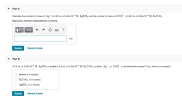 Part A Calculate the number of moles of Ag+ in 5.00 mL of 4.00x10⁻³ M AgNO3 and the number of moles of Crof. in 5.00 mL of 3.50x10⁻³ M K Cr04. Input your answers separated by a comma. PO AJO O O ? Submit Request Answer - Part B If 5.0 mL of 4.00x10⁻³ M AgNO3 is added to 5.0 mL of 3.50x10⁻³ M K, CrO4, is either Ag+ or CrO2 in stoichiometric excess? If so, which is in excess?...
1) What is the effect on equilibrium when sodium acetate is added to a solution of...
1) What is the effect on equilibrium when sodium acetate is added to a solution of acetic acid? CH3COOH(aq) H+(aq) + CH3COO– (aq) A. There is no change in the equilibrium. B. The equilibrium shifts to the right. C. More information is needed to answer the question. D. The equilibrium shifts to the left. E. The pH decreases. 29) What is the concentration of Pb2+ ions in a solution prepared by adding 5.00 g of lead(II) iodide to 500. mL...
Predict Precipitation Question Consider the following equilibrium: Ag, PO, (s) 3 Ag (aq) + PO(aq) If the concentrat...
 Predict Precipitation Question Consider the following equilibrium: Ag, PO, (s) 3 Ag (aq) + PO(aq) If the concentration of the Ag ion at a certain point is 6.3 x 10 M, and Ksp=9.1 x 10⁴, will a precipitate form? - Select the correct answer below: Oyes, because Q> K yes, because Q < K no, because o> K no, because < K
Predict Precipitation Question Consider the following equilibrium: Ag, PO, (s) 3 Ag (aq) + PO(aq) If the concentration...
Predict Precipitation Question Consider the following equilibrium: Ag, PO, (s) 3 Ag (aq) + PO(aq) If the concentration of the Ag ion at a certain point is 6.3 x 10 M, and Ksp=9.1 x 10⁴, will a precipitate form? - Select the correct answer below: Oyes, because Q> K yes, because Q < K no, because o> K no, because < K
Predict Precipitation Question Consider the following equilibrium: Ag, PO, (s) 3 Ag (aq) + PO(aq) If the concentration...
 Temperature effect Data Table 52-50 ml Amount of 1M Naci Amount of AgCl(s) added (mL) formed (R) 25 ML 11.12%bg 25 mL 1064 25 ML 1.12966 1-12 06 25 ml u inerissed to 220 26:02C the ingrase no change in tempo no change in temp Calculations Total Volume of 1M NaCl added (mL) Total Volume of 1M NaCl added (L) Final Amount of AgCl(s) formed (s) Moles of AgCl(s) formed Moles of Ag+ present in original solution Molarity of AgNO,...
 equilibrium help!!
What is the equilibrium constant for the reaction CO(g) + 3 H2(g) - CH4(g) + H2O(g) if at 20 °C the equilibrium molar concentrations are [CO] -0.613, [H2] = 1.839, (CH4) = 0.387, and [H20) - 0.387? Format Β Ι Ο The reaction for the formation of the diamine-silver ion is as follows: Ag (aq) + 2NH3(aq) + Ag(NH3)2(aq) a. Write the equilibrium constant expression for this reaction. for the above b. An experiment was carried out to...
equilibrium help!!
What is the equilibrium constant for the reaction CO(g) + 3 H2(g) - CH4(g) + H2O(g) if at 20 °C the equilibrium molar concentrations are [CO] -0.613, [H2] = 1.839, (CH4) = 0.387, and [H20) - 0.387? Format Β Ι Ο The reaction for the formation of the diamine-silver ion is as follows: Ag (aq) + 2NH3(aq) + Ag(NH3)2(aq) a. Write the equilibrium constant expression for this reaction. for the above b. An experiment was carried out to...
 The equilibrium constant for the reaction Agl(s) — Ag+ (aq) +1 (aq) is the solubility product constant, Ksp = 8.3 x 10⁻¹⁷ at 25°C. Calculate AG for the reaction when [Ag+]=1.5 x 10⁻³ M and [Br] =1.5 x 10⁻² M. Is the reaction spontaneous or nonspontaneous at these concentrations? AG = 98 kJ/mol, spontaneous AG = 92 kJ/mol, nonspontaneous AG = -65 kJ/mol, spontaneous AG = 65 kJ/mol, nonspontaneous AG = -92 kJ/mol, spontaneous
 Part A Calculate the number of moles of Ag+ in 5.00 mL of 4.00x10⁻³ M AgNO3 and the number of moles of Crof. in 5.00 mL of 3.50x10⁻³ M K Cr04. Input your answers separated by a comma. PO AJO O O ? Submit Request Answer - Part B If 5.0 mL of 4.00x10⁻³ M AgNO3 is added to 5.0 mL of 3.50x10⁻³ M K, CrO4, is either Ag+ or CrO2 in stoichiometric excess? If so, which is in excess?...
 Predict Precipitation Question Consider the following equilibrium: Ag, PO, (s) 3 Ag (aq) + PO(aq) If the concentration of the Ag ion at a certain point is 6.3 x 10 M, and Ksp=9.1 x 10⁴, will a precipitate form? - Select the correct answer below: Oyes, because Q> K yes, because Q < K no, because o> K no, because < K
Predict Precipitation Question Consider the following equilibrium: Ag, PO, (s) 3 Ag (aq) + PO(aq) If the concentration...
Predict Precipitation Question Consider the following equilibrium: Ag, PO, (s) 3 Ag (aq) + PO(aq) If the concentration of the Ag ion at a certain point is 6.3 x 10 M, and Ksp=9.1 x 10⁴, will a precipitate form? - Select the correct answer below: Oyes, because Q> K yes, because Q < K no, because o> K no, because < K
Predict Precipitation Question Consider the following equilibrium: Ag, PO, (s) 3 Ag (aq) + PO(aq) If the concentration...
Most questions answered within 3 hours.
-
Where is the error in this code sequence?
String s1 = "Hello";
String s2 = "ello";...
asked 11 months ago -
Financial data for Joel de Paris, Inc., for last year
follow:
Joel de Paris, Inc.
Balance...
asked 11 months ago -
Consider this reaction:
Al2(SO4)3 (aq)+ BaCl3
(aq) Al2Cl6 (aq)- +
3BaSO4(s) . What is the...
asked 11 months ago -
Suppose that Savneet is considering increasing her
recent random sample from 20 car rentals to 40...
asked 11 months ago -
Trucks arrive at an unloading terminal at an average rate of 120
per hour.
Trucks arrive...
asked 11 months ago -
Why are methanol and ethanol completely soluble in water while
octanol is not very little soluble....
asked 11 months ago -
A facilities manager at a university reads in a research report
that the mean amount of...
asked 11 months ago -
When the CuSO4 is rehydrated by adding water to the anhydrous
compound, is this an endothermic...
asked 11 months ago -
A ray of sunlight is passing from diamond into crown glass; the
angle of incidence is...
asked 11 months ago -
A block of mass 0.249 kg is placed on top of a light, vertical
spring of...
asked 11 months ago -
how do the kidneys compensate in the presences of acidosis
a) trigger hyperventilate
b) reserve acid...
asked 11 months ago -
Question 501 pts
The rental rate of capital to the firm increases. Which of the
following...
asked 11 months ago