Suppose you have 2 consumers in the market with the following demand curves: x1=40-2p and x2=...
Suppose you have 2 consumers in the market with the following demand curves: x1=40-2p and x2= 50-1/2P
a) Draw the inverse demand curve for these two consumers, on the same graph, with x on the horizontal and p on the vertical axis. Do this on the left hand side of the space below, leaving yourself room to add a second graph on the right. Numerically mark both y-intercepts and x-intercepts.
b) Next to the original graph of the individual demand curves, add a second graph on the right that represents the horizontal summation of these two demand curves. What can you say about demand for good x when the price is greater than 20?
c) Algebraically, add your 2 demand curves. Write xm, the market demand, as a function of p, which will be a piecewise function over different intervals of p to reflect what you observed in part b) above.
Homework Answers

Add Answer to:
Suppose you have 2 consumers in the market with the following
demand curves: x1=40-2p and x2=...
(20%) Suppose the market demand for coffee at UNM Starbuck's can be segmented into two representative, inverse dema...
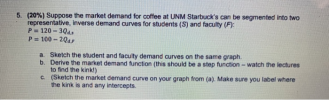 (20%) Suppose the market demand for coffee at UNM Starbuck's can be segmented into two representative, inverse demand curves for students (S) and faculty (F): P= 120 - 3Qd. P = 100-2Qd.F a. Sketch the student and faculty demand curves on the same graph. b. Derive the market demand function (this should be a step function - watch the lectures to find the kink!) C. (Sketch the market demand curve on your graph from (a). Make sure you label where...
1.(32 pts. Consider the following equations describing the market for good X Demand: =4- Supply: -p-2...
 1.(32 pts. Consider the following equations describing the market for good X Demand: =4- Supply: -p-2 Equilibrium: q-q=9 a. Find the inverse domand and supply equations. (4 pts.) b. Algebraically find the equilibrium price (p) and quantity (q) of good X. (4 pies) c. Carefully and nearly draw the inverse supply and demand curves you found in purta. In constructing your graph, use the following values of : 0.2 and 4 i.e., coordinates (9), (2.__): (4. ): ctc.). Be sure...
I need working and the graph. Thanks The supply and demand function in the market have...
 I need working and the graph. Thanks
The supply and demand function in the market have the following form: P-30-Q and P-20 The price and quantity in equilibrium will now be P-20S and Q-10 units. Now assume that firms must pay a tax of 3S per every unit that they sell (use two decimals if needed) a) Draw the situation in the graph. Which of the curves will shift due to the tax? (1) b) What is the new quantity...
I need working and the graph. Thanks
The supply and demand function in the market have the following form: P-30-Q and P-20 The price and quantity in equilibrium will now be P-20S and Q-10 units. Now assume that firms must pay a tax of 3S per every unit that they sell (use two decimals if needed) a) Draw the situation in the graph. Which of the curves will shift due to the tax? (1) b) What is the new quantity...
Problem 1. Suppose the market demand is given by D(P) = 10 – 2p and the...
 Problem 1. Suppose the market demand is given by D(P) = 10 – 2p and the market supply is given by S(p) = 3p - 5. 1. Draw the supply and demand curves. Determine the equilibrium price p* and the equilibrium output x*. Determine CS, PS, and TS. 2. Explain why TS is maximized at the equilibrium price p*. 3. Suppose government imposed a $0.5 quantity tax. Determine the equilibrium price and the equilibrium output after the tax. Also, determine...
1. Suppose there are two potential customers in the market. One has demand function D1(p)=10-p ....
1. Suppose there are two potential customers in the market. One has demand function D1(p)=10-p . The other has demand function D2(p)=20-2p. The only firm in this market has constant marginal cost of 2. (1) Draw the two demand curves in a graph, with price on the vertical axis and demand on the horizontal axis. (2) (3rd-degree price discrimination) If the monopoly can identify the two consumers and charge different prices to them, what is the optimal price charged to...
1. Suppose there are two potential customers in the market. One has demand function D1(p)=10-p ....
1. Suppose there are two potential customers in the market. One has demand function D1(p)=10-p . The other has demand function D2(p)=20-2p. The only firm in this market has constant marginal cost of 2. (1) Draw the two demand curves in a graph, with price on the vertical axis and demand on the horizontal axis. (2) (3rd-degree price discrimination) If the monopoly can identify the two consumers and charge different prices to them, what is the optimal price charged to...
Suppose you are presented with the estimates of the supply and demand curves for a market....
Suppose you are presented with the estimates of the supply and demand curves for a market. They are Qs=80+5*P and Qd=1080−5*P. a) Solve for the equilibrium price. b) Solve for the equilibrium quantity If a $60 sales tax is placed on the sellers of this good what effect will this have on the market? c) Solve for the new equilibrium price. d) Solve for the new equilibrium quantity e) What fraction of the tax has been passed on to consumers...
3. Imagine there exist three consumers, each with their own demand curves for a Public Good....
 3. Imagine there exist three consumers, each with their own demand curves for a Public Good. The equations below provide the demand curves for each consumer for this public good where P is the unit price of the public good and Q is the unit value of the public good. Consumer 1: P = 200 – Q Consumer 2: P= 40 – 30 Consumer 3: P = 50 - Q. The total cost (TC) producing the public good is given...
The following graph shows the demand curve for a group of consumers in the U.S. market (blue line) for tablets.
 The following graph shows the demand curve for a group of
consumers in the U.S. market (blue line) for tablets. The market
price of a tablet is shown by the black horizontal line at
$120. Each rectangle you can place on the following graph corresponds to a particular buyer in this market: orange (square symbols) for Dmitri, green (triangle symbols) for Frances, purple (diamond symbols) for Jake, tan (dash symbols) for Latasha, and blue (circle symbols) for Nick. Use the rectangles...
The following graph shows the demand curve for a group of
consumers in the U.S. market (blue line) for tablets. The market
price of a tablet is shown by the black horizontal line at
$120. Each rectangle you can place on the following graph corresponds to a particular buyer in this market: orange (square symbols) for Dmitri, green (triangle symbols) for Frances, purple (diamond symbols) for Jake, tan (dash symbols) for Latasha, and blue (circle symbols) for Nick. Use the rectangles...
The following graph shows the demand curve for a group of consumers in the U.S. market (blue line) for smartphones.
 3. Consumer surplus for a group of consumers The following graph shows the demand curve for a group of consumers in the U.S. market (blue line) for smartphones. The market price of a smartphone is shown by the black horizontal line at $120. Each rectangle you can place on the following graph corresponds to a particular buyer in this market: orange (square symbols) for Bob, green (triangle symbols) for Cho, purple (diamond symbols) for Eric, tan (dash symbols) for Ginny, and blue...
 (20%) Suppose the market demand for coffee at UNM Starbuck's can be segmented into two representative, inverse demand curves for students (S) and faculty (F): P= 120 - 3Qd. P = 100-2Qd.F a. Sketch the student and faculty demand curves on the same graph. b. Derive the market demand function (this should be a step function - watch the lectures to find the kink!) C. (Sketch the market demand curve on your graph from (a). Make sure you label where...
 1.(32 pts. Consider the following equations describing the market for good X Demand: =4- Supply: -p-2 Equilibrium: q-q=9 a. Find the inverse domand and supply equations. (4 pts.) b. Algebraically find the equilibrium price (p) and quantity (q) of good X. (4 pies) c. Carefully and nearly draw the inverse supply and demand curves you found in purta. In constructing your graph, use the following values of : 0.2 and 4 i.e., coordinates (9), (2.__): (4. ): ctc.). Be sure...
 I need working and the graph. Thanks
The supply and demand function in the market have the following form: P-30-Q and P-20 The price and quantity in equilibrium will now be P-20S and Q-10 units. Now assume that firms must pay a tax of 3S per every unit that they sell (use two decimals if needed) a) Draw the situation in the graph. Which of the curves will shift due to the tax? (1) b) What is the new quantity...
I need working and the graph. Thanks
The supply and demand function in the market have the following form: P-30-Q and P-20 The price and quantity in equilibrium will now be P-20S and Q-10 units. Now assume that firms must pay a tax of 3S per every unit that they sell (use two decimals if needed) a) Draw the situation in the graph. Which of the curves will shift due to the tax? (1) b) What is the new quantity...
 Problem 1. Suppose the market demand is given by D(P) = 10 – 2p and the market supply is given by S(p) = 3p - 5. 1. Draw the supply and demand curves. Determine the equilibrium price p* and the equilibrium output x*. Determine CS, PS, and TS. 2. Explain why TS is maximized at the equilibrium price p*. 3. Suppose government imposed a $0.5 quantity tax. Determine the equilibrium price and the equilibrium output after the tax. Also, determine...
 3. Imagine there exist three consumers, each with their own demand curves for a Public Good. The equations below provide the demand curves for each consumer for this public good where P is the unit price of the public good and Q is the unit value of the public good. Consumer 1: P = 200 – Q Consumer 2: P= 40 – 30 Consumer 3: P = 50 - Q. The total cost (TC) producing the public good is given...
Most questions answered within 3 hours.
-
Where is the error in this code sequence?
String s1 = "Hello";
String s2 = "ello";...
asked 11 months ago -
Financial data for Joel de Paris, Inc., for last year
follow:
Joel de Paris, Inc.
Balance...
asked 11 months ago -
Consider this reaction:
Al2(SO4)3 (aq)+ BaCl3
(aq) Al2Cl6 (aq)- +
3BaSO4(s) . What is the...
asked 11 months ago -
Suppose that Savneet is considering increasing her
recent random sample from 20 car rentals to 40...
asked 11 months ago -
Trucks arrive at an unloading terminal at an average rate of 120
per hour.
Trucks arrive...
asked 11 months ago -
Why are methanol and ethanol completely soluble in water while
octanol is not very little soluble....
asked 11 months ago -
A facilities manager at a university reads in a research report
that the mean amount of...
asked 11 months ago -
When the CuSO4 is rehydrated by adding water to the anhydrous
compound, is this an endothermic...
asked 11 months ago -
A ray of sunlight is passing from diamond into crown glass; the
angle of incidence is...
asked 11 months ago -
A block of mass 0.249 kg is placed on top of a light, vertical
spring of...
asked 11 months ago -
how do the kidneys compensate in the presences of acidosis
a) trigger hyperventilate
b) reserve acid...
asked 11 months ago -
Question 501 pts
The rental rate of capital to the firm increases. Which of the
following...
asked 11 months ago