N electrons moves at apeed v in a circular orbit of radius R. What is the...
N electrons moves at apeed v in a circular orbit of radius R. What is the magnetic dipole moment associated with the current loop?
Homework Answers

Add Answer to:
N electrons moves at apeed v in a circular orbit of radius R.
What is the...
2. An electron moves in a circle of radius r = 5.66 x 10⁻¹¹ m with...
 2. An electron moves in a circle of radius r = 5.66 x 10⁻¹¹ m with a speed 2.09 x 10 m/s. Treat the circular path as a current loop with a constant current equal to the ratio of the electrons charge magnitude to the period of the motion. If the circle lies in a uniform magnetic field of magnitude B = 6.39 mT, what is the maximum possible magnitude of the torque, T, produced on the loop by the...
A circular loop of wire of radius R carries a current I in a region where...
A circular loop of wire of radius R carries a current I in a region where a uniform magnetic field of magnitude B0 is present. (a) If the magnetic dipole moment of the loop makes an angle θ < π/2 with the magnetic field, do a drawing that includes the loop of current, its magnetic dipole moment, the magnetic field, and the direction of the torque experienced by the loop. Make sure to indicate the current i and the angle...
An electron with charge −e and mass m moves in a circular orbit of radius r...
An electron with charge −e and mass m moves in a circular orbit of radius r around a nucleus of charge Ze, where Z is the atomic number of the nucleus. Ignore the gravitational force between the electron and the nucleus. Find an expression in terms of these quantities for the speed of the electron in this orbit. (Use any variable or symbol stated above along with the following as necessary: k for Coulomb's constant.) v = ?
A proton moves in a circular orbit 150 mm in radius that is perpendicular to a...
A proton moves in a circular orbit 150 mm in radius that is perpendicular to a uniform 0.25 T magnetic field. a. What is the speed of the proton? b. How long does it take for the proton to move once in a circle? c. Would the radius increase or decrease if the proton were heavier? d. Would the radius increase or decrease if the magnetic field were larger? e. Does the speed change if the proton were negatively charged?...
An object of mass m moves at a constant speed v in a circular path of radius r.
An object of mass m moves at a constant speed v in a circular path of radius r. The force required to produce the centripetal component of acceleration is called the centripetal force and is given by F=mv2/r. Newton's Law of Universal Gravitation is given by F=GMm/d2, where d is the distance between the centers of the two bodies of masses M and m, and G is a gravitational constant. The speed required for circular motion is v= √(GM/r). Use the...
A flat circular loop of wire of radius R carrying a current I is placed in...
 A flat circular loop of wire of radius R carrying a current I is placed in a uniform magnetic field B that is directed in the plane of the current loop. What is the magnetic moment M of the loop? What is the magnitude of the torque acting on the loop? In which direction the loop will rotate under the influence of this torque?
An electron moves in a circular orbit of radius 0.1 mm, counterclockwise as you look down...
An electron moves in a circular orbit of radius 0.1 mm, counterclockwise as you look down at it, moving in a plane above and parallel to the plane of your exam paper. The velocity of the electron is v = 3VX10^6 m/s. a) Find the potential due the electron at the center of the circle. b) Find the electric eld due the electron at the center of the circle. c) Find the magnetic eld due to the electron at the...
2 A proton moves in a 80-cm radius circular orbit that is perpendicular to a unifonn...
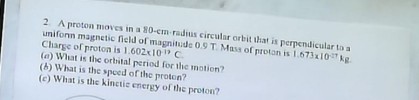 2 A proton moves in a 80-cm radius circular orbit that is perpendicular to a unifonn magnetic field of magninde 0.9 T Mass of proton is 167310k Charge of proton is 1 602x101 C (a) What is the orbital period for the motion? (b) What is the speed of the proton? c) What is the kinctic energy of tie proton?
11 In the Bohr model, the electron moves in a circular orbit around the nucleus with...
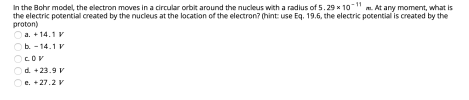 11 In the Bohr model, the electron moves in a circular orbit around the nucleus with a radius of 5.29 x 10 m. At any moment, what is the electric potential created by the nucleus at the location of the electron? (hint: use Eq. 19.6, the electric potential is created by the proton) a. + 14.1 V b. - 14.1 V c. O V d. +23.9 V e. + 27.2 V
Find the magnetic field at the centre of a circular loop of radius R, which carries...
 Find the magnetic field at the centre of a circular loop of radius R, which carries a steady current I. Use your result to calculate the magnetic field that the electron produces at the position of the nucleus in a hydrogen atom with the smallest Bohr orbit radius 0.529 Angstroms. Pretend the motion of the electron is classical.
 2. An electron moves in a circle of radius r = 5.66 x 10⁻¹¹ m with a speed 2.09 x 10 m/s. Treat the circular path as a current loop with a constant current equal to the ratio of the electrons charge magnitude to the period of the motion. If the circle lies in a uniform magnetic field of magnitude B = 6.39 mT, what is the maximum possible magnitude of the torque, T, produced on the loop by the...
 A flat circular loop of wire of radius R carrying a current I is placed in a uniform magnetic field B that is directed in the plane of the current loop. What is the magnetic moment M of the loop? What is the magnitude of the torque acting on the loop? In which direction the loop will rotate under the influence of this torque?
 2 A proton moves in a 80-cm radius circular orbit that is perpendicular to a unifonn magnetic field of magninde 0.9 T Mass of proton is 167310k Charge of proton is 1 602x101 C (a) What is the orbital period for the motion? (b) What is the speed of the proton? c) What is the kinctic energy of tie proton?
 11 In the Bohr model, the electron moves in a circular orbit around the nucleus with a radius of 5.29 x 10 m. At any moment, what is the electric potential created by the nucleus at the location of the electron? (hint: use Eq. 19.6, the electric potential is created by the proton) a. + 14.1 V b. - 14.1 V c. O V d. +23.9 V e. + 27.2 V
 Find the magnetic field at the centre of a circular loop of radius R, which carries a steady current I. Use your result to calculate the magnetic field that the electron produces at the position of the nucleus in a hydrogen atom with the smallest Bohr orbit radius 0.529 Angstroms. Pretend the motion of the electron is classical.
Most questions answered within 3 hours.
-
Where is the error in this code sequence?
String s1 = "Hello";
String s2 = "ello";...
asked 10 months ago -
Financial data for Joel de Paris, Inc., for last year
follow:
Joel de Paris, Inc.
Balance...
asked 10 months ago -
Consider this reaction:
Al2(SO4)3 (aq)+ BaCl3
(aq) Al2Cl6 (aq)- +
3BaSO4(s) . What is the...
asked 10 months ago -
Suppose that Savneet is considering increasing her
recent random sample from 20 car rentals to 40...
asked 10 months ago -
Trucks arrive at an unloading terminal at an average rate of 120
per hour.
Trucks arrive...
asked 10 months ago -
Why are methanol and ethanol completely soluble in water while
octanol is not very little soluble....
asked 10 months ago -
A facilities manager at a university reads in a research report
that the mean amount of...
asked 10 months ago -
When the CuSO4 is rehydrated by adding water to the anhydrous
compound, is this an endothermic...
asked 10 months ago -
A ray of sunlight is passing from diamond into crown glass; the
angle of incidence is...
asked 10 months ago -
A block of mass 0.249 kg is placed on top of a light, vertical
spring of...
asked 10 months ago -
how do the kidneys compensate in the presences of acidosis
a) trigger hyperventilate
b) reserve acid...
asked 10 months ago -
Question 501 pts
The rental rate of capital to the firm increases. Which of the
following...
asked 10 months ago