Using the curved arrow formalism, draw the mechanism for the reaction between N-acetyl-ptoluidine with concentrated nitric...
Using the curved arrow formalism, draw the mechanism for the reaction between N-acetyl-ptoluidine with concentrated nitric acid. Be sure to show all of the intermediates and rationalize the regioselectivity of the reaction.
Homework Answers
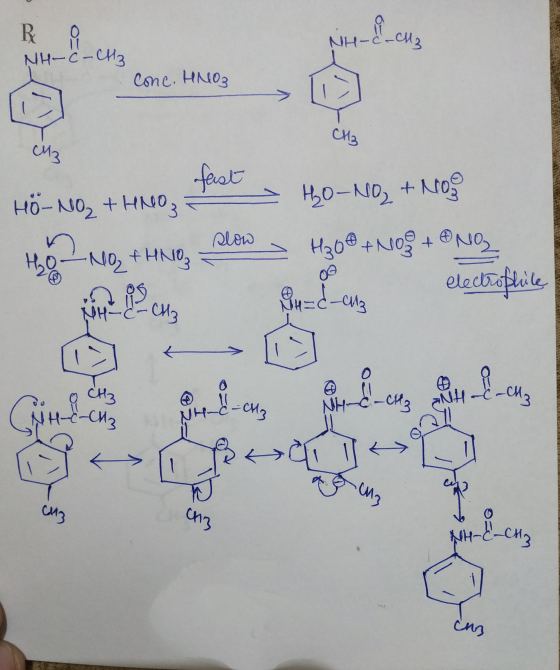
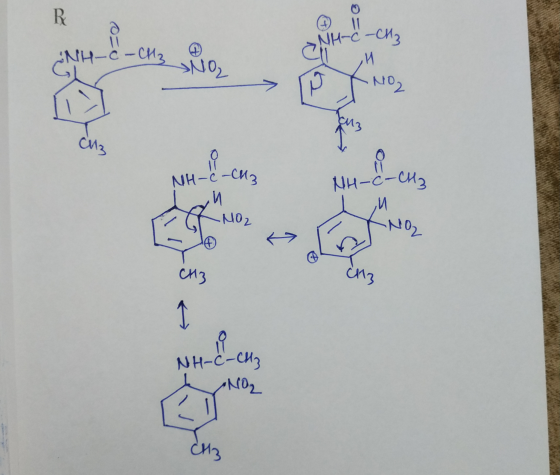
In above reaction we will get only ortho product as a major product because para position is not free it is occupied by methyl group.
Add Answer to:
Using the curved arrow formalism, draw the mechanism for the
reaction between N-acetyl-ptoluidine with concentrated nitric...
please show work Using the curved arrow formalism, draw the mechanism for the reaction between N-acetyl-ptoluidine...
please show work Using the curved arrow formalism, draw the mechanism for the reaction between N-acetyl-ptoluidine with concentrated nitric acid. Be sure to show all of the intermediates and rationalize the regioselectivity of the reaction.
“Fun in acid” question: Draw a reaction mechanism using the curved-arrow formalism (include lone pair electrons)...
“Fun in acid” question: Draw a reaction mechanism using the curved-arrow formalism (include lone pair electrons) for the conversion of an ester into an alcohol and a methyl ester in the presence of acid in excess methanol. Hint: 6-steps.
“Fun in acid” question: Draw a reaction mechanism using the curved-arrow formalism (include lone pair electrons)...
 “Fun in acid” question: Draw a reaction mechanism using the
curved-arrow formalism (include
lone pair electrons) for the following transesterification of an
ester into an alcohol and a methyl
ester in the presence of acid in excess methanol. Hint:
6-steps.
H+
“Fun in acid” question: Draw a reaction mechanism using the
curved-arrow formalism (include
lone pair electrons) for the following transesterification of an
ester into an alcohol and a methyl
ester in the presence of acid in excess methanol. Hint:
6-steps.
H+
4. (22 points) "Fun in acid" question: Draw a reasonable mechanism using the curved-arrow formalism (include...
 4. (22 points) "Fun in acid" question: Draw a reasonable mechanism using the curved-arrow formalism (include lone pair electrons) for the following rearrangement reaction of an arene oxide in the presence of dilute aqueous sulfuric acid to give the corresponding phenol. What is the thermodynamic driving force for the conversion of the arene oxide into the phenol? Hint: 4-steps H2SO4 HO in excess: used as solvent) "Fun in acid" question: Draw a reasonable mechanism using the curved-arrow formalism (include lone...
2. For the reaction outlined below draw out the reaction mechanism using arrow formalism to describe...
 2. For the reaction outlined below draw out the reaction mechanism using arrow formalism to describe how the reaction below occurs. Be sure to draw out all reaction intermediates of the moment of all electrons needed to justify the formation of the indicated product. You do not need to add in any reagents that are not shown OR any other products that could be made but are not shown. (2 points) Br NaOH, acetone Na o
6. "Fun in base" question: Draw a reaction mechanism using the curved-arrow formalism (include lone pair...
 6. "Fun in base" question: Draw a reaction mechanism using the curved-arrow formalism (include lone pair electrons) for the conversion of methyl salicylate into the corresponding conjugate base of salicylic acid and methanol in the presence of excess aqueous hydroxide. Hint: The first step is an acid- base reaction. H20 осни + он o + CH OH (in excess; used as solvent) ОН Be sure you explain acid-base chemistry and use appropriate PK, values in steps 1 and 4. Compound...
B. Using curved arrow notation, draw the reaction mechanism and predict the product the reaction below....
 B. Using curved arrow notation, draw the reaction mechanism and predict the product the reaction below. Show all reaction intermediates and account for stereochemical requirements. [6 MARKS) EtOna / EtOH ? OTS Heat
Part III - Mechanism cont'd B. Using curved arrow notation, draw the reaction mechanism and predict...
 Part III - Mechanism cont'd B. Using curved arrow notation, draw the reaction mechanism and predict the product the reaction below. Show all reaction intermediates and account for stereochemical requirements. [6 MARKS] or EtoNa / EtOH ? OTS Heat
(2 pts) Show the complete mechanism using curved arrow formalism for the reaction of 4-ethyl-1-cyclohexanecarboxaldehyde treated...
(2 pts) Show the complete mechanism using curved arrow formalism for the reaction of 4-ethyl-1-cyclohexanecarboxaldehyde treated with ethylene glycol in acid. Provide the 1H and 13C NMR data for the product formed in Question #1. Report the 1H NMR data in the sequence: chemical shift, integration, multiplicity (e.g. d 1.0, 3H, triplet). Be sure to clearly label which proton and carbon you are reporting.
Using the curved arrow formalism, outline an acceptable mechanism for the acid catalyzed electrophilic addition of...
 Using the curved arrow formalism, outline an acceptable mechanism for the acid catalyzed electrophilic addition of water to 1-Methylcyclohexene as shown below. Your mechanism should show the movement of all electrons involved in bond forming and bond breaking steps as well as all formal charges for atoms that are not neutral. CH HOH H
 “Fun in acid” question: Draw a reaction mechanism using the
curved-arrow formalism (include
lone pair electrons) for the following transesterification of an
ester into an alcohol and a methyl
ester in the presence of acid in excess methanol. Hint:
6-steps.
H+
“Fun in acid” question: Draw a reaction mechanism using the
curved-arrow formalism (include
lone pair electrons) for the following transesterification of an
ester into an alcohol and a methyl
ester in the presence of acid in excess methanol. Hint:
6-steps.
H+
 4. (22 points) "Fun in acid" question: Draw a reasonable mechanism using the curved-arrow formalism (include lone pair electrons) for the following rearrangement reaction of an arene oxide in the presence of dilute aqueous sulfuric acid to give the corresponding phenol. What is the thermodynamic driving force for the conversion of the arene oxide into the phenol? Hint: 4-steps H2SO4 HO in excess: used as solvent) "Fun in acid" question: Draw a reasonable mechanism using the curved-arrow formalism (include lone...
 2. For the reaction outlined below draw out the reaction mechanism using arrow formalism to describe how the reaction below occurs. Be sure to draw out all reaction intermediates of the moment of all electrons needed to justify the formation of the indicated product. You do not need to add in any reagents that are not shown OR any other products that could be made but are not shown. (2 points) Br NaOH, acetone Na o
 6. "Fun in base" question: Draw a reaction mechanism using the curved-arrow formalism (include lone pair electrons) for the conversion of methyl salicylate into the corresponding conjugate base of salicylic acid and methanol in the presence of excess aqueous hydroxide. Hint: The first step is an acid- base reaction. H20 осни + он o + CH OH (in excess; used as solvent) ОН Be sure you explain acid-base chemistry and use appropriate PK, values in steps 1 and 4. Compound...
 B. Using curved arrow notation, draw the reaction mechanism and predict the product the reaction below. Show all reaction intermediates and account for stereochemical requirements. [6 MARKS) EtOna / EtOH ? OTS Heat
 Part III - Mechanism cont'd B. Using curved arrow notation, draw the reaction mechanism and predict the product the reaction below. Show all reaction intermediates and account for stereochemical requirements. [6 MARKS] or EtoNa / EtOH ? OTS Heat
 Using the curved arrow formalism, outline an acceptable mechanism for the acid catalyzed electrophilic addition of water to 1-Methylcyclohexene as shown below. Your mechanism should show the movement of all electrons involved in bond forming and bond breaking steps as well as all formal charges for atoms that are not neutral. CH HOH H
Most questions answered within 3 hours.
-
Where is the error in this code sequence?
String s1 = "Hello";
String s2 = "ello";...
asked 10 months ago -
Financial data for Joel de Paris, Inc., for last year
follow:
Joel de Paris, Inc.
Balance...
asked 10 months ago -
Consider this reaction:
Al2(SO4)3 (aq)+ BaCl3
(aq) Al2Cl6 (aq)- +
3BaSO4(s) . What is the...
asked 10 months ago -
Suppose that Savneet is considering increasing her
recent random sample from 20 car rentals to 40...
asked 10 months ago -
Trucks arrive at an unloading terminal at an average rate of 120
per hour.
Trucks arrive...
asked 10 months ago -
Why are methanol and ethanol completely soluble in water while
octanol is not very little soluble....
asked 10 months ago -
A facilities manager at a university reads in a research report
that the mean amount of...
asked 10 months ago -
When the CuSO4 is rehydrated by adding water to the anhydrous
compound, is this an endothermic...
asked 10 months ago -
A ray of sunlight is passing from diamond into crown glass; the
angle of incidence is...
asked 10 months ago -
A block of mass 0.249 kg is placed on top of a light, vertical
spring of...
asked 10 months ago -
how do the kidneys compensate in the presences of acidosis
a) trigger hyperventilate
b) reserve acid...
asked 10 months ago -
Question 501 pts
The rental rate of capital to the firm increases. Which of the
following...
asked 10 months ago