Cell membranes contain channels that allow ions to cross the phospholipid bilayer. A particular K+ channel...
Cell membranes contain channels that allow ions to cross the phospholipid bilayer. A particular K+ channel carries a current of 1.77 pA . How many K+ ions, ? , pass through the channel in 1.72 ms ?
Homework Answers

Add Answer to:
Cell membranes contain channels that allow ions to cross the
phospholipid bilayer. A particular K+ channel...
Cell membranes contain channels that allow Na+ ions to rush in. Consider a channel that has...
Cell membranes contain channels that allow Na+ ions to rush in. Consider a channel that has a diameter of 2.81 nm and a length of13.0 nm. If the channel has a resistance of 16.5 GΩ, what is the resistivity ? of the solution in the channel?
All of 1 A certain channel has been isolated from a cell membrane, that allows cyanide...
 All of 1
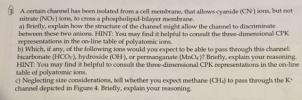
A certain channel has been isolated from a cell membrane, that allows cyanide (CN-) ions, but not nitrate (NO3) ions, to cross a phospholipid-bilayer membrane. a) Briefly, explain how the structure of the channel might allow the channel to discriminate between these two anions. HINT: You may find it helpful to consult the three-dimensional CPK representations in the on-line table of polyatomic ions. b) Which, if any, of the following ions would you expect to be able...
All of 1
A certain channel has been isolated from a cell membrane, that allows cyanide (CN-) ions, but not nitrate (NO3) ions, to cross a phospholipid-bilayer membrane. a) Briefly, explain how the structure of the channel might allow the channel to discriminate between these two anions. HINT: You may find it helpful to consult the three-dimensional CPK representations in the on-line table of polyatomic ions. b) Which, if any, of the following ions would you expect to be able...
Please help and show work. I keep getting the wrong answers for these problems 1. Cell...
Please help and show work. I keep getting the wrong answers for these problems 1. Cell membranes contain channels that allow Na + ions to rush in. Consider a channel that has a diameter of 2.91 nm and a length of 13.5 nm. If the channel has a resistance of 18.5 GΩ, what is the resistivity ? of the solution in the channel? 2. What is the resistance of a 54.154.1-m-long aluminum wire that has a diameter of 8.79 mm8.79...
09. Which of the followine statements regarding channel proteins (shown below (shown below) is for propratic...
 09. Which of the followine statements regarding channel proteins (shown below (shown below) is for propratic of all a. Channel proteins can assist polar molecules to cross the plasma membrane by facilitated diffusion b. The gated ion channel can allow ions to pass when stimulated to open. c. The surface of a channel protein in contact with the bilayer would likely have hydrophilic amino acids d. Water plays a role in determining which ions are allowed to pass through an...
Special channels called aquaporins allow water to move between cells. These channel proteins are selective- they...
Special channels called aquaporins allow water to move between cells. These channel proteins are selective- they freely let water molecules through the membrane but NOT ions or other molecules- but (like leak channels) are not gated.Based on those facts, state which of the following would be the most likely to determines the direction (and how quickly) water can move across a membrane using aquaporins, and (in a few sentences) explain your answer. how much ATP is present inside the cell...
A certain single ion channel is selectively permeable to K+ and has a resistance of 1.5...
 A
certain single ion channel is selectively permeable to K+ and has a
resistance of 1.5 GI, therefore a current of potassium ions through
the channel is possible. During an experiment, the channel is open
for approximately 1.50 ms while the voltage across the channel is
maintained at 81.5 mV. How many K+ ions travel through the channel
during this time?
A certain single ion channel is selectively permeable to K+ and has a resistance of 1.15 G, therefore a...
A
certain single ion channel is selectively permeable to K+ and has a
resistance of 1.5 GI, therefore a current of potassium ions through
the channel is possible. During an experiment, the channel is open
for approximately 1.50 ms while the voltage across the channel is
maintained at 81.5 mV. How many K+ ions travel through the channel
during this time?
A certain single ion channel is selectively permeable to K+ and has a resistance of 1.15 G, therefore a...
A certain single ion channel is selectively permeable to K+ and has a resistance of 1.15...
A certain single ion channel is selectively permeable to K+ and has a resistance of 1.15 GΩ , therefore a current of potassium ions through the channel is possible. During an experiment, the channel is open for approximately 1.50 ms while the voltage across the channel is maintained at 81.5 mV . How many K+ ions travel through the channel during this
4. Inspired by the natural design of cell membranes, you have invented a strange new semi-permeable...
 4. Inspired by the natural design of cell membranes, you have invented a strange new semi-permeable membrane consisting of a water-impemeable base layer interspersed with hydrophilic transmembrane glycoproteins which form three types of channels. Channel type 'A' is approx imately 3 angstroms in diameter and lined with negative charges Channel type 'B' is approximately 3 angstroms in diameter also but lined with positive charges Channel type C is approximately 4 angstroms in diameter and electrically neutral This membrane separates two...
During the aerobic metabolism of glucose, glucose is ____________. Reduced to form water Oxidized to form...
During the aerobic metabolism of glucose, glucose is ____________. Reduced to form water Oxidized to form water Reduced to form CO2 Oxidized to form CO2 Which of the following describes the equation: FAD + XH2 à FADH2 + X. FAD is reduced to FADH2 It is a coupled reduction – oxidation reaction XH2 is oxidized to X All of the above Which of the following is FALSE about glycolysis? The initial steps of glycolysis requires energy derived from the splitting...
change pas channels in the volta t ive protein to change shape. This A of the...
 change pas channels in the volta t ive protein to change shape. This A of the S l e terminal siste oplasmic reticum calcio p r eneule warcoplasm reticulum sodium ions m o nster transverse tubules sarcolemma: calcium ions Saroplasmic reticum: triadsarcolemma: calcium ions sons bind to This causes a change in shape and exposing C D E Calcium vesicle tylcholine action potential Sodium sarcolemma calcium on myosin heads Sodium sacoplasmic reticulum calcium ions actin 15. An attaches to exposed...
 All of 1
A certain channel has been isolated from a cell membrane, that allows cyanide (CN-) ions, but not nitrate (NO3) ions, to cross a phospholipid-bilayer membrane. a) Briefly, explain how the structure of the channel might allow the channel to discriminate between these two anions. HINT: You may find it helpful to consult the three-dimensional CPK representations in the on-line table of polyatomic ions. b) Which, if any, of the following ions would you expect to be able...
All of 1
A certain channel has been isolated from a cell membrane, that allows cyanide (CN-) ions, but not nitrate (NO3) ions, to cross a phospholipid-bilayer membrane. a) Briefly, explain how the structure of the channel might allow the channel to discriminate between these two anions. HINT: You may find it helpful to consult the three-dimensional CPK representations in the on-line table of polyatomic ions. b) Which, if any, of the following ions would you expect to be able...
 09. Which of the followine statements regarding channel proteins (shown below (shown below) is for propratic of all a. Channel proteins can assist polar molecules to cross the plasma membrane by facilitated diffusion b. The gated ion channel can allow ions to pass when stimulated to open. c. The surface of a channel protein in contact with the bilayer would likely have hydrophilic amino acids d. Water plays a role in determining which ions are allowed to pass through an...
 A
certain single ion channel is selectively permeable to K+ and has a
resistance of 1.5 GI, therefore a current of potassium ions through
the channel is possible. During an experiment, the channel is open
for approximately 1.50 ms while the voltage across the channel is
maintained at 81.5 mV. How many K+ ions travel through the channel
during this time?
A certain single ion channel is selectively permeable to K+ and has a resistance of 1.15 G, therefore a...
A
certain single ion channel is selectively permeable to K+ and has a
resistance of 1.5 GI, therefore a current of potassium ions through
the channel is possible. During an experiment, the channel is open
for approximately 1.50 ms while the voltage across the channel is
maintained at 81.5 mV. How many K+ ions travel through the channel
during this time?
A certain single ion channel is selectively permeable to K+ and has a resistance of 1.15 G, therefore a...
 4. Inspired by the natural design of cell membranes, you have invented a strange new semi-permeable membrane consisting of a water-impemeable base layer interspersed with hydrophilic transmembrane glycoproteins which form three types of channels. Channel type 'A' is approx imately 3 angstroms in diameter and lined with negative charges Channel type 'B' is approximately 3 angstroms in diameter also but lined with positive charges Channel type C is approximately 4 angstroms in diameter and electrically neutral This membrane separates two...
 change pas channels in the volta t ive protein to change shape. This A of the S l e terminal siste oplasmic reticum calcio p r eneule warcoplasm reticulum sodium ions m o nster transverse tubules sarcolemma: calcium ions Saroplasmic reticum: triadsarcolemma: calcium ions sons bind to This causes a change in shape and exposing C D E Calcium vesicle tylcholine action potential Sodium sarcolemma calcium on myosin heads Sodium sacoplasmic reticulum calcium ions actin 15. An attaches to exposed...
Most questions answered within 3 hours.
-
Where is the error in this code sequence?
String s1 = "Hello";
String s2 = "ello";...
asked 10 months ago -
Financial data for Joel de Paris, Inc., for last year
follow:
Joel de Paris, Inc.
Balance...
asked 10 months ago -
Consider this reaction:
Al2(SO4)3 (aq)+ BaCl3
(aq) Al2Cl6 (aq)- +
3BaSO4(s) . What is the...
asked 10 months ago -
Suppose that Savneet is considering increasing her
recent random sample from 20 car rentals to 40...
asked 10 months ago -
Trucks arrive at an unloading terminal at an average rate of 120
per hour.
Trucks arrive...
asked 10 months ago -
Why are methanol and ethanol completely soluble in water while
octanol is not very little soluble....
asked 10 months ago -
A facilities manager at a university reads in a research report
that the mean amount of...
asked 10 months ago -
When the CuSO4 is rehydrated by adding water to the anhydrous
compound, is this an endothermic...
asked 10 months ago -
A ray of sunlight is passing from diamond into crown glass; the
angle of incidence is...
asked 10 months ago -
A block of mass 0.249 kg is placed on top of a light, vertical
spring of...
asked 10 months ago -
how do the kidneys compensate in the presences of acidosis
a) trigger hyperventilate
b) reserve acid...
asked 10 months ago -
Question 501 pts
The rental rate of capital to the firm increases. Which of the
following...
asked 10 months ago