Please code in Python Revise the AbstractBag class so that it behaves as a subclass of...
Please code in Python
Revise the AbstractBag class so that it behaves as a subclass of AbstractCollection provided in the file abstractcollection.py.
Abstractcollection.py code:
class AbstractCollection(object):
"""An abstract collection implementation."""
# Constructor
def __init__(self, sourceCollection = None):
"""Sets the initial state of self, which includes the
contents of sourceCollection, if it's present."""
self.size = 0
if sourceCollection:
for item in sourceCollection:
self.add(item)
# Accessor methods
def isEmpty(self):
"""Returns True if len(self) == 0, or False otherwise."""
return len(self) == 0
def __len__(self):
"""Returns the number of items in self."""
return self.size
def __str__(self):
"""Returns the string representation of self."""
return "[" + ", ".join(map(str, self)) + "]"
def __add__(self, other):
"""Returns a new bag containing the contents
of self and other."""
result = type(self)(self)
for item in other:
result.add(item)
return result
def __eq__(self, other):
"""Returns True if self equals other,
or False otherwise."""
if self is other: return True
if type(self) != type(other) or \
len(self) != len(other):
return False
otherIter = iter(other)
for item in self:
if item != next(otherIter):
return False
return True
def count(self, item):
"""Returns the number of instances of item in self."""
total = 0
for nextItem in self:
if nextItem == item:
total += 1
return total
Abstractbag.py Code:
from abstractcollection import AbstractCollection
class AbstractBag(AbstractCollection):
"""An abstract bag implementation."""
# Constructor
def __init__(self, sourceCollection = None):
AbstractCollection__init__(self, sourceColletion)
"""Sets the initial state of self, which includes the
contents of sourceCollection, if it's present."""
self.size = 0
if sourceCollection:
for item in sourceCollection:
self.add(item)
# Accessor methods
def isEmpty(self):
"""Returns True if len(self) == 0, or False otherwise."""
return len(self) == 0
def __len__(self):
"""Returns the number of items in self."""
return self.size
def __str__(self):
"""Returns the string representation of self."""
return "{" + ", ".join(map(str, self)) + "}"
def __add__(self, other):
"""Returns a new bag containing the contents
of self and other."""
result = type(self)(self)
for item in other:
result.add(item)
return result
def __eq__(self, other):
"""Returns True if self equals other,
or False otherwise."""
if self is other: return True
if type(self) != type(other) or \
len(self) != len(other):
return False
for item in self:
if self.count(item) != other.count(item):
return False
return True
def count(self, item):
"""Returns the number of instances of item in self."""
total = 0
for nextItem in self:
if nextItem == item:
total += 1
return total
Homework Answers
# do comment if any problem arises
# Code
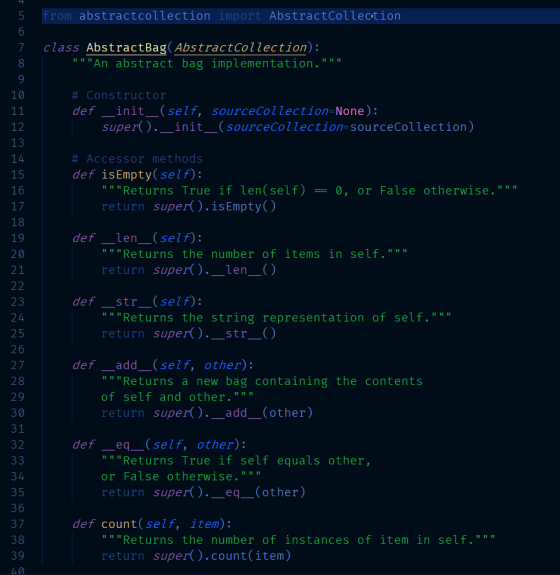
from abstractcollection import AbstractCollection
class AbstractBag(AbstractCollection):
"""An abstract bag implementation."""
# Constructor
def __init__(self, sourceCollection=None):
super().__init__(sourceCollection=sourceCollection)
# Accessor methods
def isEmpty(self):
"""Returns True if len(self) == 0, or False otherwise."""
return super().isEmpty()
def __len__(self):
"""Returns the number of items in self."""
return super().__len__()
def __str__(self):
"""Returns the string representation of self."""
return super().__str__()
def __add__(self, other):
"""Returns a new bag containing the contents
of self and other."""
return super().__add__(other)
def __eq__(self, other):
"""Returns True if self equals other,
or False otherwise."""
return super().__eq__(other)
def count(self, item):
"""Returns the number of instances of item in self."""
return super().count(item)
Screenshot:
Add Answer to:
Please code in Python
Revise the AbstractBag class so that it behaves as a subclass of...
Python 3+ Adjust the following code so the two errors below are non-present: 1. __init__() :...
Python 3+ Adjust the following code so the two errors below are non-present: 1. __init__() : Since Pizza object don't have it's own set() datastructure, the toppings in the pizza object are manimupated from out of the object. (-1.0) 2. __eq__() : How about "self.toppings == other.toppings" rather than "self.toppings - other.toppin == set())". Code: ## Program 1 ## --------------------------------- class Pizza: def __init__(self, s='M', top=set()): self.setSize(s) self.toppings = top def setSize(self, s): self.size = s def getSize(self): return self.size...
PYTHON: Conan is writing a module to contain different implementations of trees. After his first tree,...
PYTHON: Conan is writing a module to contain different implementations of trees. After his first tree, the BinaryTreeclass, he wrote test code and is having problems understanding the error. Locate his problem and explain how you would fix it. class Node(object): def __init__(self, data=None): self.data = data def __str__(self): return "NODE: " + str(self.data) class Tree(object): def __init__(self): self.root_node = None self.size = 0 def __len__(self): return self.size def add(self, data): raise NotImplementedError("Add method not implemented.") def inorder_traversal(self): raise NotImplementedError("inorder_traversal...
In this part, you will complete the code to solve a maze.
- Complete the code to solve a maze- Discuss related data structures topicsProgramming-----------In this part, you will complete the code to solve a maze.Begin with the "solveMaze.py" starter file.This file contains comment instructions that tell you where to add your code.Each maze resides in a text file (with a .txt extension).The following symbols are used in the mazes:BARRIER = '-' # barrierFINISH = 'F' # finish (goal)OPEN = 'O' # open stepSTART = 'S' # start stepVISITED = '#' #...
PYTHON. Continues off another code. I don't understand this. Someone please help! Comment the lines please...
PYTHON. Continues off another code. I don't understand this. Someone please help! Comment the lines please so I can understand LinkedList ADT: class myLinkedList: def __init__(self): self.__head = None self.__tail = None self.__size = 0 def insert(self, i, data): if self.isEmpty(): self.__head = listNode(data) self.__tail = self.__head elif i <= 0: self.__head = listNode(data, self.__head) elif i >= self.__size: self.__tail.setNext(listNode(data)) self.__tail = self.__tail.getNext() else: current = self.__getIthNode(i - 1) current.setNext(listNode(data,...
Use your Food class, utilities code, and sample data from Lab 1 to complete the following...
Use your Food class, utilities code, and sample data from Lab 1 to complete the following Tasks. def average_calories(foods): """ ------------------------------------------------------- Determines the average calories in a list of foods. foods is unchanged. Use: avg = average_calories(foods) ------------------------------------------------------- Parameters: foods - a list of Food objects (list of Food) Returns: avg - average calories in all Food objects of foods (int) ------------------------------------------------------- """ your code here is the...
PYTHON. Continues off another code(other code is below). I don't understand this. Someone please help! Comment...
PYTHON. Continues off another code(other code is below). I don't understand this. Someone please help! Comment the lines please so I can understand. There are short and med files lengths for each the list of names/ids and then search id file. These are the input files: https://codeshare.io/aVQd46 https://codeshare.io/5M3XnR https://codeshare.io/2W684E https://codeshare.io/5RJwZ4 LinkedList ADT to store student records(code is below). Using LinkedList ADT instead of the Python List. You will need to use the Student ADT(code is below) Imports the Student class...
Python code that sorts books
class Book: def __init__(self,id,bookName,authorName,nextNode=None): self.id = id self.bookName = bookName self.authorName = authorName self.nextNode = nextNode def getId(self): return self.id def getBookName(self): return self.bookName def getAuthorName(self): return self.authorName def getNextNode(self): return self.nextNode def setNextNode(self,val): self.nextNode = val class LinkedList: def __init__(self,head = None): self.head = head self.size = 0 def getSize(self): return self.size def AddBookToFront(self,newBook): newBook.setNextNode(self.head) self.head = newBook self.size+=1 def DisplayBook(self): curr = self.head while curr: print(curr.getId(),curr.getBookName(),curr.getAuthorName()) curr = curr.getNextNode() def RemoveBookAtPosition(self,n): prev = None curr = self.head curPos = 0 while curr: if curPos == n: if prev: prev.setNextNode(curr.getNextNode()) else: self.head = curr.getNextNode() self.size = self.size - 1 return True prev = curr curr = curr.getNextNode() curPos = curPos + 1 return False def AddBookAtPosition(self,newBook,n): curPos = 1 if n == 0: newBook.setNextNode(self.head) self.head = newBook self.size+=1 return else: currentNode = self.head while currentNode.getNextNode() is not None: if curPos == n: newBook.setNextNode(currentNode.getNextNode()) currentNode.setNextNode(newBook) self.size+=1 return currentNode = currentNode.getNextNode() curPos = curPos + 1 if curPos == n: newBook.setNextNode(None) currentNode.setNextNode(newBook) self.size+=1 else: print("cannot add",newBook.getId(),newBook.getBookName(),"at that position") def SortByAuthorName(self): for i in range(1,self.size): node1 = self.head node2 = node1.getNextNode() while node2 is not None: if node1.authorName > node2.authorName: temp = node1.id temp2 = node1.bookName temp3 = node1.authorName node1.id = node2.id node1.bookName = node2.bookName node1.authorName = node2.authorName node2.id = temp node2.bookName = temp2 node2.authorName = temp3 node1 = node1.getNextNode() node2 = node2.getNextNode() myLinkedList = LinkedList() nodeA = Book("#1","cool","Isaac") nodeB = Book("#2","amazing","Alfred") nodeC = Book("#3","hello","John") nodeD = Book("#4","why","Chase") nodeE = Book("#5","good","Mary") nodeF = Book("#6","hahaha","Radin") myLinkedList.AddBookToFront(nodeA) myLinkedList.AddBookToFront(nodeB) myLinkedList.AddBookToFront(nodeC) myLinkedList.AddBookAtPosition(nodeD,1) myLinkedList.AddBookAtPosition(nodeE,1) myLinkedList.AddBookAtPosition(nodeF,1) myLinkedList.RemoveBookAtPosition(2) myLinkedList.RemoveBookAtPosition(2) myLinkedList.DisplayBook() myLinkedList.SortByAuthorName()print(myLinkedList.getSize())...
reate a class called Person with the following attributes: name - A string representing the person's...
reate a class called Person with the following attributes: name - A string representing the person's name age - An int representing the person's age in years As well as appropriate __init__ and __str__ methods, include the following methods: get_name(self) - returns the name of the person get_age(self) - returns the age of the person set_name(self, new_name) - sets the name for the person set_age(self, new_age) - sets the age for the person is_older_than(self, other) - returns True if this...
Implement the class MaxHeapPriorityQueue as a heap with the following operations: • MaxHeapPriorityQueue() creates a new...
Implement the class MaxHeapPriorityQueue as a heap with the following operations: • MaxHeapPriorityQueue() creates a new heap that is empty. It needs no parameters and returns nothing. Note that as discussed in the video lecture, the index range of the array implementation of a heap is 1:n, NOT 0:n-1 • parent(index) returns the value of the parent of heap[index]. index is between 1 and the size of the heap. If index<=1 or index>size of the heap, it returns None •...
Implement the class MaxHeapPriorityQueue as a heap with the following operations using python: - ...
Implement the class MaxHeapPriorityQueue as a heap with the following operations using python: - MaxHeapPriorityQueue() creates a new heap that is empty. It needs no parameters and returns nothing. - parent(index) returns the value of the parent of heap[index]. index is between 1 and the size of the heap. If index<=1 or index>size of the heap, it returns None - leftChild(index) returns the value of the left child of heap[index], returns None if there is no value - rightChild(index) returns...
Most questions answered within 3 hours.
-
Where is the error in this code sequence?
String s1 = "Hello";
String s2 = "ello";...
asked 11 months ago -
Financial data for Joel de Paris, Inc., for last year
follow:
Joel de Paris, Inc.
Balance...
asked 11 months ago -
Consider this reaction:
Al2(SO4)3 (aq)+ BaCl3
(aq) Al2Cl6 (aq)- +
3BaSO4(s) . What is the...
asked 11 months ago -
Suppose that Savneet is considering increasing her
recent random sample from 20 car rentals to 40...
asked 11 months ago -
Trucks arrive at an unloading terminal at an average rate of 120
per hour.
Trucks arrive...
asked 11 months ago -
Why are methanol and ethanol completely soluble in water while
octanol is not very little soluble....
asked 11 months ago -
A facilities manager at a university reads in a research report
that the mean amount of...
asked 11 months ago -
When the CuSO4 is rehydrated by adding water to the anhydrous
compound, is this an endothermic...
asked 11 months ago -
A ray of sunlight is passing from diamond into crown glass; the
angle of incidence is...
asked 11 months ago -
A block of mass 0.249 kg is placed on top of a light, vertical
spring of...
asked 11 months ago -
how do the kidneys compensate in the presences of acidosis
a) trigger hyperventilate
b) reserve acid...
asked 11 months ago -
Question 501 pts
The rental rate of capital to the firm increases. Which of the
following...
asked 11 months ago