In a chemical reaction from a biological system, which component is larger in magnitude, the change...
In a chemical reaction from a biological system, which component is larger in magnitude, the change in entropy or the change in enthalpy?
Homework Answers
Answer: Change in enthalpy will be larger in magnitude than change in entropy because under equilibrium condition, change in gibbs free energy is zero and so the change in enthalpy becomes,
 =
= T
 , where T
is the temperature and is change in
entropy.
, where T
is the temperature and is change in
entropy.
Therefore, =/ T, which
means change in entropy decreases due to increase in temperature
.
Add Answer to:
In a chemical reaction from a biological system, which
component is larger in magnitude, the change...
3. Many biological macromolecules undergo a transition called denaturation, where the system unfolds. For a protein at a pH 2 the change in enthalpy associated to denaturation is 418 kJ/mol and th...
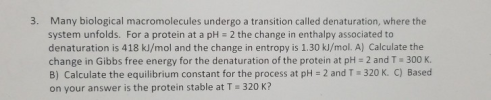 3. Many biological macromolecules undergo a transition called denaturation, where the system unfolds. For a protein at a pH 2 the change in enthalpy associated to denaturation is 418 kJ/mol and the change in entropy is 1.30 kJ/mol. A) Calculate the change in Gibbs free energy for the denaturation of the protein at pH 2 and T 300 K. B) Calculate the equilibrium constant for the process at pH 2 and T 320 K. C) Based on your answer is...
Chemical energy stored in the reactants is released as heat when the reaction is exothermic. For...
Chemical energy stored in the reactants is released as heat when the reaction is exothermic. For an exothermic reaction, the enthalpy change for a reaction is negative. Enthalpy, represented as H, is the heat content of a system. As it is a state function, it depends on the state of the system; hence, it is calculated in the form of change in heat content. Heat change, or enthalpy change, is represented as ΔH; ΔH is a measure of the heat...
Chemical energy is released or absorbed from reactions in various forms. The most easily measurable form...
Chemical energy is released or absorbed from reactions in various forms. The most easily measurable form of energy comes in the form of heat, or enthalpy. The enthalpy of a reaction can be calculated from the heats of formation of the substances involved in the reaction: ΔH∘rxn=ΔH∘f(products)−ΔH∘f(reactants) Entropy change, ΔS∘, is a measure of the number of energetically equivalent microstates introduced into the system during the reaction. The degree of spontaneity of a reaction is represented by the Gibbs free...
Chemical energy is released or absorbed from reactions in various forms. The most easily measurable form of energy comes...
Chemical energy is released or absorbed from reactions in various forms. The most easily measurable form of energy comes in the form of heat, or enthalpy. The enthalpy of a reaction can be calculated from the heats of formation of the substances involved in the reaction: ΔH∘rxn=ΔH∘f(products)−ΔH∘f(reactants) Entropy change, ΔS∘, is a measure of the number of energetically equivalent microstates introduced into the system during the reaction. The degree of spontaneity of a reaction is represented by the Gibbs free...
A critical reaction in the production of energy to do work or drive chemical reactions in...
 A critical reaction in the production of energy to do work or drive chemical reactions in biological systems is the hydrolysis of adenosine triphosphate, ATP, to adenosine diphosphate, ADP, as described by the reaction ATP(aq) + H,O(1) ADP(aq) + HPO- (aq) for which AG = -30.5 kJ/mol at 37.0 °C and pH 7.0. Calculate the value of AG xn in a biological cell in which [ATP] = 5.0 mm, (ADP) = 0.10 mM, and (HPO 1 - 5.0 mM. AG...
Phase transitions are similar to chemical reactions in that they each have an associated entropy change....
 Phase transitions are similar to chemical reactions in that they
each have an associated entropy change. A phase transition involves
the breaking or forming of intermolecular attractive forces.
A change in entropy accompanies not only a variation in the
temperature, pressure, or volume of a system but also a physical
transformation such as the fusion, vaporization, or transition from
one crystalline state into another.
In the equilibrium between two phases, the exchange of heat can
be carried out reversibly, and...
Phase transitions are similar to chemical reactions in that they
each have an associated entropy change. A phase transition involves
the breaking or forming of intermolecular attractive forces.
A change in entropy accompanies not only a variation in the
temperature, pressure, or volume of a system but also a physical
transformation such as the fusion, vaporization, or transition from
one crystalline state into another.
In the equilibrium between two phases, the exchange of heat can
be carried out reversibly, and...
The enthalpy change for a chemical reaction is the sum of the energy consumed in breaking...
 The enthalpy change for a chemical reaction is the sum of the
energy consumed in breaking bonds and the energy released during
bond formation. One way to determine the overall energy change for
a chemical reaction is to apply Hess’s law to add together a group
of reactions which can be arranged such that the chemical
equations, when combined, give the overall equation we are trying
to characterize.
The average propane cylinder for a residential grill holds
approximately 18 kg...
The enthalpy change for a chemical reaction is the sum of the
energy consumed in breaking bonds and the energy released during
bond formation. One way to determine the overall energy change for
a chemical reaction is to apply Hess’s law to add together a group
of reactions which can be arranged such that the chemical
equations, when combined, give the overall equation we are trying
to characterize.
The average propane cylinder for a residential grill holds
approximately 18 kg...
The enthalpy change for a chemical reaction is the sum of the energy consumed in breaking...
The enthalpy change for a chemical reaction is the sum of the energy consumed in breaking bonds and the energy released during bond formation. One way to determine the overall energy change for a chemical reaction is to apply Hess’s law to add together a group of reactions which can be arranged such that the chemical equations, when combined, give the overall equation we are trying to characterize. The average propane cylinder for a residential grill holds approximately 18 kg...
12. Which statement is always true for an exothermic reaction? A) The enthalpy change is negative....
 12. Which statement is always true for an exothermic reaction? A) The enthalpy change is negative. B) The reaction absorbs heat from the surroundings. C) The enthalpy change is positive. D) The work done on the system is zero
4. When methane is transferred from benzene to water methane(benzene) methane(H,0) the free-energy change is positive,...
 4. When methane is transferred from benzene to water methane(benzene) methane(H,0) the free-energy change is positive, but the enthalpy change is negative. What does this imply about the entropy change for the reaction? What do the signs of the free-energy change and the entropy change imply about the spontane- ity of the reaction? Does your answer make "chemical sense," that is, are hy- drocarbons soluble in water?
 3. Many biological macromolecules undergo a transition called denaturation, where the system unfolds. For a protein at a pH 2 the change in enthalpy associated to denaturation is 418 kJ/mol and the change in entropy is 1.30 kJ/mol. A) Calculate the change in Gibbs free energy for the denaturation of the protein at pH 2 and T 300 K. B) Calculate the equilibrium constant for the process at pH 2 and T 320 K. C) Based on your answer is...
 A critical reaction in the production of energy to do work or drive chemical reactions in biological systems is the hydrolysis of adenosine triphosphate, ATP, to adenosine diphosphate, ADP, as described by the reaction ATP(aq) + H,O(1) ADP(aq) + HPO- (aq) for which AG = -30.5 kJ/mol at 37.0 °C and pH 7.0. Calculate the value of AG xn in a biological cell in which [ATP] = 5.0 mm, (ADP) = 0.10 mM, and (HPO 1 - 5.0 mM. AG...
 Phase transitions are similar to chemical reactions in that they
each have an associated entropy change. A phase transition involves
the breaking or forming of intermolecular attractive forces.
A change in entropy accompanies not only a variation in the
temperature, pressure, or volume of a system but also a physical
transformation such as the fusion, vaporization, or transition from
one crystalline state into another.
In the equilibrium between two phases, the exchange of heat can
be carried out reversibly, and...
Phase transitions are similar to chemical reactions in that they
each have an associated entropy change. A phase transition involves
the breaking or forming of intermolecular attractive forces.
A change in entropy accompanies not only a variation in the
temperature, pressure, or volume of a system but also a physical
transformation such as the fusion, vaporization, or transition from
one crystalline state into another.
In the equilibrium between two phases, the exchange of heat can
be carried out reversibly, and...
 The enthalpy change for a chemical reaction is the sum of the
energy consumed in breaking bonds and the energy released during
bond formation. One way to determine the overall energy change for
a chemical reaction is to apply Hess’s law to add together a group
of reactions which can be arranged such that the chemical
equations, when combined, give the overall equation we are trying
to characterize.
The average propane cylinder for a residential grill holds
approximately 18 kg...
The enthalpy change for a chemical reaction is the sum of the
energy consumed in breaking bonds and the energy released during
bond formation. One way to determine the overall energy change for
a chemical reaction is to apply Hess’s law to add together a group
of reactions which can be arranged such that the chemical
equations, when combined, give the overall equation we are trying
to characterize.
The average propane cylinder for a residential grill holds
approximately 18 kg...
 12. Which statement is always true for an exothermic reaction? A) The enthalpy change is negative. B) The reaction absorbs heat from the surroundings. C) The enthalpy change is positive. D) The work done on the system is zero
 4. When methane is transferred from benzene to water methane(benzene) methane(H,0) the free-energy change is positive, but the enthalpy change is negative. What does this imply about the entropy change for the reaction? What do the signs of the free-energy change and the entropy change imply about the spontane- ity of the reaction? Does your answer make "chemical sense," that is, are hy- drocarbons soluble in water?
Most questions answered within 3 hours.
-
Where is the error in this code sequence?
String s1 = "Hello";
String s2 = "ello";...
asked 10 months ago -
Financial data for Joel de Paris, Inc., for last year
follow:
Joel de Paris, Inc.
Balance...
asked 10 months ago -
Consider this reaction:
Al2(SO4)3 (aq)+ BaCl3
(aq) Al2Cl6 (aq)- +
3BaSO4(s) . What is the...
asked 10 months ago -
Suppose that Savneet is considering increasing her
recent random sample from 20 car rentals to 40...
asked 10 months ago -
Trucks arrive at an unloading terminal at an average rate of 120
per hour.
Trucks arrive...
asked 10 months ago -
Why are methanol and ethanol completely soluble in water while
octanol is not very little soluble....
asked 10 months ago -
A facilities manager at a university reads in a research report
that the mean amount of...
asked 10 months ago -
When the CuSO4 is rehydrated by adding water to the anhydrous
compound, is this an endothermic...
asked 10 months ago -
A ray of sunlight is passing from diamond into crown glass; the
angle of incidence is...
asked 10 months ago -
A block of mass 0.249 kg is placed on top of a light, vertical
spring of...
asked 10 months ago -
how do the kidneys compensate in the presences of acidosis
a) trigger hyperventilate
b) reserve acid...
asked 10 months ago -
Question 501 pts
The rental rate of capital to the firm increases. Which of the
following...
asked 10 months ago