Three objects (a solid sphere, a thin walled cylindrical ring, and a solid cylinder) are mounted...
Three objects (a solid sphere, a thin walled cylindrical ring, and a solid cylinder) are mounted on horizontal axles. They each have equal masses and radii. Weights are hung from strings wrapped around the axles (all the same radius) so that when the weights are dropped the objects rotate. Rank the three object as to their moment of inertias. Rank the three objects according to their acceleration.
A. sphere>ring>cylinder
B. ring>cylinder>sphere
C. cylinder>sphere>ring
D. sphere>cylinder>ring
E. ring>sphere>cylinder
Homework Answers

Add Answer to:
Three objects (a solid sphere, a thin walled cylindrical ring,
and a solid cylinder) are mounted...
Four objects-a hoop, a solid cylinder, a solid sphere, and a thin, spherical shell-each have a...
 Four objects-a hoop, a solid cylinder, a solid sphere, and a thin, spherical shell-each have a mass of 4.87 kg and a radius of 0.271 m (a) Find the moment of inertia for each object as it rotates about the axes shown in this table. hoop solid cylinder solid sphere thin, spherical shell kg kg m2 kg m kg m (b) Suppose each object is rolled down a ramp. Rank the translational speed of each object from highest to lowest....
Rank the energies of the objects above (KEs) Thin Solid Sphere Thin Rod ring 0 R...
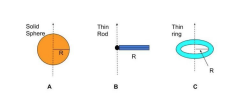 Rank the energies of the objects above (KEs)
Thin Solid Sphere Thin Rod ring 0 R R R A B с
Rank the energies of the objects above (KEs)
Thin Solid Sphere Thin Rod ring 0 R R R A B с
A solid cylinder, solid sphere, and a thin hoop which have different masses and different radii,...
 A solid cylinder, solid sphere, and a thin hoop which have different masses and different radii, roll without slipping down an incline plane. Which object reaches the bottom first? The moments of inertia are Icylinder = 1/2 MR2; Isphere = 2/5 MR2 and Ihoop = MR2. (A)The solid cylinder (B) The sphere (C) The thin hoop (D) They all reach the bottom at the same time.
Three objects roll without slipping from rest down an inclined plane. A solid sphere with 1,-...
 Three objects roll without slipping from rest down an inclined plane. A solid sphere with 1,- 2/5 MR. a hallow cylinder Solid Cylinder I = MR', And a solid cylinder with I, - 1/2MR'. . Which of the objects will reach the bottom of the inclined plane first? Use conservation of energy for translation and rotational motion. RAMP (f) Solid cylinder (h) Solid sphere MRP (9) Thin-walled hollow cylinder R R OB JE(1 3 OBJECT 2 OBJECTI a) OBJECT S...
A hollow, thin-walled cylinder and a solid sphere start from rest and roll without slipping down...
A hollow, thin-walled cylinder and a solid sphere start from rest and roll without slipping down an inclined plane of length 3.0 m. The cylinder arrives at the bottom of the plane 2.8 s after the sphere. Determine the angle between the inclined plane and the horizontal.
1. M, a solid cylinder (M=2.03kg, R=0.137m) pivots on a thin, fixed, frictionless bearing. A string...
 1. M, a solid cylinder (M=2.03kg, R=0.137m) pivots on a thin,
fixed, frictionless bearing. A string wrapped around the cylinder
pulls downward with a force F which equals the weight of a 0.670kg
mass, i.e., F = 6.573N. Calculate the angular acceleration of the
cylinder. (Answer in rad/s2.)
2. If instead of the force F an actual mass m = 0.670kg is hung
from the string, find the angular acceleration of the cylinder. Use
units of "rad/(s*s)
1. M, a...
1. M, a solid cylinder (M=2.03kg, R=0.137m) pivots on a thin,
fixed, frictionless bearing. A string wrapped around the cylinder
pulls downward with a force F which equals the weight of a 0.670kg
mass, i.e., F = 6.573N. Calculate the angular acceleration of the
cylinder. (Answer in rad/s2.)
2. If instead of the force F an actual mass m = 0.670kg is hung
from the string, find the angular acceleration of the cylinder. Use
units of "rad/(s*s)
1. M, a...
M, a solid cylinder (M=1.79 kg, R=0.119 m) pivots on a thin, fixed, frictionless bearing. A...
 M, a solid cylinder (M=1.79 kg, R=0.119 m) pivots on a thin,
fixed, frictionless bearing. A string wrapped around the cylinder
pulls downward with a force F which equals the weight of a 0.630 kg
mass, i.e., F = 6.180 N.
a) Calculate the angular acceleration of the cylinder.
b) If instead of the force F an actual mass m = 0.630
kg is hung from the string, find the angular acceleration of the
cylinder.
c) How far does m...
M, a solid cylinder (M=1.79 kg, R=0.119 m) pivots on a thin,
fixed, frictionless bearing. A string wrapped around the cylinder
pulls downward with a force F which equals the weight of a 0.630 kg
mass, i.e., F = 6.180 N.
a) Calculate the angular acceleration of the cylinder.
b) If instead of the force F an actual mass m = 0.630
kg is hung from the string, find the angular acceleration of the
cylinder.
c) How far does m...
M, a solid cylinder (M=2.23 kg, R=0.131 m) pivots on a thin, fixed, frictionless bearing. A...
M, a solid cylinder (M=2.23 kg, R=0.131 m) pivots on a thin, fixed, frictionless bearing. A string wrapped around the cylinder pulls downward with a force F which equals the weight of a 0.870 kg mass, i.e., F = 8.535 N. Calculate the angular acceleration of the cylinder. 5.84×101 rad/s^2 If instead of the force F an actual mass m = 0.870 kg is hung from the string, find the angular acceleration of the cylinder. How far does m travel...
12. (15 points) A uniform, solid cylinder of mass M and radius R rotates on a...
 12. (15 points) A uniform, solid cylinder of mass M and radius R rotates on a frictionless horizontal axle (see figure below). Two objects with equal masses m hang from light cords wrapped around the cylinder. If the system is released from rest, find the following 12 i2 a) (6 points) The tension in each cord (Use any variable or symbol stated above along with the following as necessary: g.) Hints: Two masses move down with constant accretion, while the...
M, a solid cylinder (M=2.27 kg, R=0.127 m) pivots on a thin, fixed, frictionless bearing. A...
M, a solid cylinder (M=2.27 kg, R=0.127 m) pivots on a thin, fixed, frictionless bearing. A string wrapped around the cylinder pulls downward with a force F which equals the weight of a 0.770 kg mass, i.e., F = 7.554 N. I know the answers to A and B, but I need help with C and D A) Calculate the angular acceleration of the cylinder. (ANSWER: 52.4rad/s^2) B) If instead of the force F an actual mass m = 0.770...
 Four objects-a hoop, a solid cylinder, a solid sphere, and a thin, spherical shell-each have a mass of 4.87 kg and a radius of 0.271 m (a) Find the moment of inertia for each object as it rotates about the axes shown in this table. hoop solid cylinder solid sphere thin, spherical shell kg kg m2 kg m kg m (b) Suppose each object is rolled down a ramp. Rank the translational speed of each object from highest to lowest....
 Rank the energies of the objects above (KEs)
Thin Solid Sphere Thin Rod ring 0 R R R A B с
Rank the energies of the objects above (KEs)
Thin Solid Sphere Thin Rod ring 0 R R R A B с
 A solid cylinder, solid sphere, and a thin hoop which have different masses and different radii, roll without slipping down an incline plane. Which object reaches the bottom first? The moments of inertia are Icylinder = 1/2 MR2; Isphere = 2/5 MR2 and Ihoop = MR2. (A)The solid cylinder (B) The sphere (C) The thin hoop (D) They all reach the bottom at the same time.
 Three objects roll without slipping from rest down an inclined plane. A solid sphere with 1,- 2/5 MR. a hallow cylinder Solid Cylinder I = MR', And a solid cylinder with I, - 1/2MR'. . Which of the objects will reach the bottom of the inclined plane first? Use conservation of energy for translation and rotational motion. RAMP (f) Solid cylinder (h) Solid sphere MRP (9) Thin-walled hollow cylinder R R OB JE(1 3 OBJECT 2 OBJECTI a) OBJECT S...
 1. M, a solid cylinder (M=2.03kg, R=0.137m) pivots on a thin,
fixed, frictionless bearing. A string wrapped around the cylinder
pulls downward with a force F which equals the weight of a 0.670kg
mass, i.e., F = 6.573N. Calculate the angular acceleration of the
cylinder. (Answer in rad/s2.)
2. If instead of the force F an actual mass m = 0.670kg is hung
from the string, find the angular acceleration of the cylinder. Use
units of "rad/(s*s)
1. M, a...
1. M, a solid cylinder (M=2.03kg, R=0.137m) pivots on a thin,
fixed, frictionless bearing. A string wrapped around the cylinder
pulls downward with a force F which equals the weight of a 0.670kg
mass, i.e., F = 6.573N. Calculate the angular acceleration of the
cylinder. (Answer in rad/s2.)
2. If instead of the force F an actual mass m = 0.670kg is hung
from the string, find the angular acceleration of the cylinder. Use
units of "rad/(s*s)
1. M, a...
 M, a solid cylinder (M=1.79 kg, R=0.119 m) pivots on a thin,
fixed, frictionless bearing. A string wrapped around the cylinder
pulls downward with a force F which equals the weight of a 0.630 kg
mass, i.e., F = 6.180 N.
a) Calculate the angular acceleration of the cylinder.
b) If instead of the force F an actual mass m = 0.630
kg is hung from the string, find the angular acceleration of the
cylinder.
c) How far does m...
M, a solid cylinder (M=1.79 kg, R=0.119 m) pivots on a thin,
fixed, frictionless bearing. A string wrapped around the cylinder
pulls downward with a force F which equals the weight of a 0.630 kg
mass, i.e., F = 6.180 N.
a) Calculate the angular acceleration of the cylinder.
b) If instead of the force F an actual mass m = 0.630
kg is hung from the string, find the angular acceleration of the
cylinder.
c) How far does m...
 12. (15 points) A uniform, solid cylinder of mass M and radius R rotates on a frictionless horizontal axle (see figure below). Two objects with equal masses m hang from light cords wrapped around the cylinder. If the system is released from rest, find the following 12 i2 a) (6 points) The tension in each cord (Use any variable or symbol stated above along with the following as necessary: g.) Hints: Two masses move down with constant accretion, while the...
Most questions answered within 3 hours.
-
Where is the error in this code sequence?
String s1 = "Hello";
String s2 = "ello";...
asked 10 months ago -
Financial data for Joel de Paris, Inc., for last year
follow:
Joel de Paris, Inc.
Balance...
asked 10 months ago -
Consider this reaction:
Al2(SO4)3 (aq)+ BaCl3
(aq) Al2Cl6 (aq)- +
3BaSO4(s) . What is the...
asked 10 months ago -
Suppose that Savneet is considering increasing her
recent random sample from 20 car rentals to 40...
asked 10 months ago -
Trucks arrive at an unloading terminal at an average rate of 120
per hour.
Trucks arrive...
asked 10 months ago -
Why are methanol and ethanol completely soluble in water while
octanol is not very little soluble....
asked 10 months ago -
A facilities manager at a university reads in a research report
that the mean amount of...
asked 10 months ago -
When the CuSO4 is rehydrated by adding water to the anhydrous
compound, is this an endothermic...
asked 10 months ago -
A ray of sunlight is passing from diamond into crown glass; the
angle of incidence is...
asked 10 months ago -
A block of mass 0.249 kg is placed on top of a light, vertical
spring of...
asked 10 months ago -
how do the kidneys compensate in the presences of acidosis
a) trigger hyperventilate
b) reserve acid...
asked 10 months ago -
Question 501 pts
The rental rate of capital to the firm increases. Which of the
following...
asked 10 months ago