def count_neighbors(cells, row, col): • Return value: An integer; the number of "alive" neighbors that the...
def count_neighbors(cells, row, col):
• Return value: An integer; the number of "alive" neighbors that the cell in the given row and column has.
• Assumptions: cells will be a two-dimensional list with at least one row and one element in that row.
• Notes: The tests for this function are hidden. Be careful: row or column may not be valid (return -1 if so)
• Examples:
count_neighbors([[0,0,0],[0,1,0],[0,0,0]],1,1) → 0
count_neighbors([[0,1,0,0],[0,1,0,1],[1,1,0,1]],2,1) → 3
count_neighbors([[0,0,0],[0,1,0],[0,0,0]],-1,1) → -1
Homework Answers
Note
######
Index is considered to be starting from 0 ie if the array is 3 *4 size then
row index will be 0 to 2
column index will be 0 to 3
##################### PGM START ###########################################
#method to find the neighbours which are alive
def count_neighbors(cells, row, col):
count=0
#check if the row and col values are valid, if
not return -1
if(not((row>=0 and row<len(cells)) and
(col>=0 and col<len(cells[row])))):
return -1
#check for all the 8 neighbours, if values are 1
incremnt counter by 1
if row-1>=0 and (cells[row-1][col]==1):
count+=1
if (row+1<len(cells)) and
(cells[row+1][col]==1):
count+=1
if (col-1>=0) and
(cells[row][col-1]==1):
count+=1
if (col+1<len(cells[row])) and
(cells[row][col+1]==1):
count+=1
if (col+1<len(cells[row]) and
row+1<len(cells)) and (cells[row+1][col+1]==1):
count+=1
if (col+1<len(cells[row]) and row-1>=0)
and (cells[row-1][col+1]==1):
count+=1
if (row+1<len(cells) and col-1>=0) and
(cells[row+1][col-1]==1):
count+=1
if (col-1>=0 and row-1>=0) and
(cells[row-1][col-1]==1):
count+=1
#return final count
return count
#main method
if __name__=="__main__":
print(count_neighbors([[0,0,0],[0,1,0],[0,0,0]],1,1))
print(count_neighbors([[0,1,0,0],[0,1,0,1],[1,1,0,1]],2,1))
print(count_neighbors([[0,0,0],[0,1,0],[0,0,0]],-1,1))
print(count_neighbors([[1,1,1,1],[1,1,1,1],[1,1,1,1]],1,2))
####################### PGM END ###########################################
OUTPUT
##########
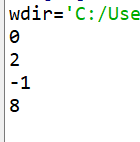
Add Answer to:
def count_neighbors(cells, row, col):
• Return value: An integer; the number of "alive" neighbors that
the...
1)def toggle_cell(row, column, cells): • Return value: Flip the cell in the column of row from...
1)def toggle_cell(row, column, cells): • Return value: Flip the cell in the column of row from alive to dead or vice versa. Return True if the toggle was successful, False otherwise. • Assumptions: o cells will be a two-dimensional list with at least one row and one element in that row. o row and column are index values of cells • Notes: o Cells is being edited in place. Note that the return value is a Boolean and not a...
can someone indent this code correctly in python programming def count_neighbors(cells,row,col): rows=len(cells) #storing no. of rows...
can someone indent this code correctly in python programming def count_neighbors(cells,row,col): rows=len(cells) #storing no. of rows cols=len(cells[0]) #storing no. of columns if(row<0 or col<0 or row>rows-1 or col>cols-1): # when row or column is out of range return -1 count=0 if(row==0 and cells[rows-1][col]==1): #cyclic order count+=1 if(col==0 and cells[row][cols-1]==1): count+=1 if(row==rows-1 and cells[0][col]==1): count+=1 if(col==cols-1 and cells[row][0]==1): count+=1 if(col>=1 and cells[row][col-1]==1): #left neighbor count+=1 if (row>=1 and cells[row-1][col]==1): #upper neighbor count+=1 if(row+1<rows and cells[row+1][col]==1): #down neighbor count+=1 if(col+1<cols and cells[row][col+1]==1):...
Def snake (grid, row, co1): Implement a function to calculate the longest "snake" of ones that ca...
 def snake (grid, row, co1): Implement a function to calculate the longest "snake" of ones that can be made from a starting position in a grid. A snake is made by moving right and down from a starting position as far as possible. o Assumption: grid will be at least 1x1, row and col will each be valid indexes in grid o Restrictions: You may not use the max() or min) functions. o Examples: (cells is a 2D list below)...
Make a program using Java that asks the user to input an integer "size". That integer...
 Make a program using Java that asks the user to input an integer
"size". That integer makes and prints out an evenly spaced, size by
size 2D array (ex: 7 should make an index of 0-6 for col and rows).
The array must be filled with random positive integers less than
100. Then, using recursion, find a "peak" and print out its number
and location. (A peak is basically a number that is bigger than all
of its "neighbors" (above,...
Make a program using Java that asks the user to input an integer
"size". That integer makes and prints out an evenly spaced, size by
size 2D array (ex: 7 should make an index of 0-6 for col and rows).
The array must be filled with random positive integers less than
100. Then, using recursion, find a "peak" and print out its number
and location. (A peak is basically a number that is bigger than all
of its "neighbors" (above,...
You must use recursion to solve each problem. You cannot use loops in this homework. You...
You must use recursion to solve each problem. You cannot use loops in this homework. You cannot import any module. A couple of the tasks have individual restrictions; note them, as we will remove points for any task that does not follow the requirements. def factorial_evens(num): Implement a function to calculate and return the product of all even numbers from 1 up to num (inclusive if num is even). o Assumption: num will be an integer greater than or equal...
You are going to be implementing the classic computer science simulation, Conway's Game of Life. Conway's...
 You are going to be implementing the classic computer science
simulation, Conway's Game of Life.
Conway's Life is played on a matrix of cells, kind of like a
chess board but theoretically extending infinitely in every
direction. Each individual cell in the matrix can either be alive
or dead. A live cell in the matrix is shown in our simulation by
printing an asterisk (*) to the screen. A dead cell is shown by
leaving that area of the matrix...
You are going to be implementing the classic computer science
simulation, Conway's Game of Life.
Conway's Life is played on a matrix of cells, kind of like a
chess board but theoretically extending infinitely in every
direction. Each individual cell in the matrix can either be alive
or dead. A live cell in the matrix is shown in our simulation by
printing an asterisk (*) to the screen. A dead cell is shown by
leaving that area of the matrix...
 def snake (grid, row, co1): Implement a function to calculate the longest "snake" of ones that can be made from a starting position in a grid. A snake is made by moving right and down from a starting position as far as possible. o Assumption: grid will be at least 1x1, row and col will each be valid indexes in grid o Restrictions: You may not use the max() or min) functions. o Examples: (cells is a 2D list below)...
 Make a program using Java that asks the user to input an integer
"size". That integer makes and prints out an evenly spaced, size by
size 2D array (ex: 7 should make an index of 0-6 for col and rows).
The array must be filled with random positive integers less than
100. Then, using recursion, find a "peak" and print out its number
and location. (A peak is basically a number that is bigger than all
of its "neighbors" (above,...
Make a program using Java that asks the user to input an integer
"size". That integer makes and prints out an evenly spaced, size by
size 2D array (ex: 7 should make an index of 0-6 for col and rows).
The array must be filled with random positive integers less than
100. Then, using recursion, find a "peak" and print out its number
and location. (A peak is basically a number that is bigger than all
of its "neighbors" (above,...
 You are going to be implementing the classic computer science
simulation, Conway's Game of Life.
Conway's Life is played on a matrix of cells, kind of like a
chess board but theoretically extending infinitely in every
direction. Each individual cell in the matrix can either be alive
or dead. A live cell in the matrix is shown in our simulation by
printing an asterisk (*) to the screen. A dead cell is shown by
leaving that area of the matrix...
You are going to be implementing the classic computer science
simulation, Conway's Game of Life.
Conway's Life is played on a matrix of cells, kind of like a
chess board but theoretically extending infinitely in every
direction. Each individual cell in the matrix can either be alive
or dead. A live cell in the matrix is shown in our simulation by
printing an asterisk (*) to the screen. A dead cell is shown by
leaving that area of the matrix...
Most questions answered within 3 hours.
-
Where is the error in this code sequence?
String s1 = "Hello";
String s2 = "ello";...
asked 10 months ago -
Financial data for Joel de Paris, Inc., for last year
follow:
Joel de Paris, Inc.
Balance...
asked 10 months ago -
Consider this reaction:
Al2(SO4)3 (aq)+ BaCl3
(aq) Al2Cl6 (aq)- +
3BaSO4(s) . What is the...
asked 10 months ago -
Suppose that Savneet is considering increasing her
recent random sample from 20 car rentals to 40...
asked 10 months ago -
Trucks arrive at an unloading terminal at an average rate of 120
per hour.
Trucks arrive...
asked 10 months ago -
Why are methanol and ethanol completely soluble in water while
octanol is not very little soluble....
asked 10 months ago -
A facilities manager at a university reads in a research report
that the mean amount of...
asked 10 months ago -
When the CuSO4 is rehydrated by adding water to the anhydrous
compound, is this an endothermic...
asked 10 months ago -
A ray of sunlight is passing from diamond into crown glass; the
angle of incidence is...
asked 10 months ago -
A block of mass 0.249 kg is placed on top of a light, vertical
spring of...
asked 10 months ago -
how do the kidneys compensate in the presences of acidosis
a) trigger hyperventilate
b) reserve acid...
asked 10 months ago -
Question 501 pts
The rental rate of capital to the firm increases. Which of the
following...
asked 10 months ago