A solution contains the following ions, Pb+2, Be+2 and Ra+2. Refer to the solubility table and...
A solution contains the following ions, Pb+2, Be+2 and Ra+2.
Refer to the solubility table and indicate a
procedure by which these ions may be separated from each other and
from the solution. Make sure to clearly
indicate the order of separation.
Homework Answers

Add Answer to:
A solution contains the following ions, Pb+2, Be+2 and Ra+2.
Refer to the solubility table and...
3. Pb(OH)2 (8) is amphoteric and forms the complex ion Pb(OH)/(aq) with excess OH in solution....
 3. Pb(OH)2 (8) is amphoteric and forms the complex ion Pb(OH)/(aq) with excess OH in solution. Write the balanced equilibrium equation of Pb(OH)2 (s) in the presence of excess hydroxide. 4. A solution contains Pb(NO3)2 and Zn(NO3)2. Consult the solubility table and answer the following questions: a. NaOH (aq) is added to the solution. What precipitate (or precipitates) forms? b. Can you separate the two metal ions using NaOH? c. Nat (aq) is added to the solution. What precipitate (or...
2. (5 pts) A solution contains lead (II), copper(I) and silver ions. An HCl solution is...
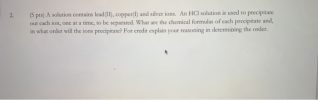 2. (5 pts) A solution contains lead (II), copper(I) and silver ions. An HCl solution is used to precipitate out each ion, one at a time, to be separated. What are the chemical formulas of each precipitate and, in what order will the ions precipitate? For credit explain your reasoning in determining the order.
Question 10 1 pts A solution contains Pb?, Cu2+ and Zn2+ ions. An aqueous solution of...
 Question 10 1 pts A solution contains Pb?, Cu2+ and Zn2+ ions. An aqueous solution of Na,Co, is added slowly, one drop at a time. Which statement(s) is/are true? Select all. Kop POCO3 7.4 x 10⁻¹⁴ CuCoz 3x 10-12 ZnCO3 1.0 x 10⁻¹⁰ All of the metal carbonates will precipitate at the same time. The precipitates will form in this order: ZnCO3, then Cucos, then Pbco, The precipitates will form in this order: Pbco, then Cucos, then Znco, The precipitates...
Lab Section: 1 Prelab: Inorganic Group I Ions 1. On the report sheet, complete the flow...
 Lab Section: 1 Prelab: Inorganic Group I Ions 1. On the report sheet, complete the flow diagram for the separation and identification of the ions in Group I 2. Write balanced net ionic equations for the following reactions: The precipitation of the chloride of Pb a. in Step 1. The formation of a yellow precipitate in Step 4. b. The formation of a complex ion in Step 5. c. d. The reaction that forms a white precipitate in Step 5....
Suppose an unknown sample only contains Pb2+ and Cr3+ ions, but no other Group 2 cations....
Suppose an unknown sample only contains Pb2+ and Cr3+ ions, but no other Group 2 cations. If an aqueous sample of this unknown is treated with NH4OH followed by NaOH, which observation will be true? A. a white precipitate will form, but the Pb2+ and Cr3+ ions will still make up a mixture B. a clear solution will be obtained, but the Pb2+ and Cr3+ ions still make up a mixture C. a blue-green gel will be produced, and the...
What is the solubility of PBF2 in a solution that contains 0.0550 M Pb2 ions? (Ksp...
 What is the solubility of PBF2 in a solution that contains 0.0550 M Pb2 ions? (Ksp of PbF2 is 3.60 x 10⁸) M 2 1 6 4 7 0 +/- x 100 LO st
#5 Write the solubility product expression for PbCl2. Using the concentration for the Pb+2 and Cl-...
 #5 Write the solubility product expression for PbCl2.
Using the concentration for the Pb+2 and Cl- ions, solve for your
experimental Ksp.
#6 Using your book, find the theoretical Ksp for PbCl2
to determine your percent error
A Solubility Product Constant Introduction: Many substances are very soluble in water. However, in this experiment you will be concerned with substances that are insoluble or only slightly soluble. Dynamic equilibrium is established when an excess of a slightly soluble substance is placed...
#5 Write the solubility product expression for PbCl2.
Using the concentration for the Pb+2 and Cl- ions, solve for your
experimental Ksp.
#6 Using your book, find the theoretical Ksp for PbCl2
to determine your percent error
A Solubility Product Constant Introduction: Many substances are very soluble in water. However, in this experiment you will be concerned with substances that are insoluble or only slightly soluble. Dynamic equilibrium is established when an excess of a slightly soluble substance is placed...
Question 5 of 15 > A A scientist is investigating the solubility of two polyatomic ions,...
 Question 5 of 15 > A A scientist is investigating the solubility of two polyatomic ions, oxalate (CO) and arsenate (Aso ), which are not listed in the table of solubility guidelines. The scientist starts with four solutions made of water-soluble salts. Solution A contains sodium arsenate. Solution B contains ammonium oxalate. Soution C contains silver chlorate. Solution D contains aluminum bromide. Solution Solute Color of Solution Na Aso, colorless B : (NH),C,0 colorless AgClo, colorless AlBr yellow The results...
What is the solubility of La(103)3 in a solution that contains 0.100 M Last ions? (Ksp...
 What is the solubility of La(103)3 in a solution that contains 0.100 M Last ions? (Ksp of La(103)3 is 7.5 102) 1 4 2 3 5 6 C +/- +/- : 0 x 100
What is the solubility of PbSO4 in a solution which originally was 0.050 M in Pb(NO3)2?
What is the solubility of PbSO4 in a solution which originally was 0.050 M in Pb(NO3)2?
 3. Pb(OH)2 (8) is amphoteric and forms the complex ion Pb(OH)/(aq) with excess OH in solution. Write the balanced equilibrium equation of Pb(OH)2 (s) in the presence of excess hydroxide. 4. A solution contains Pb(NO3)2 and Zn(NO3)2. Consult the solubility table and answer the following questions: a. NaOH (aq) is added to the solution. What precipitate (or precipitates) forms? b. Can you separate the two metal ions using NaOH? c. Nat (aq) is added to the solution. What precipitate (or...
 2. (5 pts) A solution contains lead (II), copper(I) and silver ions. An HCl solution is used to precipitate out each ion, one at a time, to be separated. What are the chemical formulas of each precipitate and, in what order will the ions precipitate? For credit explain your reasoning in determining the order.
 Question 10 1 pts A solution contains Pb?, Cu2+ and Zn2+ ions. An aqueous solution of Na,Co, is added slowly, one drop at a time. Which statement(s) is/are true? Select all. Kop POCO3 7.4 x 10⁻¹⁴ CuCoz 3x 10-12 ZnCO3 1.0 x 10⁻¹⁰ All of the metal carbonates will precipitate at the same time. The precipitates will form in this order: ZnCO3, then Cucos, then Pbco, The precipitates will form in this order: Pbco, then Cucos, then Znco, The precipitates...
 Lab Section: 1 Prelab: Inorganic Group I Ions 1. On the report sheet, complete the flow diagram for the separation and identification of the ions in Group I 2. Write balanced net ionic equations for the following reactions: The precipitation of the chloride of Pb a. in Step 1. The formation of a yellow precipitate in Step 4. b. The formation of a complex ion in Step 5. c. d. The reaction that forms a white precipitate in Step 5....
 What is the solubility of PBF2 in a solution that contains 0.0550 M Pb2 ions? (Ksp of PbF2 is 3.60 x 10⁸) M 2 1 6 4 7 0 +/- x 100 LO st
 #5 Write the solubility product expression for PbCl2.
Using the concentration for the Pb+2 and Cl- ions, solve for your
experimental Ksp.
#6 Using your book, find the theoretical Ksp for PbCl2
to determine your percent error
A Solubility Product Constant Introduction: Many substances are very soluble in water. However, in this experiment you will be concerned with substances that are insoluble or only slightly soluble. Dynamic equilibrium is established when an excess of a slightly soluble substance is placed...
#5 Write the solubility product expression for PbCl2.
Using the concentration for the Pb+2 and Cl- ions, solve for your
experimental Ksp.
#6 Using your book, find the theoretical Ksp for PbCl2
to determine your percent error
A Solubility Product Constant Introduction: Many substances are very soluble in water. However, in this experiment you will be concerned with substances that are insoluble or only slightly soluble. Dynamic equilibrium is established when an excess of a slightly soluble substance is placed...
 Question 5 of 15 > A A scientist is investigating the solubility of two polyatomic ions, oxalate (CO) and arsenate (Aso ), which are not listed in the table of solubility guidelines. The scientist starts with four solutions made of water-soluble salts. Solution A contains sodium arsenate. Solution B contains ammonium oxalate. Soution C contains silver chlorate. Solution D contains aluminum bromide. Solution Solute Color of Solution Na Aso, colorless B : (NH),C,0 colorless AgClo, colorless AlBr yellow The results...
 What is the solubility of La(103)3 in a solution that contains 0.100 M Last ions? (Ksp of La(103)3 is 7.5 102) 1 4 2 3 5 6 C +/- +/- : 0 x 100
Most questions answered within 3 hours.
-
Where is the error in this code sequence?
String s1 = "Hello";
String s2 = "ello";...
asked 10 months ago -
Financial data for Joel de Paris, Inc., for last year
follow:
Joel de Paris, Inc.
Balance...
asked 10 months ago -
Consider this reaction:
Al2(SO4)3 (aq)+ BaCl3
(aq) Al2Cl6 (aq)- +
3BaSO4(s) . What is the...
asked 10 months ago -
Suppose that Savneet is considering increasing her
recent random sample from 20 car rentals to 40...
asked 10 months ago -
Trucks arrive at an unloading terminal at an average rate of 120
per hour.
Trucks arrive...
asked 10 months ago -
Why are methanol and ethanol completely soluble in water while
octanol is not very little soluble....
asked 10 months ago -
A facilities manager at a university reads in a research report
that the mean amount of...
asked 10 months ago -
When the CuSO4 is rehydrated by adding water to the anhydrous
compound, is this an endothermic...
asked 10 months ago -
A ray of sunlight is passing from diamond into crown glass; the
angle of incidence is...
asked 10 months ago -
A block of mass 0.249 kg is placed on top of a light, vertical
spring of...
asked 10 months ago -
how do the kidneys compensate in the presences of acidosis
a) trigger hyperventilate
b) reserve acid...
asked 10 months ago -
Question 501 pts
The rental rate of capital to the firm increases. Which of the
following...
asked 10 months ago