2. Raoult’s law is defined as follows: Partial Pressure = Vapor Pressure • Mole fraction This...
2. Raoult’s law is defined as follows: Partial Pressure = Vapor Pressure • Mole fraction This equation predicts…
A. How well a salt dissolves in a liquid
B. How much higher the partial pressure will be when a salt is dissolved in a liquid
C. How much lower the partial pressure will be when a salt is dissolved in a liquid
D. How much higher the vapor pressure of a liquid becomes when it enters a phase transition.
Homework Answers

Add Answer to:
2. Raoult’s law is defined as follows: Partial Pressure = Vapor
Pressure • Mole fraction This...
If the vapor pressure of component 1 is 30kPa and the henrys law constant of component 2 is 100 kPa, the mole fraction of component 2 in the gas phase does not exceed 20% when its mole fraction is 5%...
If the vapor pressure of component 1 is 30kPa and the henrys law constant of component 2 is 100 kPa, the mole fraction of component 2 in the gas phase does not exceed 20% when its mole fraction is 5% in the liquid phase. True or False?
29. What i 30, t the heat of 4440 D.-1780 k 790.3 . r 31. The...
 29. What i 30, t the heat of 4440 D.-1780 k 790.3 . r 31. The number of atoms in the unit cal to the nghts C.4 D. 5 E.51/8 F. none of the above. 0.0821 atm the osmotic pressure of a 1.35 M solution of NaCi at 298 K7 Gas constant 32. What is The Van t Ho onstant for iron chioride is 1.9 A. 33 atm 66 atm C62.7 atm 0 atm ะ 62.7 defined as flows. Partial...
1. As the mole fraction of chloroform approaches 1, the vapor pressure of acetone could be...
 1. As the mole fraction of chloroform approaches 1, the vapor
pressure of acetone could be calculated using
A. Raoult's Law.
B. Henry's Law.
2.If a chloroform-acetone mixture with an chloroform mole
fraction of 0.62 is subjected to fractional distillation, what is
the composition of the distillate?
A. pure chloroform
B. pure azeotrope
C. pure acetone
3. Do chloroform and acetone form an ideal solution?
A. no
B. cannot be determined from the information given
C. yes
4. If a...
1. As the mole fraction of chloroform approaches 1, the vapor
pressure of acetone could be calculated using
A. Raoult's Law.
B. Henry's Law.
2.If a chloroform-acetone mixture with an chloroform mole
fraction of 0.62 is subjected to fractional distillation, what is
the composition of the distillate?
A. pure chloroform
B. pure azeotrope
C. pure acetone
3. Do chloroform and acetone form an ideal solution?
A. no
B. cannot be determined from the information given
C. yes
4. If a...
The total vapor pressure of an ideal-dilute liquid mixture of acetone and chloroform with a mole...
The total vapor pressure of an ideal-dilute liquid mixture of acetone and chloroform with a mole fraction of acetone of 0.0500 is 45.08 kPa at 308 K. (a) Use Raoult's law to determine the partial vapor pressure of acetone for the mixture, given that the vapor pressure of pure acetone is 46.26 kPa at 308 K. (b) Hence calculate the partial vapor pressure of chloroform for the mixture. (c) Determine the Henry's law constant of chloroform at this temperature. (d}...
At 90oC the vapor pressure of 1,2-dimethylbenzene is 20 kPa and that of 1,3-dimethylbenzene is ...
At 90oC the vapor pressure of 1,2-dimethylbenzene is 20 kPa and that of 1,3-dimethylbenzene is 18 kPa. Use Raoult’s law to calculate the composition of the vapor (mole fraction of each component) when the liquid mixture has the composition x12 = 0.33 and x13 = 0.67.
the liquid and ya the mole fraction in the vapor.) 8. At 90°C, the vapor pressure...
 the liquid and ya the mole fraction in the vapor.) 8. At 90°C, the vapor pressure of pure methylbenzene is 400 Torr and that of pure 1,2- dimethylbenzene is 150 Torr. What the composition of a liquid mixture that boils at 90°C when the pressure is 0.50 atm? What is the composition of the vapor produced?
9. At 50°C, a liquid solution composed of A (with a mole fraction of 0.28) and...
 9. At 50°C, a liquid solution composed of A (with a mole fraction of 0.28) and B has a total vapor pressure of 182 torr and a partial pressure of A of 62 torr. The vapor pressure of pure liquid A is 254 torr and that of pure liquid B is 169 torr. (a) Calculate the activity and the activity coefficient of each component of the liquid based on the Raoult's Law. (b) Calculate the Henry's law constant of A...
4. Two liquids, A and B, obey Raoul's law at all concentration. That is PA =...
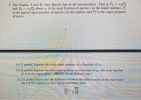 4. Two liquids, A and B, obey Raoul's law at all concentration. That is PA = DAPA and PB = xpPg where r, is the mole fraction of species i in the liquid mixture, P. is the partial vapor pressure of species i in the mixture and P* is the vapor pressure of pure i. (a) (5 points) Express the total vapor pressure as a function of x. (b) (5 points Express the total vapor pressure as a function of...
Which of the following regarding the vapor pressure of a solution containing a nonvolatile solute is...
Which of the following regarding the vapor pressure of a solution containing a nonvolatile solute is NOT correct? A. The amount by which the vapor pressure of the solution is reduced reflects the mole fraction of the solute in the solution. B. The presence of a nonvolatile solute reduces the mole fraction of the pure solvent. C. The condensation rates of the pure solvent and the solution are probably about equal in a closed container. D. The evaporation rate of...
4. Two liquids, A and B, obey Raoul's law at all concentration. That is PA =...
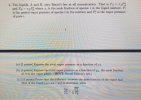 4. Two liquids, A and B, obey Raoul's law at all concentration. That is PA = IAP and Pa rpP where r, is the mole fraction of species i in the liquid mixture, P is the partial vapor pressure of species i in the mixture and P is the vapor pressure of pure i 1 (a) [5 points] Express the total vapor pressure as a function of rA (b) [5 points] Express the total vapor pressure as a function of...
 29. What i 30, t the heat of 4440 D.-1780 k 790.3 . r 31. The number of atoms in the unit cal to the nghts C.4 D. 5 E.51/8 F. none of the above. 0.0821 atm the osmotic pressure of a 1.35 M solution of NaCi at 298 K7 Gas constant 32. What is The Van t Ho onstant for iron chioride is 1.9 A. 33 atm 66 atm C62.7 atm 0 atm ะ 62.7 defined as flows. Partial...
 1. As the mole fraction of chloroform approaches 1, the vapor
pressure of acetone could be calculated using
A. Raoult's Law.
B. Henry's Law.
2.If a chloroform-acetone mixture with an chloroform mole
fraction of 0.62 is subjected to fractional distillation, what is
the composition of the distillate?
A. pure chloroform
B. pure azeotrope
C. pure acetone
3. Do chloroform and acetone form an ideal solution?
A. no
B. cannot be determined from the information given
C. yes
4. If a...
1. As the mole fraction of chloroform approaches 1, the vapor
pressure of acetone could be calculated using
A. Raoult's Law.
B. Henry's Law.
2.If a chloroform-acetone mixture with an chloroform mole
fraction of 0.62 is subjected to fractional distillation, what is
the composition of the distillate?
A. pure chloroform
B. pure azeotrope
C. pure acetone
3. Do chloroform and acetone form an ideal solution?
A. no
B. cannot be determined from the information given
C. yes
4. If a...
 the liquid and ya the mole fraction in the vapor.) 8. At 90°C, the vapor pressure of pure methylbenzene is 400 Torr and that of pure 1,2- dimethylbenzene is 150 Torr. What the composition of a liquid mixture that boils at 90°C when the pressure is 0.50 atm? What is the composition of the vapor produced?
 9. At 50°C, a liquid solution composed of A (with a mole fraction of 0.28) and B has a total vapor pressure of 182 torr and a partial pressure of A of 62 torr. The vapor pressure of pure liquid A is 254 torr and that of pure liquid B is 169 torr. (a) Calculate the activity and the activity coefficient of each component of the liquid based on the Raoult's Law. (b) Calculate the Henry's law constant of A...
 4. Two liquids, A and B, obey Raoul's law at all concentration. That is PA = DAPA and PB = xpPg where r, is the mole fraction of species i in the liquid mixture, P. is the partial vapor pressure of species i in the mixture and P* is the vapor pressure of pure i. (a) (5 points) Express the total vapor pressure as a function of x. (b) (5 points Express the total vapor pressure as a function of...
 4. Two liquids, A and B, obey Raoul's law at all concentration. That is PA = IAP and Pa rpP where r, is the mole fraction of species i in the liquid mixture, P is the partial vapor pressure of species i in the mixture and P is the vapor pressure of pure i 1 (a) [5 points] Express the total vapor pressure as a function of rA (b) [5 points] Express the total vapor pressure as a function of...
Most questions answered within 3 hours.
-
Where is the error in this code sequence?
String s1 = "Hello";
String s2 = "ello";...
asked 10 months ago -
Financial data for Joel de Paris, Inc., for last year
follow:
Joel de Paris, Inc.
Balance...
asked 10 months ago -
Consider this reaction:
Al2(SO4)3 (aq)+ BaCl3
(aq) Al2Cl6 (aq)- +
3BaSO4(s) . What is the...
asked 10 months ago -
Suppose that Savneet is considering increasing her
recent random sample from 20 car rentals to 40...
asked 10 months ago -
Trucks arrive at an unloading terminal at an average rate of 120
per hour.
Trucks arrive...
asked 10 months ago -
Why are methanol and ethanol completely soluble in water while
octanol is not very little soluble....
asked 10 months ago -
A facilities manager at a university reads in a research report
that the mean amount of...
asked 10 months ago -
When the CuSO4 is rehydrated by adding water to the anhydrous
compound, is this an endothermic...
asked 10 months ago -
A ray of sunlight is passing from diamond into crown glass; the
angle of incidence is...
asked 10 months ago -
A block of mass 0.249 kg is placed on top of a light, vertical
spring of...
asked 10 months ago -
how do the kidneys compensate in the presences of acidosis
a) trigger hyperventilate
b) reserve acid...
asked 10 months ago -
Question 501 pts
The rental rate of capital to the firm increases. Which of the
following...
asked 10 months ago