Assume you want to determine a weight of an object. Your weighing scales show a random...
Assume you want to determine a weight of an object. Your weighing scales show a random number X at each measurement, Var X=1 g. You take a measurement n times and compute the average of the results:
X¯ n = (X1 + .... + Xn)/n.
a) Use the Law of Large Numbers to compute the probability that |Xn − E(X)| < 0.5 when n=20.
b) Use Cenral Limit Theorem to compute the probability that |Xn − E(X)| < 0.5 when n=20. Compare it with the result in a).
c) How many measurements you have to make to be sure that |Xn − E(X)| < 0.5 with 90% probability. Use the Law of Large Numbers. d) How many measurements you have to make to be sure that |Xn −E(X)| < 0.5 with 90% probability. Use Central Limit Theorem. Compare your result with c).
Homework Answers


Add Answer to:
Assume you want to determine a weight of an object. Your
weighing scales show a random...
10 and 11 please LSM 5 Part C. Suppose that you are walking on a straight line. You start at position Xo =0, and only walk in the positive direction. Your positions after taking the ith step is de...
 10 and 11 please
LSM 5 Part C. Suppose that you are walking on a straight line. You start at position Xo =0, and only walk in the positive direction. Your positions after taking the ith step is denoted by X,. For each step, your step size, denoted by S, feet. Assume that sizes of different steps are m 8. (10 credits) Let Xy be your position after taking N steps where N is a given = X,-X,-, is a...
10 and 11 please
LSM 5 Part C. Suppose that you are walking on a straight line. You start at position Xo =0, and only walk in the positive direction. Your positions after taking the ith step is denoted by X,. For each step, your step size, denoted by S, feet. Assume that sizes of different steps are m 8. (10 credits) Let Xy be your position after taking N steps where N is a given = X,-X,-, is a...
LSM 5 Part C. Suppose that you are walking on a straight line. You start at position Xo , and only walk in the positive direction. Your positions after taking the ith step is denoted by X,. For e...
 LSM 5 Part C. Suppose that you are walking on a straight line. You start at position Xo , and only walk in the positive direction. Your positions after taking the ith step is denoted by X,. For each step, your step size, denoted by S, . X,-X,-ı , is a random variable uniformly distributed between 1 foot and 2 feet. Assume that sizes of different steps are mutually independent 8. (10 credits) Let X, be your position after taking...
Assume a die is rolled 100 times. Let Xư be the result of k-th roll and...
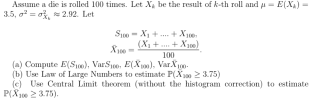 Assume a die is rolled 100 times. Let Xư be the result of k-th roll and u = E(Xk) = 3.5, o2 = 0% = 2.92. Let S100 = X1 + ... + X 100, (X1 + ... + X 100) X 100 = 100 (a) Compute E(S100), VarS100, E(X100), VarÃ100- (b) Use Law of Large Numbers to estimate P(X100 > 3.75) (c) Use Central Limit theorem (without the histogram correction) to estimate P(X100 > 3.75).
2. Biased and unbiased estimation for variance of Bernoulli variables A Bookmark this page 2 points...
 2. Biased and unbiased estimation for variance of Bernoulli variables A Bookmark this page 2 points possible (graded) Let X1, X, bed. Bernoull random variables, with unknown parameter PE (0,1). The aim of this exercise is to estimate the common variance of the X First, recall what Var (X) is for Bernoulli random variables. Var (X) - Let X, be the sample average of the Xi. X. - 3x Interested in finding an estimator for Var(X), and propose to use...
Law of Large Numbers, Central Limit Theorem, and Confidence Intervals 1. (15 points) In an exercise,...
 Law of Large Numbers, Central Limit Theorem, and Confidence Intervals 1. (15 points) In an exercise, your Professor generated random numbers in Excel. The mean is supposed to be 0.5 because the numbers are supposed to be spread at randonm between 0 and 1. I asked the software to generate samples of 100 random numbers repeatedly. Here are the sample means x for 50 samples of size 100: 0.532 0.450 0.481 0.508 0.510 0.530 0.4990.4610.5430.490 0.497 0.5520.473 0.425 0.4490.507 0.472...
6. In this question, you are going to study the approximation to binomial probabilities using the...
 6. In this question, you are going to study the approximation to binomial probabilities using the nor mal distribution. The binomial distribution is discrete while the normal distribution is continuous Therefore, we would expect some issues with approximating the binomial with the normal. (a) (2 points) Suppose X ~ Bin (25,04). Calculate E (N) and Var . (b) (4 points) Use the central lit theorem along with (a) to approximate Pr (X 8). Compare this with your result in #4(a)....
1) Let X and Y be random variables. Show that Cov( X + Y, X-Y) Var(X)--Var(Y)...
 1) Let X and Y be random variables. Show that Cov( X + Y, X-Y) Var(X)--Var(Y) without appealing to the general formulas for the covariance of the linear combinations of sets of random variables; use the basic identity Cov(Z1,22)-E[Z1Z2]- E[Z1 E[Z2, valid for any two random variables, and the properties of the expected value 2) Let X be the normal random variable with zero mean and standard deviation Let ?(t) be the distribution function of the standard normal random variable....
You want to use a set of wires to suspend a weight for the ceiling of...
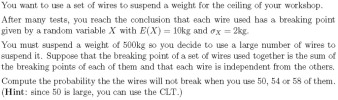 You want to use a set of wires to suspend a weight for the ceiling of your workshop. After many tests, you reach the conclusion that each wire used has a breaking point given by a random variable X with E(X) 10kg and ?x--2kg. You must suspend a weight of 500kg so you decide to use a large number of wires to suspend it. Suppose that the breaking point of a set of wires used together is the sum of...
2. Suppose that X1, X2, ..., Xn " N(41,01) and Yı,Y2,...,Ym * N(H2;02) are two independent...
 2. Suppose that X1, X2, ..., Xn " N(41,01) and Yı,Y2,...,Ym * N(H2;02) are two independent random samples. (a) What is E[X - Ÿ]? (b) Find a general expression for Var[X – Ý), and use this to find an expression for the standard error ox-ý = StDev(X – Ỹ). (c) Suppose that of = 2 and o = 2.5, and also that n = 10 and m = 15. Determine the probability P(|X – Ý - (µ1 – 42)| <...
question 7b is confusing trying to determine the melting point of a new material, of which...
 question 7b is confusing
trying to determine the melting point of a new material, of which you have a large number of samples. For each sample that you measure you find a value close to the actual melting point c but corrupted with a measurement error. We model this with random variable Mi = c + Ui where Mi is the measured value in degree Kelvin, and Ui is the occurring random error. It is known that E(U;) = 0...
question 7b is confusing
trying to determine the melting point of a new material, of which you have a large number of samples. For each sample that you measure you find a value close to the actual melting point c but corrupted with a measurement error. We model this with random variable Mi = c + Ui where Mi is the measured value in degree Kelvin, and Ui is the occurring random error. It is known that E(U;) = 0...
 10 and 11 please
LSM 5 Part C. Suppose that you are walking on a straight line. You start at position Xo =0, and only walk in the positive direction. Your positions after taking the ith step is denoted by X,. For each step, your step size, denoted by S, feet. Assume that sizes of different steps are m 8. (10 credits) Let Xy be your position after taking N steps where N is a given = X,-X,-, is a...
10 and 11 please
LSM 5 Part C. Suppose that you are walking on a straight line. You start at position Xo =0, and only walk in the positive direction. Your positions after taking the ith step is denoted by X,. For each step, your step size, denoted by S, feet. Assume that sizes of different steps are m 8. (10 credits) Let Xy be your position after taking N steps where N is a given = X,-X,-, is a...
 LSM 5 Part C. Suppose that you are walking on a straight line. You start at position Xo , and only walk in the positive direction. Your positions after taking the ith step is denoted by X,. For each step, your step size, denoted by S, . X,-X,-ı , is a random variable uniformly distributed between 1 foot and 2 feet. Assume that sizes of different steps are mutually independent 8. (10 credits) Let X, be your position after taking...
 Assume a die is rolled 100 times. Let Xư be the result of k-th roll and u = E(Xk) = 3.5, o2 = 0% = 2.92. Let S100 = X1 + ... + X 100, (X1 + ... + X 100) X 100 = 100 (a) Compute E(S100), VarS100, E(X100), VarÃ100- (b) Use Law of Large Numbers to estimate P(X100 > 3.75) (c) Use Central Limit theorem (without the histogram correction) to estimate P(X100 > 3.75).
 2. Biased and unbiased estimation for variance of Bernoulli variables A Bookmark this page 2 points possible (graded) Let X1, X, bed. Bernoull random variables, with unknown parameter PE (0,1). The aim of this exercise is to estimate the common variance of the X First, recall what Var (X) is for Bernoulli random variables. Var (X) - Let X, be the sample average of the Xi. X. - 3x Interested in finding an estimator for Var(X), and propose to use...
 Law of Large Numbers, Central Limit Theorem, and Confidence Intervals 1. (15 points) In an exercise, your Professor generated random numbers in Excel. The mean is supposed to be 0.5 because the numbers are supposed to be spread at randonm between 0 and 1. I asked the software to generate samples of 100 random numbers repeatedly. Here are the sample means x for 50 samples of size 100: 0.532 0.450 0.481 0.508 0.510 0.530 0.4990.4610.5430.490 0.497 0.5520.473 0.425 0.4490.507 0.472...
 6. In this question, you are going to study the approximation to binomial probabilities using the nor mal distribution. The binomial distribution is discrete while the normal distribution is continuous Therefore, we would expect some issues with approximating the binomial with the normal. (a) (2 points) Suppose X ~ Bin (25,04). Calculate E (N) and Var . (b) (4 points) Use the central lit theorem along with (a) to approximate Pr (X 8). Compare this with your result in #4(a)....
 1) Let X and Y be random variables. Show that Cov( X + Y, X-Y) Var(X)--Var(Y) without appealing to the general formulas for the covariance of the linear combinations of sets of random variables; use the basic identity Cov(Z1,22)-E[Z1Z2]- E[Z1 E[Z2, valid for any two random variables, and the properties of the expected value 2) Let X be the normal random variable with zero mean and standard deviation Let ?(t) be the distribution function of the standard normal random variable....
 You want to use a set of wires to suspend a weight for the ceiling of your workshop. After many tests, you reach the conclusion that each wire used has a breaking point given by a random variable X with E(X) 10kg and ?x--2kg. You must suspend a weight of 500kg so you decide to use a large number of wires to suspend it. Suppose that the breaking point of a set of wires used together is the sum of...
 2. Suppose that X1, X2, ..., Xn " N(41,01) and Yı,Y2,...,Ym * N(H2;02) are two independent random samples. (a) What is E[X - Ÿ]? (b) Find a general expression for Var[X – Ý), and use this to find an expression for the standard error ox-ý = StDev(X – Ỹ). (c) Suppose that of = 2 and o = 2.5, and also that n = 10 and m = 15. Determine the probability P(|X – Ý - (µ1 – 42)| <...
 question 7b is confusing
trying to determine the melting point of a new material, of which you have a large number of samples. For each sample that you measure you find a value close to the actual melting point c but corrupted with a measurement error. We model this with random variable Mi = c + Ui where Mi is the measured value in degree Kelvin, and Ui is the occurring random error. It is known that E(U;) = 0...
question 7b is confusing
trying to determine the melting point of a new material, of which you have a large number of samples. For each sample that you measure you find a value close to the actual melting point c but corrupted with a measurement error. We model this with random variable Mi = c + Ui where Mi is the measured value in degree Kelvin, and Ui is the occurring random error. It is known that E(U;) = 0...
Most questions answered within 3 hours.
-
Where is the error in this code sequence?
String s1 = "Hello";
String s2 = "ello";...
asked 11 months ago -
Financial data for Joel de Paris, Inc., for last year
follow:
Joel de Paris, Inc.
Balance...
asked 11 months ago -
Consider this reaction:
Al2(SO4)3 (aq)+ BaCl3
(aq) Al2Cl6 (aq)- +
3BaSO4(s) . What is the...
asked 11 months ago -
Suppose that Savneet is considering increasing her
recent random sample from 20 car rentals to 40...
asked 11 months ago -
Trucks arrive at an unloading terminal at an average rate of 120
per hour.
Trucks arrive...
asked 11 months ago -
Why are methanol and ethanol completely soluble in water while
octanol is not very little soluble....
asked 11 months ago -
A facilities manager at a university reads in a research report
that the mean amount of...
asked 11 months ago -
When the CuSO4 is rehydrated by adding water to the anhydrous
compound, is this an endothermic...
asked 11 months ago -
A ray of sunlight is passing from diamond into crown glass; the
angle of incidence is...
asked 11 months ago -
A block of mass 0.249 kg is placed on top of a light, vertical
spring of...
asked 11 months ago -
how do the kidneys compensate in the presences of acidosis
a) trigger hyperventilate
b) reserve acid...
asked 11 months ago -
Question 501 pts
The rental rate of capital to the firm increases. Which of the
following...
asked 11 months ago