a parallel plate capacitor with capacitance 7.757*10^-12 F with its plates separated by 0.0075 m. with...
a parallel plate capacitor with capacitance 7.757*10^-12 F with its plates separated by 0.0075 m. with what velocity would a charge of 60 micro coulombs and a mass of 0.00368 grams released from the positive plate strike the negative plate?
SHOW ALL WORK IN DETAIL
Homework Answers
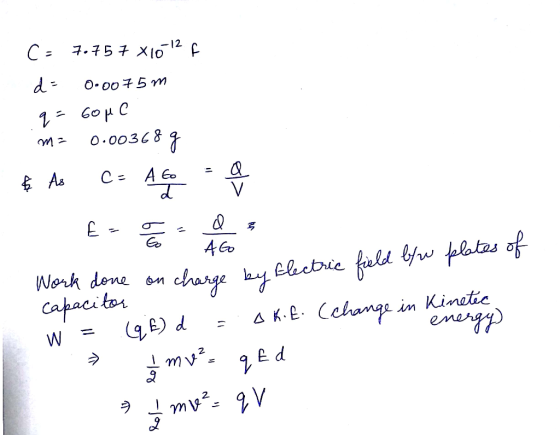
Please tell what is the volatge applied between plates or charge on the plates
And rate it up thanks :)
Add Answer to:
a parallel plate capacitor with capacitance 7.757*10^-12 F with
its plates separated by 0.0075 m. with...
A parallel-plate capacitor consists of two plates, each with an area of 29 cm2 separated by...
 A parallel-plate capacitor
consists of two plates, each with an area of 29 cm2 separated by
3.0 mm. The charge on the capacitor is 9.8 nC . A proton is
released from rest next to the positive plate. How long does it
take for the proton to reach the negative plate?
A parallel-plate capacitor consists of two plates, each with an area of 29 cm2 separated by 3.0 mm. The charge on the capacitor is 9.8 nC. A proton is...
A parallel-plate capacitor
consists of two plates, each with an area of 29 cm2 separated by
3.0 mm. The charge on the capacitor is 9.8 nC . A proton is
released from rest next to the positive plate. How long does it
take for the proton to reach the negative plate?
A parallel-plate capacitor consists of two plates, each with an area of 29 cm2 separated by 3.0 mm. The charge on the capacitor is 9.8 nC. A proton is...
A parallel plate capacitor is constructed with plate area of 0.80 m2 and a plate separation...
A parallel plate capacitor is constructed with plate area of 0.80 m2 and a plate separation of 0.10 mm. When it is charged to a potential difference of 12 V, the charge stored on it is = micro C. A parallel plate capacitor is constructed with plate area of 0.40 m2 and a plate separation of 0.10 mm. When it is charged to a potential difference of 12 V, the charge stored on it is= micro C. A parallel-plate capacitor...
8. (10 points) A parallel plate capacitor has plate area A, the plates are separated by...
 8. (10 points) A parallel plate capacitor has plate area A, the plates are separated by a distance s, and the plates carry charges ±Q. Find the work required to move an additional charge q from the negative plate to the positive plate. (The space between the plates is vacuum.)
A parallel-plate capacitor consists of two plates, each with an area of 25cm2 separated by 3.0...
A parallel-plate capacitor consists of two plates, each with an area of 25cm2 separated by 3.0 mm. The charge on the capacitor is 9.3nC . A proton is released from rest next to the positive plate. How long does it take for the proton to reach the negative plate?
Capacitor calculation a) Calculate the capacitance of a parallel-plate capacitor whose plates are made of two...
 Capacitor calculation a) Calculate the capacitance of a parallel-plate capacitor whose plates are made of two different sizes. One plate has a radius of 10 cm and the other plate has 12 cm and is separated by 0.75 mm air gap. b) What is the charge on each plate if a 12-V battery is connected across the two plates? c) What is the electric field between the plates? d) Estimate the area of the plates needed to achieve a capacitance...
A parallel-plate capacitor consists of two plates, each with an area of 28 cm2 , separated...
A parallel-plate capacitor consists of two plates, each with an area of 28 cm2 , separated by 3.0 mm. The charge on the capacitor is 8.3 nC. A proton is released from rest next to the positive plate. How long does it take for the proton to reach the negative plate? Assuming the negative plate is at 0V, at what potential was the proton released at. What is the potential at 1mm from the negative plate?
A parallel-plate capacitor consists of two plates, each with an area of 23 cm2 separated by...
A parallel-plate capacitor consists of two plates, each with an area of 23 cm2 separated by 3.0 mm. The charge on the capacitor is 8.8 nC . A proton is released from rest next to the positive plate. How long does it take for the proton to reach the negative plate?
6) Capacitor calculation a) Calculate the capacitance of a parallel-plate capacitor whose plates are made of...
 6) Capacitor calculation a) Calculate the capacitance of a parallel-plate capacitor whose plates are made of two different sizes. One plate has a radius of 10 cm and the other plate has 12 cm and is separated by 0.75 mm air gap. b) What is the charge on each plate if a 12-V battery is connected across the two plates? c) What is the electric field between the plates? d) Estimate the area of the plates needed to achieve a...
A parallel-plate capacitor consists of two plates, each with an area of 36 cm2, separated by...
 A parallel-plate capacitor consists of two plates, each with an area of 36 cm2, separated by 9.0 mm. The charge on the capacitor is 2.1 nC. An electron is released from rest next to the negative plate. How long does it take for the electron to reach the positive plate? Exoress your answer in ns.
A parallel-plate capacitor consists of two plates, each with an area of 36 cm2, separated by...
A parallel-plate capacitor consists of two plates, each with an area of 36 cm2, separated by 9.0 mm. The charge on the capacitor is 2.1 nC. An electron is released from rest next to the negative plate. How long does it take for the electron to reach the positive plate? Express your answer in ns.
 A parallel-plate capacitor
consists of two plates, each with an area of 29 cm2 separated by
3.0 mm. The charge on the capacitor is 9.8 nC . A proton is
released from rest next to the positive plate. How long does it
take for the proton to reach the negative plate?
A parallel-plate capacitor consists of two plates, each with an area of 29 cm2 separated by 3.0 mm. The charge on the capacitor is 9.8 nC. A proton is...
A parallel-plate capacitor
consists of two plates, each with an area of 29 cm2 separated by
3.0 mm. The charge on the capacitor is 9.8 nC . A proton is
released from rest next to the positive plate. How long does it
take for the proton to reach the negative plate?
A parallel-plate capacitor consists of two plates, each with an area of 29 cm2 separated by 3.0 mm. The charge on the capacitor is 9.8 nC. A proton is...
 8. (10 points) A parallel plate capacitor has plate area A, the plates are separated by a distance s, and the plates carry charges ±Q. Find the work required to move an additional charge q from the negative plate to the positive plate. (The space between the plates is vacuum.)
 Capacitor calculation a) Calculate the capacitance of a parallel-plate capacitor whose plates are made of two different sizes. One plate has a radius of 10 cm and the other plate has 12 cm and is separated by 0.75 mm air gap. b) What is the charge on each plate if a 12-V battery is connected across the two plates? c) What is the electric field between the plates? d) Estimate the area of the plates needed to achieve a capacitance...
 6) Capacitor calculation a) Calculate the capacitance of a parallel-plate capacitor whose plates are made of two different sizes. One plate has a radius of 10 cm and the other plate has 12 cm and is separated by 0.75 mm air gap. b) What is the charge on each plate if a 12-V battery is connected across the two plates? c) What is the electric field between the plates? d) Estimate the area of the plates needed to achieve a...
 A parallel-plate capacitor consists of two plates, each with an area of 36 cm2, separated by 9.0 mm. The charge on the capacitor is 2.1 nC. An electron is released from rest next to the negative plate. How long does it take for the electron to reach the positive plate? Exoress your answer in ns.
Most questions answered within 3 hours.
-
Where is the error in this code sequence?
String s1 = "Hello";
String s2 = "ello";...
asked 10 months ago -
Financial data for Joel de Paris, Inc., for last year
follow:
Joel de Paris, Inc.
Balance...
asked 10 months ago -
Consider this reaction:
Al2(SO4)3 (aq)+ BaCl3
(aq) Al2Cl6 (aq)- +
3BaSO4(s) . What is the...
asked 10 months ago -
Suppose that Savneet is considering increasing her
recent random sample from 20 car rentals to 40...
asked 10 months ago -
Trucks arrive at an unloading terminal at an average rate of 120
per hour.
Trucks arrive...
asked 10 months ago -
Why are methanol and ethanol completely soluble in water while
octanol is not very little soluble....
asked 10 months ago -
A facilities manager at a university reads in a research report
that the mean amount of...
asked 10 months ago -
When the CuSO4 is rehydrated by adding water to the anhydrous
compound, is this an endothermic...
asked 10 months ago -
A ray of sunlight is passing from diamond into crown glass; the
angle of incidence is...
asked 10 months ago -
A block of mass 0.249 kg is placed on top of a light, vertical
spring of...
asked 10 months ago -
how do the kidneys compensate in the presences of acidosis
a) trigger hyperventilate
b) reserve acid...
asked 10 months ago -
Question 501 pts
The rental rate of capital to the firm increases. Which of the
following...
asked 10 months ago