Assume a binomial model for a certain random variable. If we desire a 90% confidence interval...
Homework Answers

Add Answer to:
Assume a binomial model for a certain random variable. If we
desire a 90% confidence interval...
4.2.16. Assume a binomial model for a certain randon variable. If we desire a 90% confidence...
 4.2.16. Assume a binomial model for a certain randon variable. If we desire a 90% confidence interval for p that is at most 0.02 in length, find n. lHint: Note that um-ym)s ya-
(2) Let Y be a binomial random variable with parameters n and p. Remember that We...
 (2) Let Y be a binomial random variable with parameters n and p. Remember that We know that Y/n is an unbiased estimator of p. Now we want to estimate the variance of Y with n借)(1-n) (a) Find the expected value of this estimator (b) Find an unbiased estimator that is a simple modification of the proposed estimator
Assume random variable ? is uniformly distributed in the interval (−?/2 ,?⁄ 2]. Define the random...
 Assume random variable ? is uniformly distributed in the
interval (−?/2 ,?⁄ 2]. Define the random variable ?=tan (?), where
tan (∙) denotes the tangent function. Note that the derivative of
tan (?) is 1/(cos (?)2) .
a) Find the PDF of ?.
b) Find the mean of ?
.Define the random variable ?=1/?.
c) Find the PDF of ?.
Assume random variable X is uniformly distributed in the interval (-1/2, 1/2). Define the random variable Y = tan(X), where...
Assume random variable ? is uniformly distributed in the
interval (−?/2 ,?⁄ 2]. Define the random variable ?=tan (?), where
tan (∙) denotes the tangent function. Note that the derivative of
tan (?) is 1/(cos (?)2) .
a) Find the PDF of ?.
b) Find the mean of ?
.Define the random variable ?=1/?.
c) Find the PDF of ?.
Assume random variable X is uniformly distributed in the interval (-1/2, 1/2). Define the random variable Y = tan(X), where...
Suppose X is a Binomial Random Variable with n = 4 and p = 2. What...
Suppose X is a Binomial Random Variable with n = 4 and p = 2. What is the pdf of Y = 2X + 1? Note: The pdf of a Binomial Random Variable X is pX(k) = n k (1 − p) kp n−k , k = 0, 1, 2, . . . ,
2. Assume the random variable y has the continuous uniform distribution defined on the interval a...
 2. Assume the random variable y has the continuous uniform distribution defined on the interval a to b, that is, f(y) = 1/6 - a), a sy<b. For this problem let a = 0 and b = 2. (a) Find P(Y < 1). (Hint: Use a picture.) (b) Find u and o2 for the distribution.
(2) Let Y be a binomial random variable with parameters n and p. Remember that E(Y)...
 (2) Let Y be a binomial random variable with parameters n and p. Remember that E(Y) V(Y)p1 -p) We know that Y/n is an unbiased estimator of p. Now we want to estimate the variance of Y with n(2(1 (a) Find the expected value of this estimator (b) Find an unbiased estimator that is a simple modification of the proposed estimator
Let N be a binomial random variable with p = 0.2 and n = 10. We...
Let N be a binomial random variable with p = 0.2 and n = 10. We roll a fair die N times, let X be the number of times we roll the number 1. Find the joint probability mass function of N and X.
Recall the formula for a proportion confidence interval is p^?zp^(1?p^)n?????????<p<p^+zp^(1?p^)n????????? Thus, the margin of error is...
Recall the formula for a proportion confidence interval is p^?zp^(1?p^)n?????????<p<p^+zp^(1?p^)n????????? Thus, the margin of error is E=zp^(1?p^)n????????? . NOTE: the margin of error can be recovered after constructing a confidence interval on the calculator using algebra (that is, subtracting p^ from the right endpoint.) In a simple random sample of size 59, taken from a population, 20 of the individuals met a specified criteria. a) What is the margin of error for a 90% confidence interval for p, the population...
2) we want to develop a 90% confidence interval for the fraction of fruit flies which...
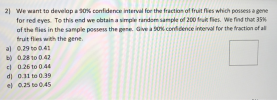 2) we want to develop a 90% confidence interval for the fraction of fruit flies which possess a gene for red eyes. To this end we obtain a simple random sample of 200 fruit flies, we find that 35% of the flies in the sample possess the gene. Give a 90% confidence interval for the fraction of all fruit flies with the gene a) 0.29 to 0.41 b) 0.28 to 0.42 c) 0.26 to 0.44 d) 0.31 to 0.39 e)...
Assume the random variable x has a binomial distribution with a given probability of obtaining a...
Assume the random variable x has a binomial distribution with a given probability of obtaining a success. Find the probability, given the number of trials and the probability of obtaining a success. P(X<=3), n=7, p=.2
 4.2.16. Assume a binomial model for a certain randon variable. If we desire a 90% confidence interval for p that is at most 0.02 in length, find n. lHint: Note that um-ym)s ya-
 (2) Let Y be a binomial random variable with parameters n and p. Remember that We know that Y/n is an unbiased estimator of p. Now we want to estimate the variance of Y with n借)(1-n) (a) Find the expected value of this estimator (b) Find an unbiased estimator that is a simple modification of the proposed estimator
 Assume random variable ? is uniformly distributed in the
interval (−?/2 ,?⁄ 2]. Define the random variable ?=tan (?), where
tan (∙) denotes the tangent function. Note that the derivative of
tan (?) is 1/(cos (?)2) .
a) Find the PDF of ?.
b) Find the mean of ?
.Define the random variable ?=1/?.
c) Find the PDF of ?.
Assume random variable X is uniformly distributed in the interval (-1/2, 1/2). Define the random variable Y = tan(X), where...
Assume random variable ? is uniformly distributed in the
interval (−?/2 ,?⁄ 2]. Define the random variable ?=tan (?), where
tan (∙) denotes the tangent function. Note that the derivative of
tan (?) is 1/(cos (?)2) .
a) Find the PDF of ?.
b) Find the mean of ?
.Define the random variable ?=1/?.
c) Find the PDF of ?.
Assume random variable X is uniformly distributed in the interval (-1/2, 1/2). Define the random variable Y = tan(X), where...
 2. Assume the random variable y has the continuous uniform distribution defined on the interval a to b, that is, f(y) = 1/6 - a), a sy<b. For this problem let a = 0 and b = 2. (a) Find P(Y < 1). (Hint: Use a picture.) (b) Find u and o2 for the distribution.
 (2) Let Y be a binomial random variable with parameters n and p. Remember that E(Y) V(Y)p1 -p) We know that Y/n is an unbiased estimator of p. Now we want to estimate the variance of Y with n(2(1 (a) Find the expected value of this estimator (b) Find an unbiased estimator that is a simple modification of the proposed estimator
 2) we want to develop a 90% confidence interval for the fraction of fruit flies which possess a gene for red eyes. To this end we obtain a simple random sample of 200 fruit flies, we find that 35% of the flies in the sample possess the gene. Give a 90% confidence interval for the fraction of all fruit flies with the gene a) 0.29 to 0.41 b) 0.28 to 0.42 c) 0.26 to 0.44 d) 0.31 to 0.39 e)...
Most questions answered within 3 hours.
-
Where is the error in this code sequence?
String s1 = "Hello";
String s2 = "ello";...
asked 10 months ago -
Financial data for Joel de Paris, Inc., for last year
follow:
Joel de Paris, Inc.
Balance...
asked 10 months ago -
Consider this reaction:
Al2(SO4)3 (aq)+ BaCl3
(aq) Al2Cl6 (aq)- +
3BaSO4(s) . What is the...
asked 10 months ago -
Suppose that Savneet is considering increasing her
recent random sample from 20 car rentals to 40...
asked 10 months ago -
Trucks arrive at an unloading terminal at an average rate of 120
per hour.
Trucks arrive...
asked 10 months ago -
Why are methanol and ethanol completely soluble in water while
octanol is not very little soluble....
asked 10 months ago -
A facilities manager at a university reads in a research report
that the mean amount of...
asked 10 months ago -
When the CuSO4 is rehydrated by adding water to the anhydrous
compound, is this an endothermic...
asked 10 months ago -
A ray of sunlight is passing from diamond into crown glass; the
angle of incidence is...
asked 10 months ago -
A block of mass 0.249 kg is placed on top of a light, vertical
spring of...
asked 10 months ago -
how do the kidneys compensate in the presences of acidosis
a) trigger hyperventilate
b) reserve acid...
asked 10 months ago -
Question 501 pts
The rental rate of capital to the firm increases. Which of the
following...
asked 10 months ago