Please use Archimedes’ approach not” modern” formulas a) Prove that the volume of a sphere is...
Please use Archimedes’ approach not” modern” formulas
a) Prove that the volume of a sphere is equal to 4 of its corresponding cones
b) Prove that the surface area of a sphere is equal to 4 of its corresponding great circles.
Homework Answers

Add Answer to:
Please use Archimedes’ approach not” modern”
formulas
a) Prove that the volume of a sphere is...
5. Use the approach of Cavalieri to prove the formula of Archimedes for the volume of...
 5. Use the approach of Cavalieri to prove the formula of Archimedes for the volume of the sphere: show that the area of the section of the sphere 2,2 +y2 +za_ r2 by the plane y = c,-1 c 1, is equal to the area of the section of the cylinder 22 outside of the cone2+222 and use the formula for the volume of the cone.
Goal: Use integration to derive the volume of the solid sphere in dimensions above 3 (R4,...
 Goal: Use integration to derive the volume of the solid sphere in dimensions above 3 (R4, Rʻ,...). Notation & Terminology: Use V, and S, for the "volume" and "surface area" of an n- dimensional solid sphere. Thus "Volume" is not always in cubic units, it is in units^n. So, similarly “surface area" is in units (n-1) and is the measurement of the boundary. 1. Look up & become familiar with the formulas for V, and S. Start in R', what...
Prove that the surface area of a sphere is V = 4*pi*a^2 using parametric equations. Then re-prove...
Prove that the surface area of a sphere is V = 4*pi*a^2 using parametric equations. Then re-prove it using polar equations. Only use one integral for polar please.
Write a program to calculate the volume and surface area of a sphere from it radius...
Write a program to calculate the volume and surface area of a sphere from it radius given as input. Here are some formulas that might be useful: V = 4/3πr3 A = 4 πr2
Calculus 1 work only please! Parabolic Arch Archimedes showed that the area of a parabolic arch...
 Calculus 1 work only please!
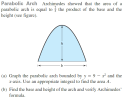
Parabolic Arch Archimedes showed that the area of a parabolic arch is equal to į the product of the base and the height (see figure). h b (a) Graph the parabolic arch bounded by y = 9 – x2 and the x-axis. Use an appropriate integral to find the area A. (b) Find the base and height of the arch and verify Archimedes' formula.
Calculus 1 work only please!
Parabolic Arch Archimedes showed that the area of a parabolic arch is equal to į the product of the base and the height (see figure). h b (a) Graph the parabolic arch bounded by y = 9 – x2 and the x-axis. Use an appropriate integral to find the area A. (b) Find the base and height of the arch and verify Archimedes' formula.
Consider a sphere of radius a with a uniform charge distribution over its volume, and a...
 Consider a sphere of radius a with a uniform charge distribution over its volume, and a total charge of q_o. Use Gauss's Law to calculate the electric field outside the sphere, and then inside the sphere. Solve the general problem in r, recognizing that problem spherical symmetry. Draw a graph of the electric field the has the surface of the strength as a function of noting where if the surface of the sphere is (a). Some hints: the surface area...
Please answer all three parts. Please write down formulas that you use and write down explanations...
 Please answer all three parts. Please write down formulas that
you use and write down explanations when needed! Will give you
thumbs up and leave a great comment!!! Thank you!!!
4. (a) let x[n] be a finite duration signal of duration N. Let y[n] = DFT(DFT(a[n])). All DFTs are N point DFTs. Find vinl in termas of rinl Prove all the properties you use in arriving at your result (b) Let an] and yIn] be sequences of duration N with...
Please answer all three parts. Please write down formulas that
you use and write down explanations when needed! Will give you
thumbs up and leave a great comment!!! Thank you!!!
4. (a) let x[n] be a finite duration signal of duration N. Let y[n] = DFT(DFT(a[n])). All DFTs are N point DFTs. Find vinl in termas of rinl Prove all the properties you use in arriving at your result (b) Let an] and yIn] be sequences of duration N with...
A sphere of radius r has surface area A = 4πr2 and volume V = (4/3)...
A sphere of radius r has surface area A = 4πr2 and volume V = (4/3) πr3. The radius of sphere 2 is double the radius of sphere 1. (a)What is the ratio of the areas, A2/A1? (b)What is the ratio of the volumes, V2/V1?
can you please answer b with formulas end explaination I. A solid, non-conducting sphere of radius...
 can you please answer b
with formulas end explaination
I. A solid, non-conducting sphere of radius a carries a charge of +6 μC. This sphere is located at the center of a hollow, conducting sphere with an inner radius of b and an outer radius of c as shown. The hollow sphere also carries a total excess charge of +6 HC. d) y ouer Surface: 666e12/Mc (2 (a) Determine (i) the charge on the inner surface of the outer sphere...
can you please answer b
with formulas end explaination
I. A solid, non-conducting sphere of radius a carries a charge of +6 μC. This sphere is located at the center of a hollow, conducting sphere with an inner radius of b and an outer radius of c as shown. The hollow sphere also carries a total excess charge of +6 HC. d) y ouer Surface: 666e12/Mc (2 (a) Determine (i) the charge on the inner surface of the outer sphere...
A solid, insulating sphere of radius a has a uniform charge density throughout its volume and...
 A solid, insulating sphere of radius a has a uniform charge density throughout its volume and a total charge Q Concentric with this sphere is a conducting, hollow sphere with total charge -Q, whose inner and outer radii are b and c as shown in the figure. Express all your answers in terms of Q, a, b, c,r and k, or o as appropriate (a) [4 pts.] Draw an appropriate Gaussian surface and use it to find the electric field...
 5. Use the approach of Cavalieri to prove the formula of Archimedes for the volume of the sphere: show that the area of the section of the sphere 2,2 +y2 +za_ r2 by the plane y = c,-1 c 1, is equal to the area of the section of the cylinder 22 outside of the cone2+222 and use the formula for the volume of the cone.
 Goal: Use integration to derive the volume of the solid sphere in dimensions above 3 (R4, Rʻ,...). Notation & Terminology: Use V, and S, for the "volume" and "surface area" of an n- dimensional solid sphere. Thus "Volume" is not always in cubic units, it is in units^n. So, similarly “surface area" is in units (n-1) and is the measurement of the boundary. 1. Look up & become familiar with the formulas for V, and S. Start in R', what...
 Calculus 1 work only please!
Parabolic Arch Archimedes showed that the area of a parabolic arch is equal to į the product of the base and the height (see figure). h b (a) Graph the parabolic arch bounded by y = 9 – x2 and the x-axis. Use an appropriate integral to find the area A. (b) Find the base and height of the arch and verify Archimedes' formula.
Calculus 1 work only please!
Parabolic Arch Archimedes showed that the area of a parabolic arch is equal to į the product of the base and the height (see figure). h b (a) Graph the parabolic arch bounded by y = 9 – x2 and the x-axis. Use an appropriate integral to find the area A. (b) Find the base and height of the arch and verify Archimedes' formula.
 Consider a sphere of radius a with a uniform charge distribution over its volume, and a total charge of q_o. Use Gauss's Law to calculate the electric field outside the sphere, and then inside the sphere. Solve the general problem in r, recognizing that problem spherical symmetry. Draw a graph of the electric field the has the surface of the strength as a function of noting where if the surface of the sphere is (a). Some hints: the surface area...
 Please answer all three parts. Please write down formulas that
you use and write down explanations when needed! Will give you
thumbs up and leave a great comment!!! Thank you!!!
4. (a) let x[n] be a finite duration signal of duration N. Let y[n] = DFT(DFT(a[n])). All DFTs are N point DFTs. Find vinl in termas of rinl Prove all the properties you use in arriving at your result (b) Let an] and yIn] be sequences of duration N with...
Please answer all three parts. Please write down formulas that
you use and write down explanations when needed! Will give you
thumbs up and leave a great comment!!! Thank you!!!
4. (a) let x[n] be a finite duration signal of duration N. Let y[n] = DFT(DFT(a[n])). All DFTs are N point DFTs. Find vinl in termas of rinl Prove all the properties you use in arriving at your result (b) Let an] and yIn] be sequences of duration N with...
 can you please answer b
with formulas end explaination
I. A solid, non-conducting sphere of radius a carries a charge of +6 μC. This sphere is located at the center of a hollow, conducting sphere with an inner radius of b and an outer radius of c as shown. The hollow sphere also carries a total excess charge of +6 HC. d) y ouer Surface: 666e12/Mc (2 (a) Determine (i) the charge on the inner surface of the outer sphere...
can you please answer b
with formulas end explaination
I. A solid, non-conducting sphere of radius a carries a charge of +6 μC. This sphere is located at the center of a hollow, conducting sphere with an inner radius of b and an outer radius of c as shown. The hollow sphere also carries a total excess charge of +6 HC. d) y ouer Surface: 666e12/Mc (2 (a) Determine (i) the charge on the inner surface of the outer sphere...
 A solid, insulating sphere of radius a has a uniform charge density throughout its volume and a total charge Q Concentric with this sphere is a conducting, hollow sphere with total charge -Q, whose inner and outer radii are b and c as shown in the figure. Express all your answers in terms of Q, a, b, c,r and k, or o as appropriate (a) [4 pts.] Draw an appropriate Gaussian surface and use it to find the electric field...
Most questions answered within 3 hours.
-
Where is the error in this code sequence?
String s1 = "Hello";
String s2 = "ello";...
asked 10 months ago -
Financial data for Joel de Paris, Inc., for last year
follow:
Joel de Paris, Inc.
Balance...
asked 10 months ago -
Consider this reaction:
Al2(SO4)3 (aq)+ BaCl3
(aq) Al2Cl6 (aq)- +
3BaSO4(s) . What is the...
asked 10 months ago -
Suppose that Savneet is considering increasing her
recent random sample from 20 car rentals to 40...
asked 10 months ago -
Trucks arrive at an unloading terminal at an average rate of 120
per hour.
Trucks arrive...
asked 10 months ago -
Why are methanol and ethanol completely soluble in water while
octanol is not very little soluble....
asked 10 months ago -
A facilities manager at a university reads in a research report
that the mean amount of...
asked 10 months ago -
When the CuSO4 is rehydrated by adding water to the anhydrous
compound, is this an endothermic...
asked 10 months ago -
A ray of sunlight is passing from diamond into crown glass; the
angle of incidence is...
asked 10 months ago -
A block of mass 0.249 kg is placed on top of a light, vertical
spring of...
asked 10 months ago -
how do the kidneys compensate in the presences of acidosis
a) trigger hyperventilate
b) reserve acid...
asked 10 months ago -
Question 501 pts
The rental rate of capital to the firm increases. Which of the
following...
asked 10 months ago