A. look up the lowest energy electron pair arrangement for seven pairs of electrons in VSEPR...
Homework Answers
A.
Name of the (XeF5)- is Xenon pentafluoride anion.
This molecule is having seven pairs of electrons. Among them, five pairs are bonding pairs forms Xe-F bonds and two pairs are lone pairs of electrons which not involving in the bonding.
We know from VSEPR theory, the structure of the molecule can determined by differences of electrostatic repulsion between bonding pairs and lone pairs involves in the molecule.
We know that, the order of repulsion is lone pair-lone pair>lone pair-bond pair>bond pair-bond pair.
Because, lone pairs are average closer to nucleus than bonding pair and more strongly repulse other electrons.
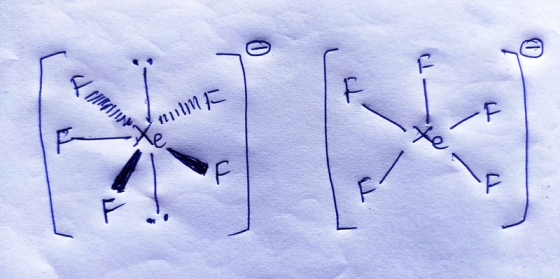
The structure of the (XeF5)- is pentagonal bipyramidal shape which is consider as parent shape with all seven pairs of electrons.
The two pairs of lone pair of electrons are kept in equatorial plane to reduce the repulsion of lone pair-lone pair electrons. As a result, the shape of the molecule is pentagonal planar.
i.e.,
Add Answer to:
A.
look up the lowest energy electron pair arrangement for seven pairs
of electrons in VSEPR...
Q) Using VSEPR theory predict the arrangement of electron pairs for OF2. a)Trigonal Bipyrimidal b)Square Planar...
Q) Using VSEPR theory predict the arrangement of electron pairs for OF2. a)Trigonal Bipyrimidal b)Square Planar c)Tetrahedral d)Octahedral e)T-shaped Q) Does OF2 have a permanent dipole moment? a)No b)Yes Q)Using VSEPR theory predict the arrangement of electron pairs for XeCl2. a)T-shaped b)Linear c)Trigonal Bipyrimidal d)Octahedral e)Square Planar Q)Does XeCl2 have a permanent dipole moment? a)Yes b)No Q)Using VSEPR theory predict the arrangement of electron pairs for BrF3. a)Square Planar b)Bent c)Trigonal Bipyrimidal d)Trigonal Pyrimidal e)Octahedral Q)Does BrF3 have a permanent...
9.a) For the molecule whose Lewis structure is shown to the right, draw the corresponding VSEPR....
 9.a) For the molecule whose Lewis structure is shown to the right, draw the corresponding VSEPR. HH :0=c=C=NH b) & c) Assign the hybridization for C1. d) Draw both the valence unhybridized, and hybridized energy diagram for C1. On your hybridized energy diagram label which orbitals would be involved in a sigma bond, pi-bond or represent a lone pair. e) and f) Using the knowledge from the atom hybridization energy diagrams, draw the sigma (o) and pi (T) frameworks for...
Please answer b&c onwards. I will thumbs up :) CHEM 201 Stage II Written Exercise -...
 Please answer b&c onwards. I will thumbs up :)
CHEM 201 Stage II Written Exercise - Tutorial 4 Page 1 This work should be completed on the template in the second to last and last page of your pre-tutorial. You will then need to submit this and your pre-tutorial to the Tutorial #4 Dropbox on D2L before the Sunday March 22nd deadline of 11:59pm. 9.a) For thr molecule whose Lewis structure is shown to the nght, draw the corresponding VSEPR....
Please answer b&c onwards. I will thumbs up :)
CHEM 201 Stage II Written Exercise - Tutorial 4 Page 1 This work should be completed on the template in the second to last and last page of your pre-tutorial. You will then need to submit this and your pre-tutorial to the Tutorial #4 Dropbox on D2L before the Sunday March 22nd deadline of 11:59pm. 9.a) For thr molecule whose Lewis structure is shown to the nght, draw the corresponding VSEPR....
8. Select the true statement. a. Atomic radius increases going from left to right across a...
 8. Select the true statement. a. Atomic radius increases going from left to right across a period. b. The p electrons in fluorine are more poorly shielded from the nuclear charge than the p electrons in carbon. c. Cations are larger than their corresponding neutral atoms. d. Anions are smaller than their corresponding neutral atoms. e. Ionic radius generally decreases down a group. 9. (ACS question) Which of these elements has the highest first ionization energy? a. Ne b. F...
My homework is due tomorrow and I have work! Please help me and answer these questions!...
 My homework is due tomorrow and I have work! Please help me and
answer these questions! I'll give a thumbs up!
Electronic Structure of Atoms 1.20 Write the ground-state electron configuration for each atom. After each atom is its atomic number in parentheses. (a) Sodium (11) (b) Magnesium (12) (c) Oxygen (8) (d) Nitrogen (7) 1.21 Identify the atom that has each ground-state electron configuration. (a) 1s 2s 2p 3:23p (b) 1:2 2:22 1.23 How many electrons are in the...
My homework is due tomorrow and I have work! Please help me and
answer these questions! I'll give a thumbs up!
Electronic Structure of Atoms 1.20 Write the ground-state electron configuration for each atom. After each atom is its atomic number in parentheses. (a) Sodium (11) (b) Magnesium (12) (c) Oxygen (8) (d) Nitrogen (7) 1.21 Identify the atom that has each ground-state electron configuration. (a) 1s 2s 2p 3:23p (b) 1:2 2:22 1.23 How many electrons are in the...
please I need help with the data sheet INTRODUCTION The chemical and physical properties of substances...
 please I need help with the data sheet
INTRODUCTION The chemical and physical properties of substances are influenced by the way in which valence electrons are distributed and by the three-dimensional shape of the molecule or ion. X- ray and neutron diffraction, infrared, Raman and microwave absorption spectroscopy, as well as dipole moment measurements are used to ascertain the three-dimensional structure of a substance. Thus, techniques are available which can identify the geometry of substances. Results of these measurements generally...
please I need help with the data sheet
INTRODUCTION The chemical and physical properties of substances are influenced by the way in which valence electrons are distributed and by the three-dimensional shape of the molecule or ion. X- ray and neutron diffraction, infrared, Raman and microwave absorption spectroscopy, as well as dipole moment measurements are used to ascertain the three-dimensional structure of a substance. Thus, techniques are available which can identify the geometry of substances. Results of these measurements generally...
please I need help with this Х Lab 11.pdf Lab 11.pdf INTRODUCTION The chemical and physical...
 please I need help with this
Х Lab 11.pdf Lab 11.pdf INTRODUCTION The chemical and physical properties of substances are influenced by the way in which valence electrons are distributed and by the three-dimensional shape of the molecule or ion. X- ray and neutron diffraction, infrared, Raman and microwave absorption spectroscopy, as well as dipole moment measurements, are used to ascertain the three-dimensional structure of a substance. Thus, techniques are available which can identify the geometry of substances Results of...
please I need help with this
Х Lab 11.pdf Lab 11.pdf INTRODUCTION The chemical and physical properties of substances are influenced by the way in which valence electrons are distributed and by the three-dimensional shape of the molecule or ion. X- ray and neutron diffraction, infrared, Raman and microwave absorption spectroscopy, as well as dipole moment measurements, are used to ascertain the three-dimensional structure of a substance. Thus, techniques are available which can identify the geometry of substances Results of...
 9.a) For the molecule whose Lewis structure is shown to the right, draw the corresponding VSEPR. HH :0=c=C=NH b) & c) Assign the hybridization for C1. d) Draw both the valence unhybridized, and hybridized energy diagram for C1. On your hybridized energy diagram label which orbitals would be involved in a sigma bond, pi-bond or represent a lone pair. e) and f) Using the knowledge from the atom hybridization energy diagrams, draw the sigma (o) and pi (T) frameworks for...
 Please answer b&c onwards. I will thumbs up :)
CHEM 201 Stage II Written Exercise - Tutorial 4 Page 1 This work should be completed on the template in the second to last and last page of your pre-tutorial. You will then need to submit this and your pre-tutorial to the Tutorial #4 Dropbox on D2L before the Sunday March 22nd deadline of 11:59pm. 9.a) For thr molecule whose Lewis structure is shown to the nght, draw the corresponding VSEPR....
Please answer b&c onwards. I will thumbs up :)
CHEM 201 Stage II Written Exercise - Tutorial 4 Page 1 This work should be completed on the template in the second to last and last page of your pre-tutorial. You will then need to submit this and your pre-tutorial to the Tutorial #4 Dropbox on D2L before the Sunday March 22nd deadline of 11:59pm. 9.a) For thr molecule whose Lewis structure is shown to the nght, draw the corresponding VSEPR....
 8. Select the true statement. a. Atomic radius increases going from left to right across a period. b. The p electrons in fluorine are more poorly shielded from the nuclear charge than the p electrons in carbon. c. Cations are larger than their corresponding neutral atoms. d. Anions are smaller than their corresponding neutral atoms. e. Ionic radius generally decreases down a group. 9. (ACS question) Which of these elements has the highest first ionization energy? a. Ne b. F...
 My homework is due tomorrow and I have work! Please help me and
answer these questions! I'll give a thumbs up!
Electronic Structure of Atoms 1.20 Write the ground-state electron configuration for each atom. After each atom is its atomic number in parentheses. (a) Sodium (11) (b) Magnesium (12) (c) Oxygen (8) (d) Nitrogen (7) 1.21 Identify the atom that has each ground-state electron configuration. (a) 1s 2s 2p 3:23p (b) 1:2 2:22 1.23 How many electrons are in the...
My homework is due tomorrow and I have work! Please help me and
answer these questions! I'll give a thumbs up!
Electronic Structure of Atoms 1.20 Write the ground-state electron configuration for each atom. After each atom is its atomic number in parentheses. (a) Sodium (11) (b) Magnesium (12) (c) Oxygen (8) (d) Nitrogen (7) 1.21 Identify the atom that has each ground-state electron configuration. (a) 1s 2s 2p 3:23p (b) 1:2 2:22 1.23 How many electrons are in the...
 please I need help with the data sheet
INTRODUCTION The chemical and physical properties of substances are influenced by the way in which valence electrons are distributed and by the three-dimensional shape of the molecule or ion. X- ray and neutron diffraction, infrared, Raman and microwave absorption spectroscopy, as well as dipole moment measurements are used to ascertain the three-dimensional structure of a substance. Thus, techniques are available which can identify the geometry of substances. Results of these measurements generally...
please I need help with the data sheet
INTRODUCTION The chemical and physical properties of substances are influenced by the way in which valence electrons are distributed and by the three-dimensional shape of the molecule or ion. X- ray and neutron diffraction, infrared, Raman and microwave absorption spectroscopy, as well as dipole moment measurements are used to ascertain the three-dimensional structure of a substance. Thus, techniques are available which can identify the geometry of substances. Results of these measurements generally...
 please I need help with this
Х Lab 11.pdf Lab 11.pdf INTRODUCTION The chemical and physical properties of substances are influenced by the way in which valence electrons are distributed and by the three-dimensional shape of the molecule or ion. X- ray and neutron diffraction, infrared, Raman and microwave absorption spectroscopy, as well as dipole moment measurements, are used to ascertain the three-dimensional structure of a substance. Thus, techniques are available which can identify the geometry of substances Results of...
please I need help with this
Х Lab 11.pdf Lab 11.pdf INTRODUCTION The chemical and physical properties of substances are influenced by the way in which valence electrons are distributed and by the three-dimensional shape of the molecule or ion. X- ray and neutron diffraction, infrared, Raman and microwave absorption spectroscopy, as well as dipole moment measurements, are used to ascertain the three-dimensional structure of a substance. Thus, techniques are available which can identify the geometry of substances Results of...
Most questions answered within 3 hours.
-
Where is the error in this code sequence?
String s1 = "Hello";
String s2 = "ello";...
asked 10 months ago -
Financial data for Joel de Paris, Inc., for last year
follow:
Joel de Paris, Inc.
Balance...
asked 10 months ago -
Consider this reaction:
Al2(SO4)3 (aq)+ BaCl3
(aq) Al2Cl6 (aq)- +
3BaSO4(s) . What is the...
asked 10 months ago -
Suppose that Savneet is considering increasing her
recent random sample from 20 car rentals to 40...
asked 10 months ago -
Trucks arrive at an unloading terminal at an average rate of 120
per hour.
Trucks arrive...
asked 10 months ago -
Why are methanol and ethanol completely soluble in water while
octanol is not very little soluble....
asked 10 months ago -
A facilities manager at a university reads in a research report
that the mean amount of...
asked 10 months ago -
When the CuSO4 is rehydrated by adding water to the anhydrous
compound, is this an endothermic...
asked 10 months ago -
A ray of sunlight is passing from diamond into crown glass; the
angle of incidence is...
asked 10 months ago -
A block of mass 0.249 kg is placed on top of a light, vertical
spring of...
asked 10 months ago -
how do the kidneys compensate in the presences of acidosis
a) trigger hyperventilate
b) reserve acid...
asked 10 months ago -
Question 501 pts
The rental rate of capital to the firm increases. Which of the
following...
asked 10 months ago