Let f(x) = x(ln x)2 and g(x) = x(sqrt(x)). Show that f(x) is o(g(x)) by taking...
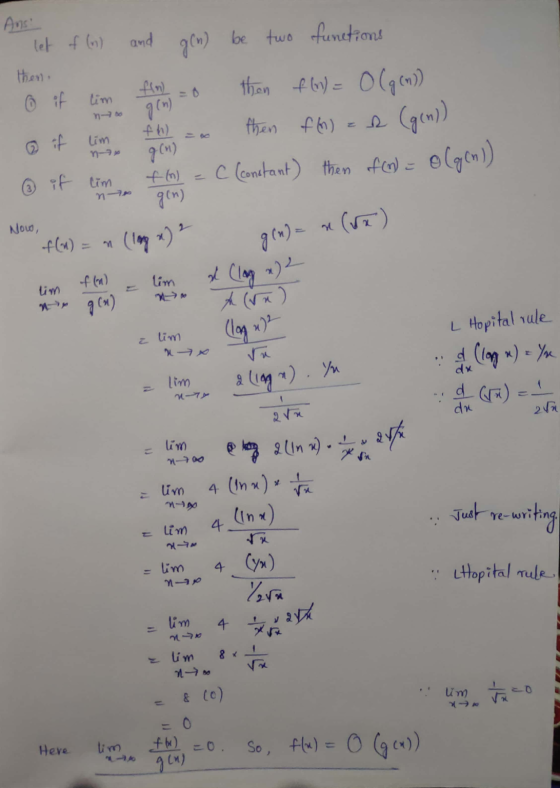
Let f(x) = x(ln x)2 and g(x) = x(sqrt(x)). Show that f(x) is o(g(x)) by taking a limit. Show each step in finding the limit. (Note: the o means "little o" not big O.) You may need to use l'Hopital's rule one or more times in taking the limit.
You may type the word lim without anything underneath to mean "the limit as x goes to infinity."
Please type each step on a separate line to facilitate grading. Also, don't forget to put in parentheses where necessary.
Homework Answers
Note:
In LHopitals rule,
Derivative of ln(x)= (1/x)
Derivative of (√x)=(1/√x)
Add Answer to:
Let f(x) = x(ln x)2 and g(x) = x(sqrt(x)). Show that
f(x) is o(g(x)) by taking...
True of False (dont need to solve) _____According to the L’hospital’s rule, lim(x-->a) f(x)/g(x)= L if...
True of False (dont need to solve) _____According to the L’hospital’s rule, lim(x-->a) f(x)/g(x)= L if f'(x)/g'(x)=L _____ A monotonically increasing function cannot have a max or min in a closed interval [a, b] because f’(x) >0 for all x in (a, b). _____ For x>10, the ratio ln(x)/sqrt(x-10) approaches 0 as x --> infinity . _____ lim(x-->infinity) (3x^3 +12x^2 -8x +1)/(x^2 + 2)(3x-1) =3 _____ _____ x = -1 is an asymptote of y= 1/(sqrt(x+1)) _____ _____ y=0 is...
QUESTION 3 To show that f(x) is O(g(x) using the definition of big o, we find...
 QUESTION 3 To show that f(x) is O(g(x) using the definition of big o, we find Cand k such that f(x) < Cg(x) for all x > k. QUESTION 4 Finding the smallest number in a list of n elements would use an OU) algorithm.
If we are given that the composite function g(x) = ln(f(x) passes through the point (0,1)...
 If we are given that the composite function g(x) = ln(f(x) passes through the point (0,1) where it has a tangent line of slope -1, then what is the value off'(0)? a) 0 b) 0-1 c) O-e d) e) Review Later Question 24 Find lim x? In(x2). X-0 a) 4 b) The limit does not exist. c) 0 d) 01 e) 2 Review Later
[12 marks] Using the definition of big-O, show that f(x) is big-O of g, where: f(x)...
 [12 marks] Using the definition of big-O, show that f(x) is big-O of g, where: f(x) = 2* + 33 and g(x) = 3* Show the details of your work to obtain a full mark.
1.state the shaded area f(x)=cos(x)+5 g(x)=cos(x)+3 #2. state the shaded area f(x)=sqrt x-4 +3 g(x)=-x+7 Show...
 1.state the shaded area f(x)=cos(x)+5 g(x)=cos(x)+3 #2. state
the shaded area f(x)=sqrt x-4 +3 g(x)=-x+7
Show work as needed. Circle answer. 1. State the shaded area. f(x) = cos(x) + 5 g(x) = cos(x) + 3 2. State the shaded area 1x) = *-4+3 9(4)=-x.7
1.state the shaded area f(x)=cos(x)+5 g(x)=cos(x)+3 #2. state
the shaded area f(x)=sqrt x-4 +3 g(x)=-x+7
Show work as needed. Circle answer. 1. State the shaded area. f(x) = cos(x) + 5 g(x) = cos(x) + 3 2. State the shaded area 1x) = *-4+3 9(4)=-x.7
(a) Let f(x) = 3x – 2. Show that f'(x) = 3 using the definition of...
 (a) Let f(x) = 3x – 2. Show that f'(x) = 3 using the definition of the derivative as a limit (Definition 21.1.2). 1 (b) Let g(x) = ? . Show that y that -1 g'(x) = (x - 2)2 using the definition of the derivative as a limit (Definition 21.1.2).
Just the ones without answers plz 3x Consider the hyperbola f(x) = The numerator is dominated...
 Just the ones without answers plz
3x Consider the hyperbola f(x) = The numerator is dominated by 3x and the numerator is dominated by x, so we can easily convince ourselves that the limit of this function as x goes to infinity is L = lim f(x) =3 Now we prove this using the formal definition of a limit. Given any e 0 assume x> M.Since M can be large we also assume that M> 2 So: Step 1. Using...
Just the ones without answers plz
3x Consider the hyperbola f(x) = The numerator is dominated by 3x and the numerator is dominated by x, so we can easily convince ourselves that the limit of this function as x goes to infinity is L = lim f(x) =3 Now we prove this using the formal definition of a limit. Given any e 0 assume x> M.Since M can be large we also assume that M> 2 So: Step 1. Using...
2. See below. a. Let f(x) = 8x and g(x)=2* Is f(x) O(g(x))?_ Is f(x) (g(x))?___...
 2. See below. a. Let f(x) = 8x and g(x)=2* Is f(x) O(g(x))?_ Is f(x) (g(x))?___ Justify your answers below. b. Let f(x) = logax and g(x) log2x. Is f(x)O(g(x))? Is f(x) (g(x)) ? Justify your answers below.
5. (10 points) Let f(x) = -(9x² +6x+2). Then according to the definition of derivative f'(x)...
 5. (10 points) Let f(x) = -(9x² +6x+2). Then according to the definition of derivative f'(x) = lim h0 (Your answer above and the next few answers below will involve the variables x and h. We are using h instead of Ar because it is easier to type) We can cancel the common factor — from the numerator and denominator leaving the polynomial Taking the limit of this expression gives us f'(x) = 6. (10 points) Let f(x) = x3...
Parts e, f, and g only please 2. Let f(x) = -3x + 2 for 0...
 Parts e, f, and g only please
2. Let f(x) = -3x + 2 for 0 < x < 1. (a) If we partition the interval (0, 1) into five subintervals of equal length Ar, 0 = xo <12 <2<83 < 14 < 25 < x6 = 1, what is Ar and what are the ri? (b) Sketch a diagram for each of L5 and R5, the left and right enpoint Riemann sums for f(c) using the partition above. (c)...
Parts e, f, and g only please
2. Let f(x) = -3x + 2 for 0 < x < 1. (a) If we partition the interval (0, 1) into five subintervals of equal length Ar, 0 = xo <12 <2<83 < 14 < 25 < x6 = 1, what is Ar and what are the ri? (b) Sketch a diagram for each of L5 and R5, the left and right enpoint Riemann sums for f(c) using the partition above. (c)...
 QUESTION 3 To show that f(x) is O(g(x) using the definition of big o, we find Cand k such that f(x) < Cg(x) for all x > k. QUESTION 4 Finding the smallest number in a list of n elements would use an OU) algorithm.
 If we are given that the composite function g(x) = ln(f(x) passes through the point (0,1) where it has a tangent line of slope -1, then what is the value off'(0)? a) 0 b) 0-1 c) O-e d) e) Review Later Question 24 Find lim x? In(x2). X-0 a) 4 b) The limit does not exist. c) 0 d) 01 e) 2 Review Later
 [12 marks] Using the definition of big-O, show that f(x) is big-O of g, where: f(x) = 2* + 33 and g(x) = 3* Show the details of your work to obtain a full mark.
 1.state the shaded area f(x)=cos(x)+5 g(x)=cos(x)+3 #2. state
the shaded area f(x)=sqrt x-4 +3 g(x)=-x+7
Show work as needed. Circle answer. 1. State the shaded area. f(x) = cos(x) + 5 g(x) = cos(x) + 3 2. State the shaded area 1x) = *-4+3 9(4)=-x.7
1.state the shaded area f(x)=cos(x)+5 g(x)=cos(x)+3 #2. state
the shaded area f(x)=sqrt x-4 +3 g(x)=-x+7
Show work as needed. Circle answer. 1. State the shaded area. f(x) = cos(x) + 5 g(x) = cos(x) + 3 2. State the shaded area 1x) = *-4+3 9(4)=-x.7
 (a) Let f(x) = 3x – 2. Show that f'(x) = 3 using the definition of the derivative as a limit (Definition 21.1.2). 1 (b) Let g(x) = ? . Show that y that -1 g'(x) = (x - 2)2 using the definition of the derivative as a limit (Definition 21.1.2).
 Just the ones without answers plz
3x Consider the hyperbola f(x) = The numerator is dominated by 3x and the numerator is dominated by x, so we can easily convince ourselves that the limit of this function as x goes to infinity is L = lim f(x) =3 Now we prove this using the formal definition of a limit. Given any e 0 assume x> M.Since M can be large we also assume that M> 2 So: Step 1. Using...
Just the ones without answers plz
3x Consider the hyperbola f(x) = The numerator is dominated by 3x and the numerator is dominated by x, so we can easily convince ourselves that the limit of this function as x goes to infinity is L = lim f(x) =3 Now we prove this using the formal definition of a limit. Given any e 0 assume x> M.Since M can be large we also assume that M> 2 So: Step 1. Using...
 2. See below. a. Let f(x) = 8x and g(x)=2* Is f(x) O(g(x))?_ Is f(x) (g(x))?___ Justify your answers below. b. Let f(x) = logax and g(x) log2x. Is f(x)O(g(x))? Is f(x) (g(x)) ? Justify your answers below.
 5. (10 points) Let f(x) = -(9x² +6x+2). Then according to the definition of derivative f'(x) = lim h0 (Your answer above and the next few answers below will involve the variables x and h. We are using h instead of Ar because it is easier to type) We can cancel the common factor — from the numerator and denominator leaving the polynomial Taking the limit of this expression gives us f'(x) = 6. (10 points) Let f(x) = x3...
 Parts e, f, and g only please
2. Let f(x) = -3x + 2 for 0 < x < 1. (a) If we partition the interval (0, 1) into five subintervals of equal length Ar, 0 = xo <12 <2<83 < 14 < 25 < x6 = 1, what is Ar and what are the ri? (b) Sketch a diagram for each of L5 and R5, the left and right enpoint Riemann sums for f(c) using the partition above. (c)...
Parts e, f, and g only please
2. Let f(x) = -3x + 2 for 0 < x < 1. (a) If we partition the interval (0, 1) into five subintervals of equal length Ar, 0 = xo <12 <2<83 < 14 < 25 < x6 = 1, what is Ar and what are the ri? (b) Sketch a diagram for each of L5 and R5, the left and right enpoint Riemann sums for f(c) using the partition above. (c)...
Most questions answered within 3 hours.
-
Where is the error in this code sequence?
String s1 = "Hello";
String s2 = "ello";...
asked 11 months ago -
Financial data for Joel de Paris, Inc., for last year
follow:
Joel de Paris, Inc.
Balance...
asked 11 months ago -
Consider this reaction:
Al2(SO4)3 (aq)+ BaCl3
(aq) Al2Cl6 (aq)- +
3BaSO4(s) . What is the...
asked 11 months ago -
Suppose that Savneet is considering increasing her
recent random sample from 20 car rentals to 40...
asked 11 months ago -
Trucks arrive at an unloading terminal at an average rate of 120
per hour.
Trucks arrive...
asked 11 months ago -
Why are methanol and ethanol completely soluble in water while
octanol is not very little soluble....
asked 11 months ago -
A facilities manager at a university reads in a research report
that the mean amount of...
asked 11 months ago -
When the CuSO4 is rehydrated by adding water to the anhydrous
compound, is this an endothermic...
asked 11 months ago -
A ray of sunlight is passing from diamond into crown glass; the
angle of incidence is...
asked 11 months ago -
A block of mass 0.249 kg is placed on top of a light, vertical
spring of...
asked 11 months ago -
how do the kidneys compensate in the presences of acidosis
a) trigger hyperventilate
b) reserve acid...
asked 11 months ago -
Question 501 pts
The rental rate of capital to the firm increases. Which of the
following...
asked 11 months ago