In a one-way ANOVA, what 2 conditions must be met to justify a post-hoc analysis (like...
In a one-way ANOVA, what 2 conditions must be met to justify a post-hoc analysis (like Tukey's HSD) to investigate which groups are significantly different?
Homework Answers
The two conditions that must be met to justify a post-hoc analysis are:
1. Normality of the group variables, that is the distribution of all the group variables are approximately normal.
2. Homogeneity of variance, that is the variance of the groups are not significantly different from each other.
If you have more questions you can send them to us and we will try our best to help you out.
Good luck with your studies!!!
Add Answer to:
In a one-way ANOVA, what 2 conditions must be met to justify a
post-hoc analysis (like...
Which is true about post hoc tests? Tukey's HSD test is the most conservative post hoc...
Which is true about post hoc tests? Tukey's HSD test is the most conservative post hoc test. Tukey's HSD is used when all conditions are being compared. Scheffe's test is the most common post hoc analysis. None of the options.
In an analysis of variance ANOVA, a post-hoc HSD test is Select one: a. done when...
In an analysis of variance ANOVA, a post-hoc HSD test is Select one: a. done when the null hypothesis is rejected. b. done before the computed F is compared to the critical value of F. c. not done if all the means are similar except one. d. always done when there are four or more groups.
In a one way-ANOVA with F test, the F value tends to decrease when: SStotal increases...
In a one way-ANOVA with F test, the F value tends to decrease when: SStotal increases SStotal decreases SSwithin increases SSbetween increases Tukey's honestly significant difference (HSD) test of post-hoc analysis should be used only if: the omnibus null hypothesis in an AVOVA is retained. the omnibus null hypothesis in an AVOVA is rejected. the all the groups have the same sample size. the distributions are skewed.
In a One-Way ANOVA, it is essential to do Post-Hoc analyses (comparisons) because Group of answer...
In a One-Way ANOVA, it is essential to do Post-Hoc analyses (comparisons) because Group of answer choices a. The Post Hoc tells us if there is a significance between “all groups combined” while the F ratio tells us where only one difference is. b. The F ratio only tells us there is a significance between “all groups” and the Post Hoc comparisons show us where that difference is in each “pair” of groups. c. The F ratio tells us if...
QUESTION 1 After a one-way ANOVA test, you conduct all possible post-hoc pairwise comparisons using the...
 QUESTION 1 After a one-way ANOVA test, you conduct all possible post-hoc pairwise comparisons using the Bonferroni correction. If there were 4 groups (J = 4), what would your adjusted alpha value be for the post-hoc tests? Remember, our alpha is 0.05 for the class. Round final answers to four decimal places. QUESTION 2 After a one-way ANOVA test, you conduct all possible post-hoc pairwise comparisons using the Bonferroni correction. If there were 6 groups (J = 6), what would...
Assignment #5: Analysis of Variance and Post Hoc Tests Directions: Using the information from the...
Assignment #5: Analysis of Variance and Post Hoc Tests Directions: Using the information from the following scenario, conduct a one-way ANOVA and specify the LSD post hoc test. The superintendent is continuing to examine the data that has been reported for the district. Another question concerned the differences in performance on high stakes tests. To examine this issue, the superintendent obtained the average scale scores for schools that participated in the high stakes testing for the district and two comparison...
3. + -11 points 0/2 Submissions Used Which is true about post hoc tests? Scheffe's test...
 3. + -11 points 0/2 Submissions Used Which is true about post hoc tests? Scheffe's test is the most common post hoc analysis. None of the options. Post hoc tests are not needed when comparing 3 or more group means. Tukey's HSD test is the most conservative post hoc test. Submit Answer
Discuss why ANOVA requires post-hoc analyses, while t tests do not, and describe under what conditions...
Discuss why ANOVA requires post-hoc analyses, while t tests do not, and describe under what conditions a post-hoc test must be performed.
Why must post hoc analyses be conducted when the Fobt > Fcrit? ANOVA is only telling...
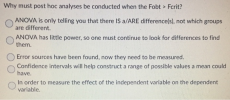 Why must post hoc analyses be conducted when the Fobt > Fcrit? ANOVA is only telling you that there is a/ARE difference(s), not which groups are different. ANOVA has little power, so one must continue to look for differences to find them. Error sources have been found, now they need to be measured. Confidence intervals will help construct a range of possible values a mean could have. In order to measure the effect of the independent variable on the dependent...
correctly explained the general rationale behind a post-hoc analysis. It's used to determine which specific pairings...
correctly explained the general rationale behind a post-hoc analysis. It's used to determine which specific pairings led to the main effect, if one exists. That's one of the issues with an ANOVA - if you have a main effect, you're not sure which comparisons led to the result. Therefore, while an ANOVA is powerful and allows you to compare multiple groups, it doesn't tell you which comparisons are significant. Another issue with ANOVAs is that you often have three groups...
 QUESTION 1 After a one-way ANOVA test, you conduct all possible post-hoc pairwise comparisons using the Bonferroni correction. If there were 4 groups (J = 4), what would your adjusted alpha value be for the post-hoc tests? Remember, our alpha is 0.05 for the class. Round final answers to four decimal places. QUESTION 2 After a one-way ANOVA test, you conduct all possible post-hoc pairwise comparisons using the Bonferroni correction. If there were 6 groups (J = 6), what would...
 3. + -11 points 0/2 Submissions Used Which is true about post hoc tests? Scheffe's test is the most common post hoc analysis. None of the options. Post hoc tests are not needed when comparing 3 or more group means. Tukey's HSD test is the most conservative post hoc test. Submit Answer
 Why must post hoc analyses be conducted when the Fobt > Fcrit? ANOVA is only telling you that there is a/ARE difference(s), not which groups are different. ANOVA has little power, so one must continue to look for differences to find them. Error sources have been found, now they need to be measured. Confidence intervals will help construct a range of possible values a mean could have. In order to measure the effect of the independent variable on the dependent...
Most questions answered within 3 hours.
-
Where is the error in this code sequence?
String s1 = "Hello";
String s2 = "ello";...
asked 11 months ago -
Financial data for Joel de Paris, Inc., for last year
follow:
Joel de Paris, Inc.
Balance...
asked 11 months ago -
Consider this reaction:
Al2(SO4)3 (aq)+ BaCl3
(aq) Al2Cl6 (aq)- +
3BaSO4(s) . What is the...
asked 11 months ago -
Suppose that Savneet is considering increasing her
recent random sample from 20 car rentals to 40...
asked 11 months ago -
Trucks arrive at an unloading terminal at an average rate of 120
per hour.
Trucks arrive...
asked 11 months ago -
Why are methanol and ethanol completely soluble in water while
octanol is not very little soluble....
asked 11 months ago -
A facilities manager at a university reads in a research report
that the mean amount of...
asked 11 months ago -
When the CuSO4 is rehydrated by adding water to the anhydrous
compound, is this an endothermic...
asked 11 months ago -
A ray of sunlight is passing from diamond into crown glass; the
angle of incidence is...
asked 11 months ago -
A block of mass 0.249 kg is placed on top of a light, vertical
spring of...
asked 11 months ago -
how do the kidneys compensate in the presences of acidosis
a) trigger hyperventilate
b) reserve acid...
asked 11 months ago -
Question 501 pts
The rental rate of capital to the firm increases. Which of the
following...
asked 11 months ago