A firm produces 100 units of good A at a total cost of $1,500 and separately...
- A firm produces 100 units of good A at a total cost of $1,500 and separately 200 units of good B at a cost of $2,000. By combining the production of A and B, it is possible to produce the same quantities of A and B respectively at a combined total cost of $2,800. Compute the economies of scope experienced by this firm.
Homework Answers

Add Answer to:
A firm produces 100 units of good A at a total cost of $1,500
and separately...
5. A firm produces 100 units of good A at a total cost of $1,500 and...
5. A firm produces 100 units of good A at a total cost of $1,500 and separately 200 units of good B at a cost of $2,000. By combining the production of A and B, it is possible to produce the same quantities of A and B respectively at a combined total cost of $2,800. Compute the economies of scope experienced by this firm. 6. The production manager of a clothing manufacturer estimates that the total annual cost of producing...
Suppose a firm has the ability to produce soap, toothpaste, or both. If the firm produces...
 Suppose a firm has the ability to produce soap, toothpaste, or both. If the firm produces qs units of soap and no toothpaste, then the total cost of production will be $21 thousand. If instead the firm produces y units of toothpaste and no soap, then the total cost of production will be $13 thousand. However, if the firm produces both 95 units of soap and qr units of toothpaste, then the firm's total cost of production will be 591...
I am really stuck with this please help Thanks. 4. Suppose that a firm produces two...
 I am really stuck with this please help Thanks.
4. Suppose that a firm produces two different outputs, the quantities of which are repre- sented by yı and y2. In general, the firm's total costs can be represented by C(y1, y2). This function exhibits economies of scope if C(0,42) + C(4,0) > C(y1, y2) for all output levels of either good. 4.1 Explain in words why this mathematical formulation implies that costs will be lower in this multiproduct firm than...
I am really stuck with this please help Thanks.
4. Suppose that a firm produces two different outputs, the quantities of which are repre- sented by yı and y2. In general, the firm's total costs can be represented by C(y1, y2). This function exhibits economies of scope if C(0,42) + C(4,0) > C(y1, y2) for all output levels of either good. 4.1 Explain in words why this mathematical formulation implies that costs will be lower in this multiproduct firm than...
Assume that the cost function for a multiproduct firm is given by �(�1, �2), where �1...
 Assume that the cost function for a multiproduct firm is given
by �(�1, �2), where �1 is the number of units produced of product 1
and �2 is the number of units produced of product 2. The
multiproduct cost function thus defines the cost of producing �1
units of product 1 and �2 units of product 2 assuming all inputs
are used efficiently. Suppose that the multiproduct cost function
of firm A, which produces the two goods, is given by:...
Assume that the cost function for a multiproduct firm is given
by �(�1, �2), where �1 is the number of units produced of product 1
and �2 is the number of units produced of product 2. The
multiproduct cost function thus defines the cost of producing �1
units of product 1 and �2 units of product 2 assuming all inputs
are used efficiently. Suppose that the multiproduct cost function
of firm A, which produces the two goods, is given by:...
12. A firm produces a commodity at two different factories. The overall cost C of production...
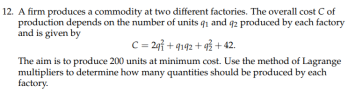 12. A firm produces a commodity at two different factories. The overall cost C of production depends on the number of units qi and q2 produced by each factory and is given by C 2q112+ qž 42 The aim is to produce 200 units at minimum cost. Use the method of Lagrange multipliers to determine how many quantities should be produced by each factory
12. A firm produces a commodity at two different factories. The overall cost C of production...
12. A firm produces a commodity at two different factories. The overall cost C of production depends on the number of units qi and q2 produced by each factory and is given by C 2q112+ qž 42 The aim is to produce 200 units at minimum cost. Use the method of Lagrange multipliers to determine how many quantities should be produced by each factory
12. A firm produces a commodity at two different factories. The overall cost C of production...
A firm produces 200 units of output at a total cost of $1,000. The firm's total...
A firm produces 200 units of output at a total cost of $1,000. The firm's total fixed cost equals $200.The firm’s per-unit average variable cost is _____. a. $4 b. $8 c. $5 d. $10 e. $7 A game that demonstrates the basic problem confronting noncolluding oligopolists is known as _____. a. a tit-for-strategy game b. the prisoners’ dilemma c. a cooperative game d. a noncooperative game e. the oligopolists’ dilemma A linear demand curve for a good is: a....
For the same firm, what is the average total cost? A firm produces 200 units hourly with $150 in labor costs an hour, $8...
For the same firm, what is the average total cost? A firm produces 200 units hourly with $150 in labor costs an hour, $80 in materials costs an hour, and a fixed cost that works out to $20 per hour. a. $1.15 b. $1.25 c. $250 d. $1
2. A firm produces two different kinds, A and B, of a commodity. The daily cost...
 2. A firm produces two different kinds, A and B, of a commodity. The daily cost of producing x units of A and y units of Bis C(x,y)=2x² - 4xy + 4y2 - 40x - 20y + 514 Suppose that the firm sells all its output at a price per unit of $24 for A and $12 for B. (a) Find the daily production levels x and y that maximize profit. (b) The firm is required to produce exactly 54...
A firm that can produce 15 units at a total cost of $200 or 18 units...
A firm that can produce 15 units at a total cost of $200 or 18 units at $260 has a marginal cost of the eighteenth unit equal to a. $20 b. $60 c. 3 units d. $14.44
A firm is required to produce 100 units of output using quantities of labor and capital...
A firm is required to produce 100 units of output using quantities of labor and capital (L, K) = (7, 6). For each of the following production functions, state whether it is possible to produce the required output with the given input combination. If it is possible, state whether the input combination is technically efficient or inefficient: (a) Q = 7L + 8K (b) Q = 20√ KL (c) Q = min{16L, 20K} (d) Q = 2(KL + L +...
 Suppose a firm has the ability to produce soap, toothpaste, or both. If the firm produces qs units of soap and no toothpaste, then the total cost of production will be $21 thousand. If instead the firm produces y units of toothpaste and no soap, then the total cost of production will be $13 thousand. However, if the firm produces both 95 units of soap and qr units of toothpaste, then the firm's total cost of production will be 591...
 I am really stuck with this please help Thanks.
4. Suppose that a firm produces two different outputs, the quantities of which are repre- sented by yı and y2. In general, the firm's total costs can be represented by C(y1, y2). This function exhibits economies of scope if C(0,42) + C(4,0) > C(y1, y2) for all output levels of either good. 4.1 Explain in words why this mathematical formulation implies that costs will be lower in this multiproduct firm than...
I am really stuck with this please help Thanks.
4. Suppose that a firm produces two different outputs, the quantities of which are repre- sented by yı and y2. In general, the firm's total costs can be represented by C(y1, y2). This function exhibits economies of scope if C(0,42) + C(4,0) > C(y1, y2) for all output levels of either good. 4.1 Explain in words why this mathematical formulation implies that costs will be lower in this multiproduct firm than...
 Assume that the cost function for a multiproduct firm is given
by �(�1, �2), where �1 is the number of units produced of product 1
and �2 is the number of units produced of product 2. The
multiproduct cost function thus defines the cost of producing �1
units of product 1 and �2 units of product 2 assuming all inputs
are used efficiently. Suppose that the multiproduct cost function
of firm A, which produces the two goods, is given by:...
Assume that the cost function for a multiproduct firm is given
by �(�1, �2), where �1 is the number of units produced of product 1
and �2 is the number of units produced of product 2. The
multiproduct cost function thus defines the cost of producing �1
units of product 1 and �2 units of product 2 assuming all inputs
are used efficiently. Suppose that the multiproduct cost function
of firm A, which produces the two goods, is given by:...
 12. A firm produces a commodity at two different factories. The overall cost C of production depends on the number of units qi and q2 produced by each factory and is given by C 2q112+ qž 42 The aim is to produce 200 units at minimum cost. Use the method of Lagrange multipliers to determine how many quantities should be produced by each factory
12. A firm produces a commodity at two different factories. The overall cost C of production...
12. A firm produces a commodity at two different factories. The overall cost C of production depends on the number of units qi and q2 produced by each factory and is given by C 2q112+ qž 42 The aim is to produce 200 units at minimum cost. Use the method of Lagrange multipliers to determine how many quantities should be produced by each factory
12. A firm produces a commodity at two different factories. The overall cost C of production...
 2. A firm produces two different kinds, A and B, of a commodity. The daily cost of producing x units of A and y units of Bis C(x,y)=2x² - 4xy + 4y2 - 40x - 20y + 514 Suppose that the firm sells all its output at a price per unit of $24 for A and $12 for B. (a) Find the daily production levels x and y that maximize profit. (b) The firm is required to produce exactly 54...
Most questions answered within 3 hours.
-
Where is the error in this code sequence?
String s1 = "Hello";
String s2 = "ello";...
asked 11 months ago -
Financial data for Joel de Paris, Inc., for last year
follow:
Joel de Paris, Inc.
Balance...
asked 11 months ago -
Consider this reaction:
Al2(SO4)3 (aq)+ BaCl3
(aq) Al2Cl6 (aq)- +
3BaSO4(s) . What is the...
asked 11 months ago -
Suppose that Savneet is considering increasing her
recent random sample from 20 car rentals to 40...
asked 11 months ago -
Trucks arrive at an unloading terminal at an average rate of 120
per hour.
Trucks arrive...
asked 11 months ago -
Why are methanol and ethanol completely soluble in water while
octanol is not very little soluble....
asked 11 months ago -
A facilities manager at a university reads in a research report
that the mean amount of...
asked 11 months ago -
When the CuSO4 is rehydrated by adding water to the anhydrous
compound, is this an endothermic...
asked 11 months ago -
A ray of sunlight is passing from diamond into crown glass; the
angle of incidence is...
asked 11 months ago -
A block of mass 0.249 kg is placed on top of a light, vertical
spring of...
asked 11 months ago -
how do the kidneys compensate in the presences of acidosis
a) trigger hyperventilate
b) reserve acid...
asked 11 months ago -
Question 501 pts
The rental rate of capital to the firm increases. Which of the
following...
asked 11 months ago