A sample of 0.635 mol of a metal M reacts completely with excess fluorine to form...
A sample of 0.635 mol of a metal M reacts completely with excess
fluorine to form 49.5 g of MF2.
What element is represented by the symbol M? (Give its symbol).
Homework Answers

Add Answer to:
A sample of 0.635 mol of a metal M reacts completely with excess
fluorine to form...
24. A 39.652 g sample of a metallic element, M, reacts completely with 0.138 mol of...
 24. A 39.652 g sample of a metallic element, M, reacts completely with 0.138 mol of X2 gas to form 61.704 g of the compound MX. (15 points) (a) Find the atomic mass of M and state its identity. (b) Find the atomic mass of X and state its identity
Only part B is incorrect A 0.428-mol sample of a metal oxide, M203, weighs 64.1 g....
 Only part B is incorrect
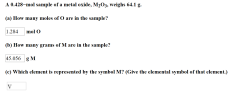
A 0.428-mol sample of a metal oxide, M203, weighs 64.1 g. (a) How many moles of O are in the sample? 1.284 mol O (b) How many grams of M are in the sample? 45.056 g M (c) Which element is represented by the symbol M? (Give the elemental symbol of that element.) V
Only part B is incorrect
A 0.428-mol sample of a metal oxide, M203, weighs 64.1 g. (a) How many moles of O are in the sample? 1.284 mol O (b) How many grams of M are in the sample? 45.056 g M (c) Which element is represented by the symbol M? (Give the elemental symbol of that element.) V
< Question 4 of 9 > A 0.196 g sample of a metal, M, reacts completely with sulfuric acid according to M(s) + H2SO...
 < Question 4 of 9 > A 0.196 g sample of a metal, M, reacts completely with sulfuric acid according to M(s) + H2SO4 (aq) → MSO4 (aq) + H2(g) A volume of 205 mL of hydrogen is collected over water; the water level in the collecting vessel is the same as the outside level. Atmospheric pressure is 756.0 Torr, and the temperature is 25 °C. Calculate the molar mass of the metal. molar mass: g/mol
A 7.844 gram sample of cobalt is heated in the presence of excess fluorine. A metal...
 A 7.844 gram sample of cobalt is heated in the presence of excess fluorine. A metal fluoride is formed with a mass of 15.43 g. Determine the empirical formula of the metal fluoride. Enter the elements in the order Co, F empirical formula =
A 0.193 g sample of a metal, M, reacts completely with sulfuric acid according to the reaction M(s) + H2SO4(aq) → MSO4...
 A 0.193 g sample of a metal, M, reacts completely with sulfuric acid according to the reaction M(s) + H2SO4(aq) → MSO4 (aq) + H2(g) A volume of 201 mL of hydrogen gas is collected over water; the water level in the collecting vessel is the same as the outside level. Atmospheric pressure is 1.0079 bar and the temperature is 25 °C. The vapor pressure of water at 25 °C is 0.03167 bar. Calculate the molar mass of the metal....
1. What volume of fluorine gas is produced when 0.496 mol of bromine trifluoride reacts completely...
1. What volume of fluorine gas is produced when 0.496 mol of bromine trifluoride reacts completely according to the following reaction at 0 C and 1 atm? Bromine trifluoride (g) ——> bromine(g) + fluorine (g) _____liters fluorine gas 2. How many moles of nitrogen gas are required to react completely with 30.6 L of oxygen gas according to the following reaction at 0 C and 1 atm? nitrogen (g) + oxygen (g) ——> nitrogen monoxide (g) ______moles nitrogen gas 3....
1. A 0.750-g sample of tin metal reacts with 0.201 g of oxygen gas to form tin oxide.
1. A 0.750-g sample of tin metal reacts with 0.201 g of oxygen gas to form tin oxide. Calculate the empirical formula of the tin oxide. 2. A 0.565-g sample of cobalt metal reacts with excess sulfur to give 1.027 g of cobalt sulfide. Calculate the empirical formula of the product. 3. A 1.164-g sample of iron filings reacts with chlorine gas to give 3.384 g of iron chloride. Calculate the empirical formula of the product? 4. A 0.626-8 sample of copper oxide...
Lithium metal reacts with molecular fluorine gas to form lithium fluoride. A closed container of volume...
 Lithium metal reacts with
molecular fluorine gas to form lithium fluoride. A closed container
of volume 1.00 x 10³ mL contains fluorine gas at 99.2 °C
and 4.66 x 10³ Torr. Then 1.27 g of solid lithium is
introduced, and the reaction goes to completion. What is the final
pressure (in Torr) if the temperature rises to 198.7 °C?
tice Assignment Gradebook ORION Downloadable eTextbook ment FULL SCREEN PRINTER VERSION BACK NEXT Chapter 2, Question 25 Parameterization Lithium metal reacts...
Lithium metal reacts with
molecular fluorine gas to form lithium fluoride. A closed container
of volume 1.00 x 10³ mL contains fluorine gas at 99.2 °C
and 4.66 x 10³ Torr. Then 1.27 g of solid lithium is
introduced, and the reaction goes to completion. What is the final
pressure (in Torr) if the temperature rises to 198.7 °C?
tice Assignment Gradebook ORION Downloadable eTextbook ment FULL SCREEN PRINTER VERSION BACK NEXT Chapter 2, Question 25 Parameterization Lithium metal reacts...
A 0.599 g0.599 g sample of a metal, M, reacts completely with sulfuric acid according to...
A 0.599 g0.599 g sample of a metal, M, reacts completely with sulfuric acid according to M(s)+H2SO4(aq)⟶MSO4(aq)+H2(g)M(s)+H2SO4(aq)⟶MSO4(aq)+H2(g) A volume of 259 mL259 mL of hydrogen is collected over water; the water level in the collecting vessel is the same as the outside level. Atmospheric pressure is 756.0 Torr, and the temperature is 25 °C. Calculate the molar mass of the metal.
A 0.662 gram sample of a metal, M, reacts completely with sulfuric acid. A volume of...
A 0.662 gram sample of a metal, M, reacts completely with sulfuric acid. A volume of 301 mL of hydrogen is collected over water; the water level in the collecting vessel is the same as the outside level. Atmospheric pressure is 756.0 Torr and the temperature is 25 °C. Calculate the molar mass of the metal.
 24. A 39.652 g sample of a metallic element, M, reacts completely with 0.138 mol of X2 gas to form 61.704 g of the compound MX. (15 points) (a) Find the atomic mass of M and state its identity. (b) Find the atomic mass of X and state its identity
 Only part B is incorrect
A 0.428-mol sample of a metal oxide, M203, weighs 64.1 g. (a) How many moles of O are in the sample? 1.284 mol O (b) How many grams of M are in the sample? 45.056 g M (c) Which element is represented by the symbol M? (Give the elemental symbol of that element.) V
Only part B is incorrect
A 0.428-mol sample of a metal oxide, M203, weighs 64.1 g. (a) How many moles of O are in the sample? 1.284 mol O (b) How many grams of M are in the sample? 45.056 g M (c) Which element is represented by the symbol M? (Give the elemental symbol of that element.) V
 < Question 4 of 9 > A 0.196 g sample of a metal, M, reacts completely with sulfuric acid according to M(s) + H2SO4 (aq) → MSO4 (aq) + H2(g) A volume of 205 mL of hydrogen is collected over water; the water level in the collecting vessel is the same as the outside level. Atmospheric pressure is 756.0 Torr, and the temperature is 25 °C. Calculate the molar mass of the metal. molar mass: g/mol
 A 7.844 gram sample of cobalt is heated in the presence of excess fluorine. A metal fluoride is formed with a mass of 15.43 g. Determine the empirical formula of the metal fluoride. Enter the elements in the order Co, F empirical formula =
 A 0.193 g sample of a metal, M, reacts completely with sulfuric acid according to the reaction M(s) + H2SO4(aq) → MSO4 (aq) + H2(g) A volume of 201 mL of hydrogen gas is collected over water; the water level in the collecting vessel is the same as the outside level. Atmospheric pressure is 1.0079 bar and the temperature is 25 °C. The vapor pressure of water at 25 °C is 0.03167 bar. Calculate the molar mass of the metal....
 Lithium metal reacts with
molecular fluorine gas to form lithium fluoride. A closed container
of volume 1.00 x 10³ mL contains fluorine gas at 99.2 °C
and 4.66 x 10³ Torr. Then 1.27 g of solid lithium is
introduced, and the reaction goes to completion. What is the final
pressure (in Torr) if the temperature rises to 198.7 °C?
tice Assignment Gradebook ORION Downloadable eTextbook ment FULL SCREEN PRINTER VERSION BACK NEXT Chapter 2, Question 25 Parameterization Lithium metal reacts...
Lithium metal reacts with
molecular fluorine gas to form lithium fluoride. A closed container
of volume 1.00 x 10³ mL contains fluorine gas at 99.2 °C
and 4.66 x 10³ Torr. Then 1.27 g of solid lithium is
introduced, and the reaction goes to completion. What is the final
pressure (in Torr) if the temperature rises to 198.7 °C?
tice Assignment Gradebook ORION Downloadable eTextbook ment FULL SCREEN PRINTER VERSION BACK NEXT Chapter 2, Question 25 Parameterization Lithium metal reacts...
Most questions answered within 3 hours.
-
Where is the error in this code sequence?
String s1 = "Hello";
String s2 = "ello";...
asked 11 months ago -
Financial data for Joel de Paris, Inc., for last year
follow:
Joel de Paris, Inc.
Balance...
asked 11 months ago -
Consider this reaction:
Al2(SO4)3 (aq)+ BaCl3
(aq) Al2Cl6 (aq)- +
3BaSO4(s) . What is the...
asked 11 months ago -
Suppose that Savneet is considering increasing her
recent random sample from 20 car rentals to 40...
asked 11 months ago -
Trucks arrive at an unloading terminal at an average rate of 120
per hour.
Trucks arrive...
asked 11 months ago -
Why are methanol and ethanol completely soluble in water while
octanol is not very little soluble....
asked 11 months ago -
A facilities manager at a university reads in a research report
that the mean amount of...
asked 11 months ago -
When the CuSO4 is rehydrated by adding water to the anhydrous
compound, is this an endothermic...
asked 11 months ago -
A ray of sunlight is passing from diamond into crown glass; the
angle of incidence is...
asked 11 months ago -
A block of mass 0.249 kg is placed on top of a light, vertical
spring of...
asked 11 months ago -
how do the kidneys compensate in the presences of acidosis
a) trigger hyperventilate
b) reserve acid...
asked 11 months ago -
Question 501 pts
The rental rate of capital to the firm increases. Which of the
following...
asked 11 months ago