An ore sample is known to contain copper sulfate pentahydrate, CuSO4•5H2O. If a 10.000 g sample...
An ore sample is known to contain copper sulfate pentahydrate, CuSO4•5H2O. If a 10.000 g sample of the ore loses 0.8332 g of water when strongly heated, what is the maximum quantity of CuSO4•5H2O that could be in the sample? (f.wt. CuSO4•5H2O = 249.69)
Homework Answers

Add Answer to:
An ore sample is known to contain copper sulfate pentahydrate,
CuSO4•5H2O. If a 10.000 g sample...
A 2.794-g sample of a mixture of anhydrous copper(II) sulfate, CuSO4, and copper(II) sulfate pentahydrate, CuSO4∙5H2O,was...
A 2.794-g sample of a mixture of anhydrous copper(II) sulfate, CuSO4, and copper(II) sulfate pentahydrate, CuSO4∙5H2O,was analyzed by heating todrive off the water in the hydrate.CuSO4∙5H2O(s)→CuSO4(s)+ 5 H2O(g)If the mass after heating was 2.578 g, determine the percentage of the hydrate in the original sample
When copper(II) sulfate pentahydrate is heated in air above 100C, it loses the water molecules and...
When copper(II) sulfate pentahydrate is heated in air above 100C, it loses the water molecules and also its blue color. CuSO4•5H2O—>CuSO4 + 5H2O If 9.75 g of CuSO4 are left after heating 15.25 g of the blue hydrate, calculate the number of moles of water originally present in 15.25 g of the hydrate.
A sample of pure oxalic acid hydrate was obtained by extraction from a plant called Snake...
 A sample of pure oxalic acid hydrate was obtained by extraction from a plant called Snake Tongue. A 3.000 g sample of the material was heated carefully in a vacuum oven until no more mass was lost from the sample. After heating, the final weight of the material was 2.143 g. What is the formula of the oxalic acid hydrate. (COOH)_2 middot H_2O? (mol.wt. (COOH)_2 = 90.0 g/mol) An ore sample is known to contain copper sulfate pentahydrate, CuSO_4 middot...
When copper(II) sulfate (CuSO4) is prepared from copper(II) nitrate and sodium sulfate, the reaction initially produces...
When copper(II) sulfate (CuSO4) is prepared from copper(II) nitrate and sodium sulfate, the reaction initially produces a hydrated product, copper(II) sulfate pentahydrate (CuSO4.5H2O). If the CuSO4.5H2O is heated, the water is removed, leaving anhydrous CuSO4. What mass (in grams ) of anhydrous CuSO4 will be produced from 2.05 g of CuSO4.5H2O?
12. If the student began with 83.2 g of copper(II) sulfate pentahydrate, CuSO4 . 5H20, how...
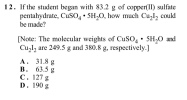 12. If the student began with 83.2 g of copper(II) sulfate pentahydrate, CuSO4 . 5H20, how much Cu2l2 could be made? Note: The molecular weights of CuSO4· 5H20 and Cu212 are 249.5 g and 380.8 g, respectively.] A. 31.81g B. 63.5g C. 127 g D. 190 g
A 0.551-g sample of hydrated copper(II) sulfate, CuSO4.xH2O, was heated carefully until it had changed completely...
A 0.551-g sample of hydrated copper(II) sulfate, CuSO4.xH2O, was heated carefully until it had changed completely to anydrous copper(II) sulfate (CuSO4) with a mass of 0.308 g. Determine the value of x. [This number is called the number of waters of hydration of copper(II) sulfate. It specifies the number of water molecules per formula unit of copper(II) sulfate in the hydrated crystal.
A blue compound called copper sulfate pentahydrate; the anhydrous form of this compound (copper sulfate) is...
A blue compound called copper sulfate pentahydrate; the anhydrous form of this compound (copper sulfate) is white. Why? What causes the color change when water molecules are removed?
CuSO4• 5H20 -------> Custy + D u 2) What is the color for anhydrous salt of copper (II) sulfate (CuSO4)? What is...
 CuSO4• 5H20 -------> Custy + D u 2) What is the color for anhydrous salt of copper (II) sulfate (CuSO4)? What is the color for ionic hydrate compound of copper (II) sulfate pentahydrate (CuSO4.5H2O)? 3) How would you test a colorless crystalline compound to determine whether it is a hydrate or not? 4) How many grams of CuSO4.5H20 are needed to prepare 50.0 mL of a 1.00 M CuSO4 solution? 5) Suppose you used the Procedure in this experiment to...
a student heated 4.82 grams of copper(ll) sulfate pentahydrate until all water of hydration was expelled....
a student heated 4.82 grams of copper(ll) sulfate pentahydrate until all water of hydration was expelled. How much weight would the sample lose?
A hydrated form of copper sulfate (CuSO4⋅?H2O) is heated to drive off all of the water....
A hydrated form of copper sulfate (CuSO4⋅?H2O) is heated to drive off all of the water. If there is initially 7.28 g of hydrated salt and there is 4.07 g of anhydrous CuSO4 after heating, find the number of water molecules associated with each CuSO4 formula unit. x = ?
 A sample of pure oxalic acid hydrate was obtained by extraction from a plant called Snake Tongue. A 3.000 g sample of the material was heated carefully in a vacuum oven until no more mass was lost from the sample. After heating, the final weight of the material was 2.143 g. What is the formula of the oxalic acid hydrate. (COOH)_2 middot H_2O? (mol.wt. (COOH)_2 = 90.0 g/mol) An ore sample is known to contain copper sulfate pentahydrate, CuSO_4 middot...
 12. If the student began with 83.2 g of copper(II) sulfate pentahydrate, CuSO4 . 5H20, how much Cu2l2 could be made? Note: The molecular weights of CuSO4· 5H20 and Cu212 are 249.5 g and 380.8 g, respectively.] A. 31.81g B. 63.5g C. 127 g D. 190 g
 CuSO4• 5H20 -------> Custy + D u 2) What is the color for anhydrous salt of copper (II) sulfate (CuSO4)? What is the color for ionic hydrate compound of copper (II) sulfate pentahydrate (CuSO4.5H2O)? 3) How would you test a colorless crystalline compound to determine whether it is a hydrate or not? 4) How many grams of CuSO4.5H20 are needed to prepare 50.0 mL of a 1.00 M CuSO4 solution? 5) Suppose you used the Procedure in this experiment to...
Most questions answered within 3 hours.
-
Where is the error in this code sequence?
String s1 = "Hello";
String s2 = "ello";...
asked 10 months ago -
Financial data for Joel de Paris, Inc., for last year
follow:
Joel de Paris, Inc.
Balance...
asked 10 months ago -
Consider this reaction:
Al2(SO4)3 (aq)+ BaCl3
(aq) Al2Cl6 (aq)- +
3BaSO4(s) . What is the...
asked 10 months ago -
Suppose that Savneet is considering increasing her
recent random sample from 20 car rentals to 40...
asked 10 months ago -
Trucks arrive at an unloading terminal at an average rate of 120
per hour.
Trucks arrive...
asked 10 months ago -
Why are methanol and ethanol completely soluble in water while
octanol is not very little soluble....
asked 10 months ago -
A facilities manager at a university reads in a research report
that the mean amount of...
asked 10 months ago -
When the CuSO4 is rehydrated by adding water to the anhydrous
compound, is this an endothermic...
asked 10 months ago -
A ray of sunlight is passing from diamond into crown glass; the
angle of incidence is...
asked 10 months ago -
A block of mass 0.249 kg is placed on top of a light, vertical
spring of...
asked 10 months ago -
how do the kidneys compensate in the presences of acidosis
a) trigger hyperventilate
b) reserve acid...
asked 10 months ago -
Question 501 pts
The rental rate of capital to the firm increases. Which of the
following...
asked 10 months ago