Consider the following observations for 2 metals (B and D) and solutions for metal cations (A+...
Consider the following observations for 2 metals (B and D) and solutions for metal cations (A+ and D+):
When metal B is placed in an aqueous solution of A+, a dark residue forms on the metal.
When metal B is placed in an aqueous solution of D+, a dark residue forms on the metal.
When metal D is placed in an aqueous solution of A+, the
appearance of the metal does not change.
a. Rank the metals (A, B, and D) in terms of reducing agent
strength, from the strongest to the weakest.
b. Rank the metal ions (A+, B+, D+) in terms of oxidizing agent strength, from the strongest to the weakest.
Homework Answers
When metal B is placed in an aqueous solution of A+, a dark residue forms on the metal.
that means B is more reactive than A.
When metal B is placed in an aqueous solution of D+, a dark residue forms on the metal.
that means B is more reactive than D.
When metal D is placed in an aqueous solution of A+, the appearance of the metal does not change.
that means D is less reactive than A.
thus
increasing reactivity order: D < A < B
thus
a. Rank the metals (A, B, and D) in terms of reducing agent strength, from the strongest to the weakest: B > A > D
B is strongest and D is weakest reducing agent.
b. Rank the metal ions (A+, B+, D+) in terms of oxidizing agent strength, from the strongest to the weakest: D > A > B
D is strongest oxidizing agent and B is weakest oxidizing agent.
Add Answer to:
Consider the following observations for 2 metals (B and D) and
solutions for metal cations (A+...
Activity Series for Metals following redox reactions, which take place in a basic solution. 3. Balance...
 Activity Series for Metals following redox reactions, which take place in a basic solution. 3. Balance the Bromine water was added dropwise to test tubes containing aqueous solutions of bromide, chloride, and iodide. Iodide was oxidized to iodine; bromide and chloride gave no reaction. Arrange Br2, Cl2.12 in order of their strength as an oxidizing agent. 4. Strongest oxidizing agent: 5. (optional) Consider the following redox equation: 2K1 + Cl2 → 12 + 2KCI Identify the reactant undergoing: (a) oxidation...
1)Consider the following half-reactions: Half-reaction E° (V) Cl2(g) + 2e- > 2Cl-(aq) 1.360V Cd2+(aq) + 2e-...
1)Consider the following half-reactions: Half-reaction E° (V) Cl2(g) + 2e- > 2Cl-(aq) 1.360V Cd2+(aq) + 2e- > Cd(s) -0.403V Al3+(aq) + 3e- > Al(s) -1.660 The strongest oxidizing agent is: _______ enter formula The weakest oxidizing agent is: _______ The weakest reducing agent is: _______ The strongest reducing agent is: _______ Will Al3+(aq) reduce Cl2(g) to Cl-(aq)? _____yes or no Which species can be reduced by Cd(s)? If none, leave box blank. 2) Use the table 'Standard Reduction Potentials' located...
I just understand how to get to the answers of these questions. Please help with all...
 I just understand how to get
to the answers of these questions. Please help with all of them.
Especially with the reactions
33 Determine the oxidation number of the underlined element in each of the following chemical formulas. Your answers must include any calculations and/or reasoning in how you derived the oxidation numbers. (4 marks total) а) О, b) Н.РО, с) MnO; d) C0 (5 marks total) 34. Identify the element oxidized and the element reduced, in this chemical equation:...
I just understand how to get
to the answers of these questions. Please help with all of them.
Especially with the reactions
33 Determine the oxidation number of the underlined element in each of the following chemical formulas. Your answers must include any calculations and/or reasoning in how you derived the oxidation numbers. (4 marks total) а) О, b) Н.РО, с) MnO; d) C0 (5 marks total) 34. Identify the element oxidized and the element reduced, in this chemical equation:...
Substances A2, B2, and C2 can all act as oxidizing agents. In solution, A2 is green, B2 is yellow, and C2 is red. In th...
 Substances A2, B2, and C2 can all act as oxidizing agents. In solution, A2 is green, B2 is yellow, and C2 is red. In the reactions in which they participate, they are reduced to A-, B-, and C ions, all of which are colorless. When a solution of B2 is mixed with one containing C ions, the color changes from yellow to red. a. Which species is oxidized? b. Which is reduced? When a solution of B2 is mixed with...
Consider the following half-reactions: Half-reaction E° (V) 12(s) + 2e - →21"(aq) 0.535V 2H+ (aq) +...
 Consider the following half-reactions: Half-reaction E° (V) 12(s) + 2e - →21"(aq) 0.535V 2H+ (aq) + 2e - → H2(g) 0.000V Cr3+(aq) + 3e —— Cr(s) -0.740V The strongest oxidizing agent is: enter formula The weakest oxidizing agent is: The weakest reducing agent is: The strongest reducing agent is: Will 12(s) reduce Cr3+(aq) to Cr(s)? — Which species can be reduced by H2(g)? If none, leave box blank. Use the References to access important values if needed for this question....
Consider a voltaic cell in which one half-cell is made of metal X immersed in an...
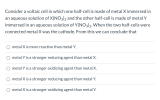 Consider a voltaic cell in which one half-cell is made of metal X immersed in an aqueous solution of X(NO3)2 and the other half-cell is made of metal Y immersed in an aqueous solution of Y(NO3)2. When the two half-cells were connected metal X was the cathode. From this we can conclude that metal X is more reactive than metal Y. metal Y is a stronger reducing agent than metal X. metal Y is a stronger oxidizing agent than metal...
The aqueous solutions of the transition metal salts are acidic as a result of hydrolysis of...
 The aqueous solutions of the transition metal salts are acidic as a result of hydrolysis of their hydrated cations. The H2O in these hydrated cations can form different colors in the solution of colmplex ions by entering ligand exchange reaction with different ligands like CI, NH3 SO Cu2+ Fe2+ Cr3+ Ni2+ Co2+ Mn2+ Al3+ V3+ Sc3+ salts are separately a)Write down water-solubility / hydration reactions. b)Write down the hydrolysis reactions and explain the reason for the acidity according to the...
1. Suppose you are given an unknown aqueous solution that contained one of the following cations...
 1. Suppose you are given an unknown aqueous solution that contained one of the following cations AR', Ba", or Na'lons. You have available the following test solutions: 1 M sulfuric acid and 1 M hydrochloric acid. Explain how you would use these test solutions to determine the identity of the cation in the unknown solution. Using complete sentences and proper terms, explain the tests you would perform, the expected outcomes, and how the results would allow you to determine the...
Group I Cations A INTRODUCTION Most metal halides are soluble in water and dilute hydrochloric acid....
 Group I Cations A INTRODUCTION Most metal halides are soluble in water and dilute hydrochloric acid. The exceptions are silver ion, Ag mercurous ion, Hg,: and lead(II) ion, Pb. Consequently, the addition of HCI to a solution of metal cations leads to the selective precipitation of these three ions. While the theory behind the separation and identification of these ions has been outlined in the general discus- sion of the qualitative analysis scheme, some aspects of this chemistry need to...
Consider the following half-reactions and their reduction potentials (volt Au (aq) +3e- Au(s) +1....
 Consider the following half-reactions and their reduction potentials (volt Au (aq) +3e- Au(s) +1.50 petad) +2 e' → Pt(s) +1.20 Co2+(aq) + 2 e' → Cols) -0.28 Mn? (aq)+2e Mn/s) -1.18 Which one of the following statements is correct? O A Ptis) can reduce Ht in aqueous solution OB. P (ag) can be reduced by Cols) OC. A (aa) is the weakest oxidizing agent D. Mn? (aq) can oxidize Au (s) OE. Auls) is the strongest reducing agent ous Save...
 Activity Series for Metals following redox reactions, which take place in a basic solution. 3. Balance the Bromine water was added dropwise to test tubes containing aqueous solutions of bromide, chloride, and iodide. Iodide was oxidized to iodine; bromide and chloride gave no reaction. Arrange Br2, Cl2.12 in order of their strength as an oxidizing agent. 4. Strongest oxidizing agent: 5. (optional) Consider the following redox equation: 2K1 + Cl2 → 12 + 2KCI Identify the reactant undergoing: (a) oxidation...
 I just understand how to get
to the answers of these questions. Please help with all of them.
Especially with the reactions
33 Determine the oxidation number of the underlined element in each of the following chemical formulas. Your answers must include any calculations and/or reasoning in how you derived the oxidation numbers. (4 marks total) а) О, b) Н.РО, с) MnO; d) C0 (5 marks total) 34. Identify the element oxidized and the element reduced, in this chemical equation:...
I just understand how to get
to the answers of these questions. Please help with all of them.
Especially with the reactions
33 Determine the oxidation number of the underlined element in each of the following chemical formulas. Your answers must include any calculations and/or reasoning in how you derived the oxidation numbers. (4 marks total) а) О, b) Н.РО, с) MnO; d) C0 (5 marks total) 34. Identify the element oxidized and the element reduced, in this chemical equation:...
 Substances A2, B2, and C2 can all act as oxidizing agents. In solution, A2 is green, B2 is yellow, and C2 is red. In the reactions in which they participate, they are reduced to A-, B-, and C ions, all of which are colorless. When a solution of B2 is mixed with one containing C ions, the color changes from yellow to red. a. Which species is oxidized? b. Which is reduced? When a solution of B2 is mixed with...
 Consider the following half-reactions: Half-reaction E° (V) 12(s) + 2e - →21"(aq) 0.535V 2H+ (aq) + 2e - → H2(g) 0.000V Cr3+(aq) + 3e —— Cr(s) -0.740V The strongest oxidizing agent is: enter formula The weakest oxidizing agent is: The weakest reducing agent is: The strongest reducing agent is: Will 12(s) reduce Cr3+(aq) to Cr(s)? — Which species can be reduced by H2(g)? If none, leave box blank. Use the References to access important values if needed for this question....
 Consider a voltaic cell in which one half-cell is made of metal X immersed in an aqueous solution of X(NO3)2 and the other half-cell is made of metal Y immersed in an aqueous solution of Y(NO3)2. When the two half-cells were connected metal X was the cathode. From this we can conclude that metal X is more reactive than metal Y. metal Y is a stronger reducing agent than metal X. metal Y is a stronger oxidizing agent than metal...
 The aqueous solutions of the transition metal salts are acidic as a result of hydrolysis of their hydrated cations. The H2O in these hydrated cations can form different colors in the solution of colmplex ions by entering ligand exchange reaction with different ligands like CI, NH3 SO Cu2+ Fe2+ Cr3+ Ni2+ Co2+ Mn2+ Al3+ V3+ Sc3+ salts are separately a)Write down water-solubility / hydration reactions. b)Write down the hydrolysis reactions and explain the reason for the acidity according to the...
 1. Suppose you are given an unknown aqueous solution that contained one of the following cations AR', Ba", or Na'lons. You have available the following test solutions: 1 M sulfuric acid and 1 M hydrochloric acid. Explain how you would use these test solutions to determine the identity of the cation in the unknown solution. Using complete sentences and proper terms, explain the tests you would perform, the expected outcomes, and how the results would allow you to determine the...
 Group I Cations A INTRODUCTION Most metal halides are soluble in water and dilute hydrochloric acid. The exceptions are silver ion, Ag mercurous ion, Hg,: and lead(II) ion, Pb. Consequently, the addition of HCI to a solution of metal cations leads to the selective precipitation of these three ions. While the theory behind the separation and identification of these ions has been outlined in the general discus- sion of the qualitative analysis scheme, some aspects of this chemistry need to...
 Consider the following half-reactions and their reduction potentials (volt Au (aq) +3e- Au(s) +1.50 petad) +2 e' → Pt(s) +1.20 Co2+(aq) + 2 e' → Cols) -0.28 Mn? (aq)+2e Mn/s) -1.18 Which one of the following statements is correct? O A Ptis) can reduce Ht in aqueous solution OB. P (ag) can be reduced by Cols) OC. A (aa) is the weakest oxidizing agent D. Mn? (aq) can oxidize Au (s) OE. Auls) is the strongest reducing agent ous Save...
Most questions answered within 3 hours.
-
Where is the error in this code sequence?
String s1 = "Hello";
String s2 = "ello";...
asked 10 months ago -
Financial data for Joel de Paris, Inc., for last year
follow:
Joel de Paris, Inc.
Balance...
asked 10 months ago -
Consider this reaction:
Al2(SO4)3 (aq)+ BaCl3
(aq) Al2Cl6 (aq)- +
3BaSO4(s) . What is the...
asked 10 months ago -
Suppose that Savneet is considering increasing her
recent random sample from 20 car rentals to 40...
asked 10 months ago -
Trucks arrive at an unloading terminal at an average rate of 120
per hour.
Trucks arrive...
asked 10 months ago -
Why are methanol and ethanol completely soluble in water while
octanol is not very little soluble....
asked 10 months ago -
A facilities manager at a university reads in a research report
that the mean amount of...
asked 10 months ago -
When the CuSO4 is rehydrated by adding water to the anhydrous
compound, is this an endothermic...
asked 10 months ago -
A ray of sunlight is passing from diamond into crown glass; the
angle of incidence is...
asked 10 months ago -
A block of mass 0.249 kg is placed on top of a light, vertical
spring of...
asked 10 months ago -
how do the kidneys compensate in the presences of acidosis
a) trigger hyperventilate
b) reserve acid...
asked 10 months ago -
Question 501 pts
The rental rate of capital to the firm increases. Which of the
following...
asked 10 months ago