Draw the 4-point decimation-in-frequency FFT algorithm with butterfly computation.
Draw the 4-point decimation-in-frequency FFT algorithm with butterfly computation.
Homework Answers


Add Answer to:
Draw the 4-point decimation-in-frequency FFT algorithm with
butterfly computation.
determine and draw the signal flow graph for the N = 16 point, radix-4 decimation-in-time FFT...
determine and draw the signal flow graph for the N = 16 point, radix-4 decimation-in-time FFT algorithm. Using this flow graph, determine the DFT of the sequence x(n) = cos (πn/2) , 0 ≤ n ≤ 15
Compute the FFT for x(n)-3, -2,-1,0,1,2,3,4], compute using 4-point DFT blocks and decimation in time method...
 Compute the FFT for x(n)-3, -2,-1,0,1,2,3,4], compute using 4-point DFT blocks and decimation in time method (all details are required) (2 points)
Draw the flow graph of a 4-pt FFT decimation in time. Also, complete the table shown...
 Draw the flow graph of a 4-pt FFT decimation in time.
Also, complete the table shown below for the given x[n]. Note that
are the 2−pt DFTs, and X[k] is a 4−pt DFT. x[n]={1 0 -1 1} for
n=0, 1, 2, 3
Gk, i = 1,2 1 | x[n] | G[k] | X[k] I k
Draw the flow graph of a 4-pt FFT decimation in time.
Also, complete the table shown below for the given x[n]. Note that
are the 2−pt DFTs, and X[k] is a 4−pt DFT. x[n]={1 0 -1 1} for
n=0, 1, 2, 3
Gk, i = 1,2 1 | x[n] | G[k] | X[k] I k
FFT = fast Fourier Transform. 16) Calculate the maximum magnitude error of a 1024 point FFT for sine wave input signal and rectangle window. What is the frequency resolution of the FFT for a sampl...
 FFT = fast Fourier Transform.
16) Calculate the maximum magnitude error of a 1024 point FFT for sine wave input signal and rectangle window. What is the frequency resolution of the FFT for a sample rate of 20 kHz. How can this resolution be increased ? (3)
16) Calculate the maximum magnitude error of a 1024 point FFT for sine wave input signal and rectangle window. What is the frequency resolution of the FFT for a sample rate of 20...
FFT = fast Fourier Transform.
16) Calculate the maximum magnitude error of a 1024 point FFT for sine wave input signal and rectangle window. What is the frequency resolution of the FFT for a sample rate of 20 kHz. How can this resolution be increased ? (3)
16) Calculate the maximum magnitude error of a 1024 point FFT for sine wave input signal and rectangle window. What is the frequency resolution of the FFT for a sample rate of 20...
Problem 10: a) Given the following sequence: x[n]={1, 2, 3, 4} where x[?= 1. Use the...
 Problem 10: a) Given the following sequence: x[n]={1, 2, 3, 4} where x[?= 1. Use the decimation in time FFT algorithm to compute the 4-point DFT of the sequence X[k]. Draw the signal flow & the butterfly structure and clearly label the branches with the intermediate values and the twiddle factors W = e- /2nk b) The inverse discrete Fourier transform can be calculated using the same structure and method but after appropriately changing the variable WN and multiplying the...
ASSIGNMENT 2 (C4,_CO2, PO1) 1. Calculate DFT of the following discrete-time sequence, x(n) using DFT technique...
 ASSIGNMENT 2 (C4,_CO2, PO1) 1. Calculate DFT of the following discrete-time sequence, x(n) using DFT technique x(n) = {72,-56, 159) (C4, CO2,PO1) 2. Calculate the 8-point DFT of the following discrete-time sequence, x(n) using Decimation In Time Fast Fourier transform (DIT-FFT) algorithm. Show the sketch and label all parameters on a signal flow graph/butterfly diagram structure in your answer. (1-3<ns3 x(n) = 0 elsewhere
Prob.1.(6pts) Compute the 4-point i) (3pts) DFT for x(n)-l-5 4-7 -2] ii) (3pts) IDFT for X(k)-1-10...
 Prob.1.(6pts) Compute the 4-point i) (3pts) DFT for x(n)-l-5 4-7 -2] ii) (3pts) IDFT for X(k)-1-10 2-j6 -14 2+j6] Prob. 2. (5pts) i) (3pts)Derive the 4-point DIT (Decimation-InTime) FFT and draw its signal-flow graph representation. ii) (2pts) Using the signal-flow graph representations of the 4-point DIF FFT, calculate the 4-point DFT of X(k) for x(n)-1-5 4-7-2].
27.2-1 Draw the computation dag for computing P-SQUARE-MATRIX-MULTIPLY on 2x2 matrices, labeling how the vertices in...
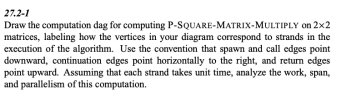 27.2-1 Draw the computation dag for computing P-SQUARE-MATRIX-MULTIPLY on 2x2 matrices, labeling how the vertices in your diagram correspond to strands in the execution of the algorithm. Use the convention that spawn and call edges point downward, continuation edges point horizontally to the right, and return edges point upward. Assuming that each strand takes unit time, analyze the work, span, and parallelism of this computation.
In the following flow graph that implements 8-point fast Fourier transform (FFT): a) Highlight the lines...
 In the following flow graph that implements 8-point fast Fourier transform (FFT): a) Highlight the lines (by marking the associated lines in red or think black) that need to compute multiplications (excluding multiplications with 1 and -1). What is the number of required complex multiplications? b) What is the number of require complex multiplications when performing a 16-point FFT? x[0] X[0] x[4] Wind x1200 + X[2] *[6] W LILIA wi WN
A) Draw a frequency divider "divide by 2" and "divide by 4" logic circuits as a...
 A) Draw a frequency divider "divide by 2" and
"divide by 4" logic circuits as a single circuit utilizing JK
Flip-Flops. Indicate the input and output values on each
connection. Draw JK flip-flops as block
structures. Use rising edge triggering.
B) Draw your drawn JK Flip
Flop frequency divider circuit's outputs waveform to the
are below. Use rising edge triggering.
C) Draw a frequency divider "divide by 2" and
"divide by 4" logic circuits as a single circuit utilizing JK...
A) Draw a frequency divider "divide by 2" and
"divide by 4" logic circuits as a single circuit utilizing JK
Flip-Flops. Indicate the input and output values on each
connection. Draw JK flip-flops as block
structures. Use rising edge triggering.
B) Draw your drawn JK Flip
Flop frequency divider circuit's outputs waveform to the
are below. Use rising edge triggering.
C) Draw a frequency divider "divide by 2" and
"divide by 4" logic circuits as a single circuit utilizing JK...
 Compute the FFT for x(n)-3, -2,-1,0,1,2,3,4], compute using 4-point DFT blocks and decimation in time method (all details are required) (2 points)
 Draw the flow graph of a 4-pt FFT decimation in time.
Also, complete the table shown below for the given x[n]. Note that
are the 2−pt DFTs, and X[k] is a 4−pt DFT. x[n]={1 0 -1 1} for
n=0, 1, 2, 3
Gk, i = 1,2 1 | x[n] | G[k] | X[k] I k
Draw the flow graph of a 4-pt FFT decimation in time.
Also, complete the table shown below for the given x[n]. Note that
are the 2−pt DFTs, and X[k] is a 4−pt DFT. x[n]={1 0 -1 1} for
n=0, 1, 2, 3
Gk, i = 1,2 1 | x[n] | G[k] | X[k] I k
 FFT = fast Fourier Transform.
16) Calculate the maximum magnitude error of a 1024 point FFT for sine wave input signal and rectangle window. What is the frequency resolution of the FFT for a sample rate of 20 kHz. How can this resolution be increased ? (3)
16) Calculate the maximum magnitude error of a 1024 point FFT for sine wave input signal and rectangle window. What is the frequency resolution of the FFT for a sample rate of 20...
FFT = fast Fourier Transform.
16) Calculate the maximum magnitude error of a 1024 point FFT for sine wave input signal and rectangle window. What is the frequency resolution of the FFT for a sample rate of 20 kHz. How can this resolution be increased ? (3)
16) Calculate the maximum magnitude error of a 1024 point FFT for sine wave input signal and rectangle window. What is the frequency resolution of the FFT for a sample rate of 20...
 Problem 10: a) Given the following sequence: x[n]={1, 2, 3, 4} where x[?= 1. Use the decimation in time FFT algorithm to compute the 4-point DFT of the sequence X[k]. Draw the signal flow & the butterfly structure and clearly label the branches with the intermediate values and the twiddle factors W = e- /2nk b) The inverse discrete Fourier transform can be calculated using the same structure and method but after appropriately changing the variable WN and multiplying the...
 ASSIGNMENT 2 (C4,_CO2, PO1) 1. Calculate DFT of the following discrete-time sequence, x(n) using DFT technique x(n) = {72,-56, 159) (C4, CO2,PO1) 2. Calculate the 8-point DFT of the following discrete-time sequence, x(n) using Decimation In Time Fast Fourier transform (DIT-FFT) algorithm. Show the sketch and label all parameters on a signal flow graph/butterfly diagram structure in your answer. (1-3<ns3 x(n) = 0 elsewhere
 Prob.1.(6pts) Compute the 4-point i) (3pts) DFT for x(n)-l-5 4-7 -2] ii) (3pts) IDFT for X(k)-1-10 2-j6 -14 2+j6] Prob. 2. (5pts) i) (3pts)Derive the 4-point DIT (Decimation-InTime) FFT and draw its signal-flow graph representation. ii) (2pts) Using the signal-flow graph representations of the 4-point DIF FFT, calculate the 4-point DFT of X(k) for x(n)-1-5 4-7-2].
 27.2-1 Draw the computation dag for computing P-SQUARE-MATRIX-MULTIPLY on 2x2 matrices, labeling how the vertices in your diagram correspond to strands in the execution of the algorithm. Use the convention that spawn and call edges point downward, continuation edges point horizontally to the right, and return edges point upward. Assuming that each strand takes unit time, analyze the work, span, and parallelism of this computation.
 In the following flow graph that implements 8-point fast Fourier transform (FFT): a) Highlight the lines (by marking the associated lines in red or think black) that need to compute multiplications (excluding multiplications with 1 and -1). What is the number of required complex multiplications? b) What is the number of require complex multiplications when performing a 16-point FFT? x[0] X[0] x[4] Wind x1200 + X[2] *[6] W LILIA wi WN
 A) Draw a frequency divider "divide by 2" and
"divide by 4" logic circuits as a single circuit utilizing JK
Flip-Flops. Indicate the input and output values on each
connection. Draw JK flip-flops as block
structures. Use rising edge triggering.
B) Draw your drawn JK Flip
Flop frequency divider circuit's outputs waveform to the
are below. Use rising edge triggering.
C) Draw a frequency divider "divide by 2" and
"divide by 4" logic circuits as a single circuit utilizing JK...
A) Draw a frequency divider "divide by 2" and
"divide by 4" logic circuits as a single circuit utilizing JK
Flip-Flops. Indicate the input and output values on each
connection. Draw JK flip-flops as block
structures. Use rising edge triggering.
B) Draw your drawn JK Flip
Flop frequency divider circuit's outputs waveform to the
are below. Use rising edge triggering.
C) Draw a frequency divider "divide by 2" and
"divide by 4" logic circuits as a single circuit utilizing JK...
Most questions answered within 3 hours.
-
Where is the error in this code sequence?
String s1 = "Hello";
String s2 = "ello";...
asked 11 months ago -
Financial data for Joel de Paris, Inc., for last year
follow:
Joel de Paris, Inc.
Balance...
asked 11 months ago -
Consider this reaction:
Al2(SO4)3 (aq)+ BaCl3
(aq) Al2Cl6 (aq)- +
3BaSO4(s) . What is the...
asked 11 months ago -
Suppose that Savneet is considering increasing her
recent random sample from 20 car rentals to 40...
asked 11 months ago -
Trucks arrive at an unloading terminal at an average rate of 120
per hour.
Trucks arrive...
asked 11 months ago -
Why are methanol and ethanol completely soluble in water while
octanol is not very little soluble....
asked 11 months ago -
A facilities manager at a university reads in a research report
that the mean amount of...
asked 11 months ago -
When the CuSO4 is rehydrated by adding water to the anhydrous
compound, is this an endothermic...
asked 11 months ago -
A ray of sunlight is passing from diamond into crown glass; the
angle of incidence is...
asked 11 months ago -
A block of mass 0.249 kg is placed on top of a light, vertical
spring of...
asked 11 months ago -
how do the kidneys compensate in the presences of acidosis
a) trigger hyperventilate
b) reserve acid...
asked 11 months ago -
Question 501 pts
The rental rate of capital to the firm increases. Which of the
following...
asked 11 months ago